How Much Water Do You Need Each Day? What the Numbers Mean
US and European reference values for daily water intake differ by roughly a liter, they count water from food and every beverage, and thirst is a workable guide for most healthy adults. Here is where the figures come from and when they stop applying.
Where the daily water numbers come from
The figure most people have heard, eight glasses a day, is not a scientific reference value. The values that are used in nutrition policy come from the Dietary Reference Intakes for water published by the Institute of Medicine (now part of the National Academies) in 2005, and from a separate scientific opinion issued by the European Food Safety Authority in 2010. Both are worth understanding, because they are built differently from most nutrient recommendations.
Most vitamins and minerals have a Recommended Dietary Allowance, which is set from evidence about what prevents deficiency. Water has no such evidence base for a precise number: healthy people regulate their water balance closely and tightly, and no experiment has identified a single intake that all adults need. The Institute of Medicine therefore set an Adequate Intake, a value based on the median intake of healthy, apparently well-hydrated people in national surveys. An Adequate Intake is an observation of what healthy people actually drink and eat, not a calculation of what they require.
| Authority | Men | Women |
|---|---|---|
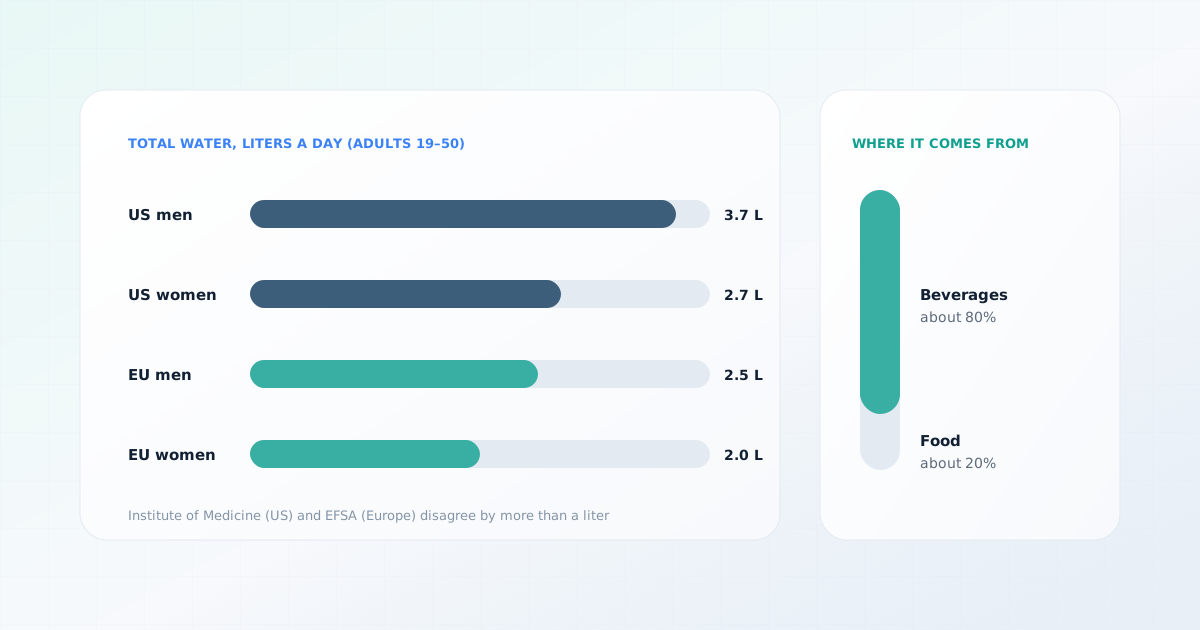
| Institute of Medicine (US), 2005 | 3.7 liters | 2.7 liters |
| European Food Safety Authority, 2010 | 2.5 liters | 2.0 liters |
The two sets of values disagree by more than a liter for men. That is not because one body of experts made an error. The two panels worked from different populations, applied different assumptions about food moisture and climate, and reached different judgments about what counts as adequate. When two reputable authorities publish reference values that far apart, the honest reading is that the true individual figure sits within a wide band and varies from person to person.
Total water is not the same as water you drink
Both reference values describe total water. That includes plain water, but it also includes coffee, tea, milk, juice, soup and the water held in solid foods. The Institute of Medicine noted that roughly 80 percent of total water intake typically comes from beverages and about 20 percent from food. Fruits, vegetables, yogurt, cooked grains and soups all contribute materially.
In practice, that means the headline figures overstate how much a person needs to pour into a glass. Applied to the US value for women, 2.7 liters of total water implies something like 2.2 liters from drinks across a whole day, and for men about 3.0 liters from drinks. Someone who eats a lot of produce and soup needs less from beverages than someone who eats mostly dry, processed food.
Coffee and tea count
The Centers for Disease Control and Prevention has published national survey data on what US adults actually drink and eat, which shows that many healthy adults live comfortably around or below the headline reference values. That is consistent with how an Adequate Intake is defined: it was derived from healthy people who were not experiencing the effects of deficiency.
What raises or lowers your needs
A single daily figure hides most of the things that actually move water requirements. The reference values are for adults in temperate conditions at modest activity levels, and several ordinary circumstances shift the picture.
- Heat and humidity increase sweat losses, sometimes by a liter or more over a day for someone working outdoors.
- Exercise adds sweat. The American College of Sports Medicine position stand on exercise and fluid replacement describes sweat rates that commonly fall in the range of roughly 0.4 to 0.8 liters per hour, with large differences between individuals and between environments.
- Altitude increases breathing rate and urine output over the first days at elevation.
- Fever, vomiting and diarrhea cause rapid fluid loss, and replacing it is a medical matter if it persists.
- Pregnancy and breastfeeding raise requirements, and the Institute of Medicine set higher adequate intakes for both.
- Some medications, including diuretics, change fluid balance, and some medical conditions require fluid to be restricted rather than increased.
Older adults deserve a note of their own. Thirst perception can be blunted with age, and some older people drink less than they need without noticing. For someone in that position, a deliberate habit of regular fluids is more reliable than waiting for thirst. This is one place where the generic advice to drink to thirst needs a qualifier.
Exercise, sweat and the two opposite mistakes
Water advice for people who exercise tends to fail in one of two directions. Some people under-drink during long hot sessions and finish with a significant fluid deficit. Others follow a rigid schedule of drinking whether or not they are thirsty, and over a long endurance event can drink more than they lose.
The second error has a name, exercise-associated hyponatremia, in which the sodium concentration of the blood falls because fluid intake has exceeded sweat losses. It is uncommon but serious, and it is why the American College of Sports Medicine position stand moved away from blanket instructions to drink as much as possible and toward individualized plans. A practical way to find a personal sweat rate is to weigh yourself before and after a typical session, accounting for what you drank, since a kilogram of weight lost corresponds to roughly a liter of fluid.
Drinking more is not always safer
Practical signals that matter more than a target
Because the reference values are estimates with a broad band around them, the signals your body gives are usually more informative than hitting a specific number. For most healthy adults, none of these requires measuring anything.
- Thirst. In healthy adults who can drink freely, thirst is a reasonably accurate regulator and responds to small changes in body water.
- Urine color. Pale yellow generally indicates that fluid intake is adequate, while dark amber suggests that you may be drinking too little, although some vitamins and foods change color independently of hydration.
- Frequency. Passing urine several times a day, without a pattern of very infrequent or very frequent visits, is the usual rhythm.
- Context. A hot afternoon in the garden is a different situation from a seated office day, and your intake should follow.
Persistent, unusually intense thirst or very frequent urination is not a hydration problem to solve with more drinking. Both can be early features of high blood glucose and are worth raising with a clinician.
Try the calculatorEstimate a starting point for your own dayWhere any water target stops being useful
A calculator or reference table can give a reasonable starting estimate for a healthy adult. It cannot account for the things that matter most to individual requirements: how much you sweat, what you eat, where you live, which medicines you take and whether a medical condition is changing how your body handles fluid.
People with heart failure, advanced kidney disease, liver disease, or conditions that affect sodium and water balance are sometimes told to limit fluid, and generic targets can be actively unhelpful for them. If a clinician has given you a specific fluid allowance, that instruction replaces any general figure, including the ones in this article.
Every figure in this article is an estimate with a margin of error, and none is a substitute for individual advice. The most defensible summary is modest: the reference values describe typical total water intake in healthy adults, they include food and every beverage, they differ between authorities, and most healthy people maintain adequate hydration by drinking when thirsty and more in the heat or when exercising.
Frequently asked questions
Sources
This page is based on the following sources. Each was reviewed on the access date shown.
- Dietary Reference Intakes for Water, Potassium, Sodium, Chloride, and Sulfate(opens in a new tab)
Institute of Medicine, National Academies
Reference workPublished January 1, 2005Accessed September 27, 2026DOI 10.17226/10925
- Scientific Opinion on Dietary Reference Values for water(opens in a new tab)
EFSA Journal (European Food Safety Authority)
Clinical guidelinePublished March 25, 2010Accessed September 27, 2026DOI 10.2903/j.efsa.2010.1459
- Daily Water Intake Among U.S. Men and Women, 2009-2012 (NCHS Data Brief No. 242)(opens in a new tab)
Centers for Disease Control and Prevention, National Center for Health Statistics
Government health agencyPublished April 1, 2016Accessed September 27, 2026
- American College of Sports Medicine position stand. Exercise and fluid replacement(opens in a new tab)
Medicine and Science in Sports and Exercise (American College of Sports Medicine)
Professional societyPublished February 1, 2007Accessed September 27, 2026DOI 10.1249/mss.0b013e31802ca597