Body Surface Area Formulas: Mosteller, Du Bois, Haycock and Why They Differ
Body surface area scales drug doses and kidney measurements such as eGFR. Four published equations estimate it, they agree closely at average size and diverge at higher body weight, and none is a measurement of health.
What body surface area is and why anyone calculates it
Body surface area is the total area of the skin, usually given in square meters. It is not something you can easily measure directly, so clinicians estimate it from height and weight with an equation. A typical adult comes out at roughly 1.7 to 2.0 square meters.
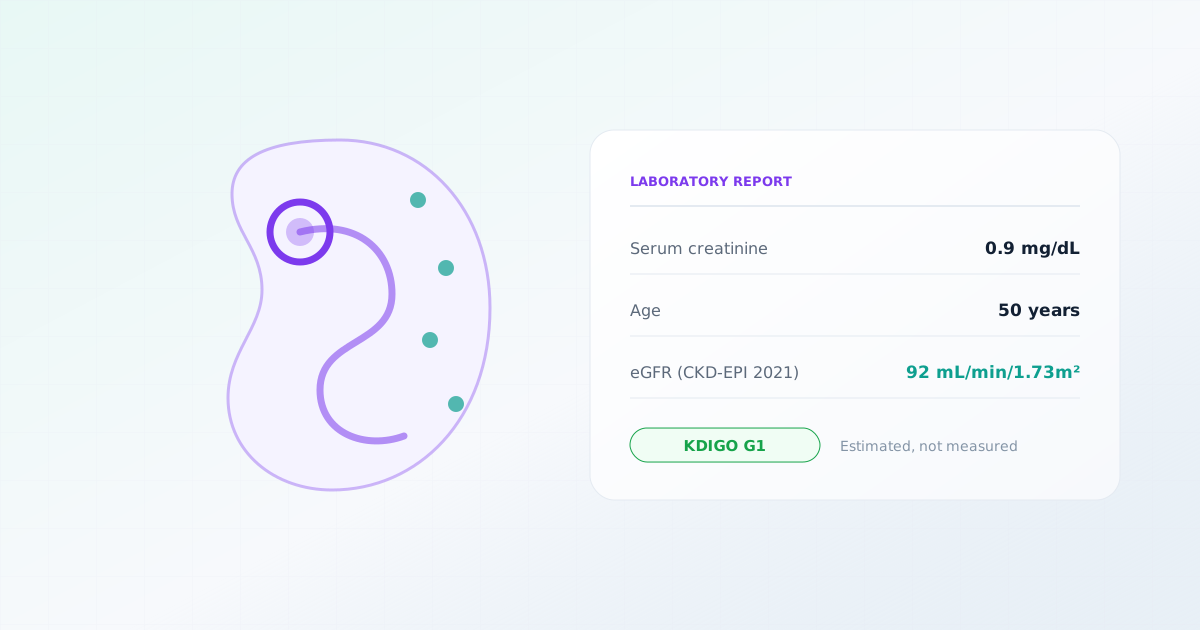
The reason to bother is that many body functions scale with surface area better than with weight alone. Two uses are worth knowing. The first is drug dosing, particularly in oncology, where some chemotherapy doses are written per square meter. The second is indexing: kidney function is reported as eGFR in mL/min/1.73 m² precisely so that a large person and a small one can be compared on the same scale, with 1.73 square meters being the standard reference adult.
- Indexed to BSA
- A measurement divided or scaled by body surface area so that people of different sizes can be compared. The 1.73 in eGFR units refers to a reference body surface area of 1.73 square meters.
The four equations
Each equation is a regression, a formula fitted to a small set of measured people. The calculator on this site reports all four, with height in centimeters and weight in kilograms.
The names also tell a story. The Du Bois and Du Bois equation dates from 1916, Gehan and George from 1970, Haycock from 1978 and Mosteller from 1987. Each later author was trying to improve on or simplify the earlier ones, using their own small measured sample, so the set reflects a century of incremental adjustment more than a single settled measurement.
| Equation | Formula |
|---|---|
| Mosteller (1987) | √(height × weight ÷ 3600) |
| Du Bois and Du Bois (1916) | 0.007184 × height^0.725 × weight^0.425 |
| Haycock (1978) | 0.024265 × height^0.3964 × weight^0.5378 |
| Gehan and George (1970) | 0.0235 × height^0.42246 × weight^0.51456 |
Mosteller is reported as the primary value on this site for a practical reason. It is the form most widely used in practice, and it is simple enough to verify by hand. A person who is 170 centimeters tall and weighs 70 kilograms has a Mosteller BSA of the square root of 170 × 70 ÷ 3600, which is the square root of 3.306, or about 1.82 square meters.
Try the calculatorCompare all four equations side by sideWhere the equations agree and where they do not
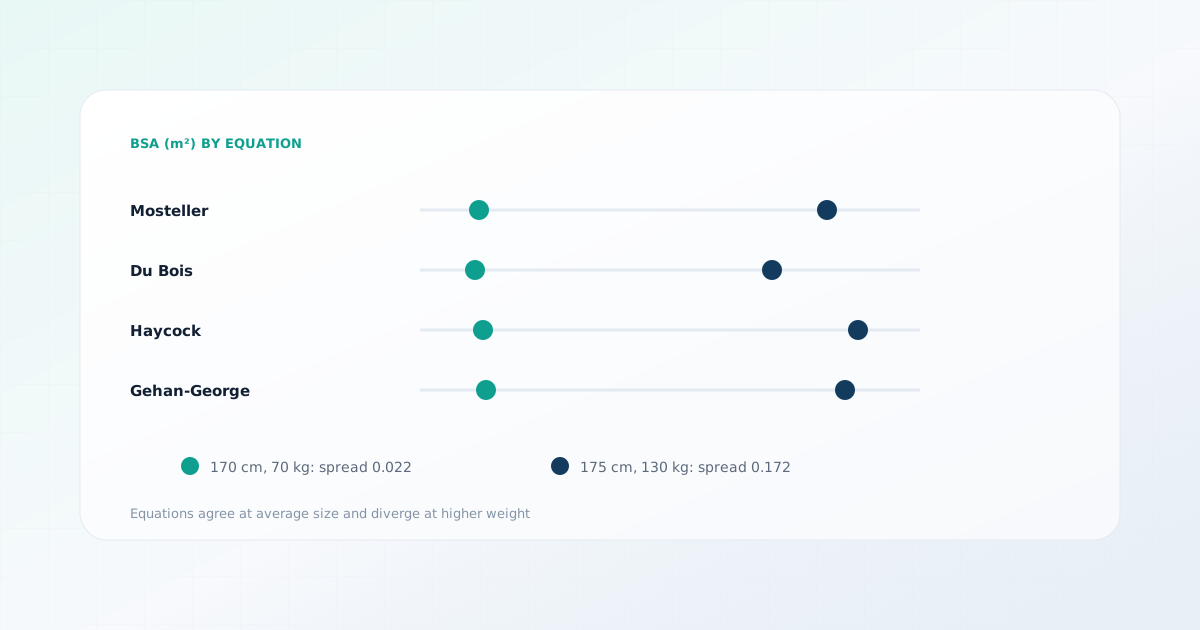
Because the equations are different fits to different small samples, they do not give identical answers. The disagreement is tiny for an average adult and grows with body size.
| Equation | 170 cm, 70 kg | 175 cm, 130 kg |
|---|---|---|
| Mosteller | 1.818 | 2.514 |
| Du Bois and Du Bois | 1.810 | 2.404 |
| Haycock | 1.826 | 2.576 |
| Gehan and George | 1.831 | 2.549 |
| Spread (highest minus lowest) | 0.022 | 0.172 |
For the average-size person the four results sit within about 0.02 square meters of one another, which is about one percent. At 130 kilograms the spread is 0.17 square meters, around seven percent. A study published in the Journal of Global Oncology by Faisal and colleagues compared the Du Bois, Mosteller, Haycock, Gehan-George and Boyd formulas and quantified how far they diverge at higher body weight, which is the reason the calculator shows the spread and not a single figure.
The practical meaning of a seven percent spread depends on use. For indexing a kidney measurement, a difference of that size is small relative to the other sources of error in an eGFR. For a dose scaled directly to BSA, a seven percent difference is a seven percent difference in the amount of drug, which is one reason protocols specify an equation, and in some cases a cap on the calculated value, instead of leaving the choice to the person doing the arithmetic.
The spread is the honest uncertainty
BSA in drug dosing and in eGFR
In oncology, a dose might be written as a number of milligrams per square meter, and the pharmacy multiplies by the patient’s BSA. Because the equations differ, protocols specify which one to use, and some cap or adjust the calculated BSA for very large patients. Choosing a dose from a BSA figure is a clinical decision that depends on the drug and the protocol, and a general-purpose calculator is not the tool for it.
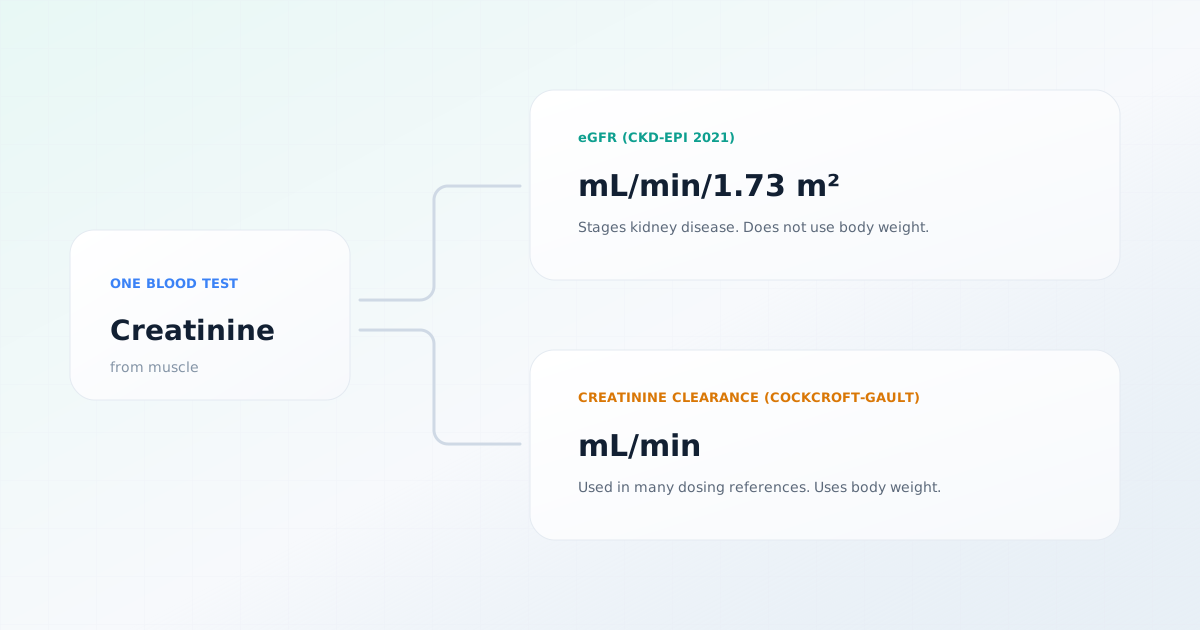
In kidney medicine, BSA explains the unit on a lab report. An eGFR of 80 mL/min/1.73 m² means the estimated filtration has been scaled to a reference body size. For a person much larger or smaller than the reference, a clinician choosing a drug dose may want the un-indexed filtration rate in mL/min, which is one reason the creatinine clearance and eGFR numbers are not interchangeable.
- Where a protocol or label names a specific BSA equation, that is the equation to use, because the equations are not interchangeable.
- A BSA calculator is for understanding the number and does not decide a dose.
- eGFR is already indexed to 1.73 m², so it is not re-multiplied by a person’s BSA unless a clinician specifically needs the un-indexed value.
Limits of every BSA equation
- Each equation is a regression fitted to a small sample. The Du Bois and Du Bois formula was derived from nine subjects, so every equation is an approximation and they disagree at the same height and weight.
- They were derived in adults of average build and are least reliable at the extremes: infants, very short or very tall people, and very high body weight.
- BSA ignores body composition, so two people of the same height and weight get the same figure whether the weight is mostly muscle or mostly fat.
- Amputation, significant edema and pregnancy change the relationship between height, weight and true surface area in ways the equations do not model.
- BSA is a scaling quantity and carries no interpretation about a person’s health on its own.
The sensible reading of a BSA figure is that it is a useful scale factor with a margin of error, and that the margin grows with body size. If a figure is going to be used for a decision, the protocol, the prescriber and the pharmacist are the right people to settle which equation and which weight apply.
When two sources quote different BSA values for the same person, the likeliest explanation is that they used different equations or different rounding, and not that either made a mistake.
Frequently asked questions
Sources
This page is based on the following sources. Each was reviewed on the access date shown.
- Simplified calculation of body-surface area(opens in a new tab)
New England Journal of Medicine
Peer-reviewed articlePublished October 22, 1987Accessed September 27, 2026DOI 10.1056/NEJM198710223171717
- Not All Body Surface Area Formulas Are the Same, but Does It Matter?(opens in a new tab)
Journal of Global Oncology
Peer-reviewed articlePublished December 1, 2016Accessed September 27, 2026DOI 10.1200/JGO.2016.005876
- Estimated Glomerular Filtration Rate (eGFR)(opens in a new tab)
National Kidney Foundation
Professional societyAccessed September 27, 2026
- New Creatinine- and Cystatin C-Based Equations to Estimate GFR without Race(opens in a new tab)
New England Journal of Medicine
Peer-reviewed articlePublished November 4, 2021Accessed September 27, 2026DOI 10.1056/NEJMoa2102953