What Is eGFR? Understanding Kidney Function
eGFR estimates how much blood your kidneys filter each minute, calculated from creatinine, age and sex rather than measured directly. A single result does not establish kidney disease — that requires persistence over three months plus a urine albumin test.
What the number is trying to describe
Each kidney contains around a million microscopic filtering units called nephrons. Blood enters a tiny knot of capillaries, the glomerulus, where pressure forces water and small dissolved molecules through a filter while retaining blood cells and large proteins. The kidney then reclaims most of the water and useful substances, and what remains becomes urine.
- Glomerular filtration rate (GFR)
- The total volume of fluid filtered by all your glomeruli per minute, expressed in milliliters per minute and standardized to a body surface area of 1.73 m² so that people of different sizes can be compared.
Measuring GFR properly requires injecting a marker substance — inulin, iohexol or a radioisotope — and tracking its clearance over hours. It is accurate, and entirely impractical as a routine test. So in practice GFR is estimated, which is what the "e" in eGFR stands for.
Creatinine: the substance actually measured
Creatinine is a waste product of creatine phosphate metabolism in muscle. Your muscles produce it at a fairly steady rate, it is not reabsorbed to any significant extent, and healthy kidneys clear it efficiently. That combination makes it a convenient marker: if creatinine rises in the blood, filtration has probably fallen.
The logic is indirect but sound. Creatinine production is roughly constant, so blood creatinine is set mainly by how fast it is being removed. Slower removal means a higher concentration.
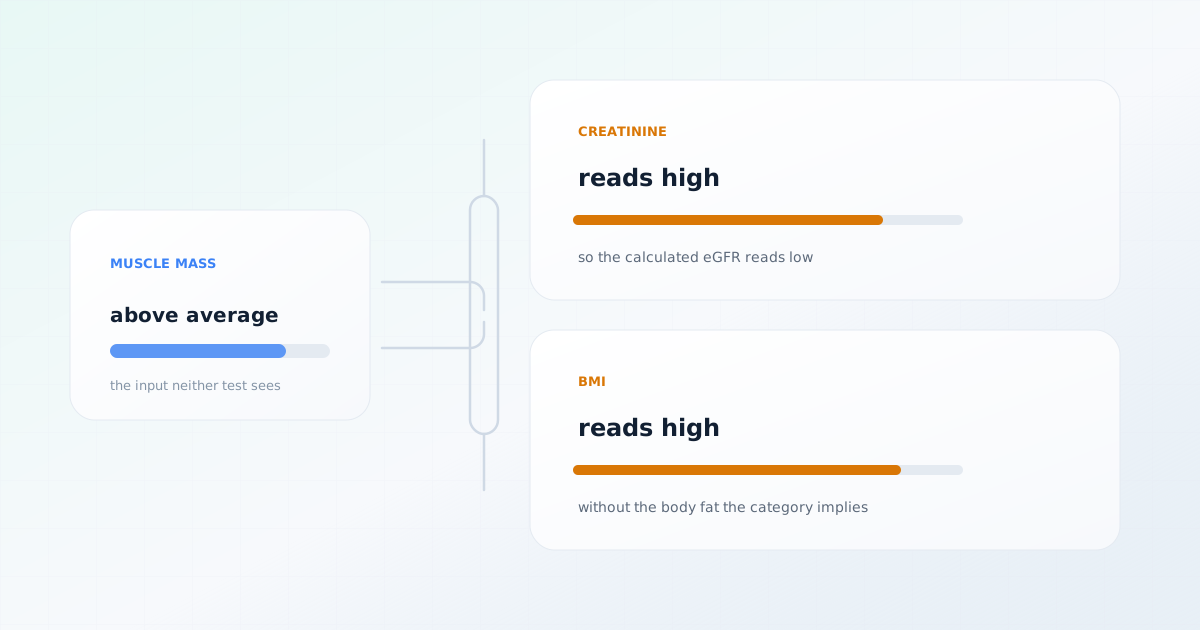
The catch is in the word "muscle"
Creatinine is also reported in two units: mg/dL in the United States and µmol/L elsewhere, converting at 1 mg/dL = 88.42 µmol/L.
How the estimate is calculated
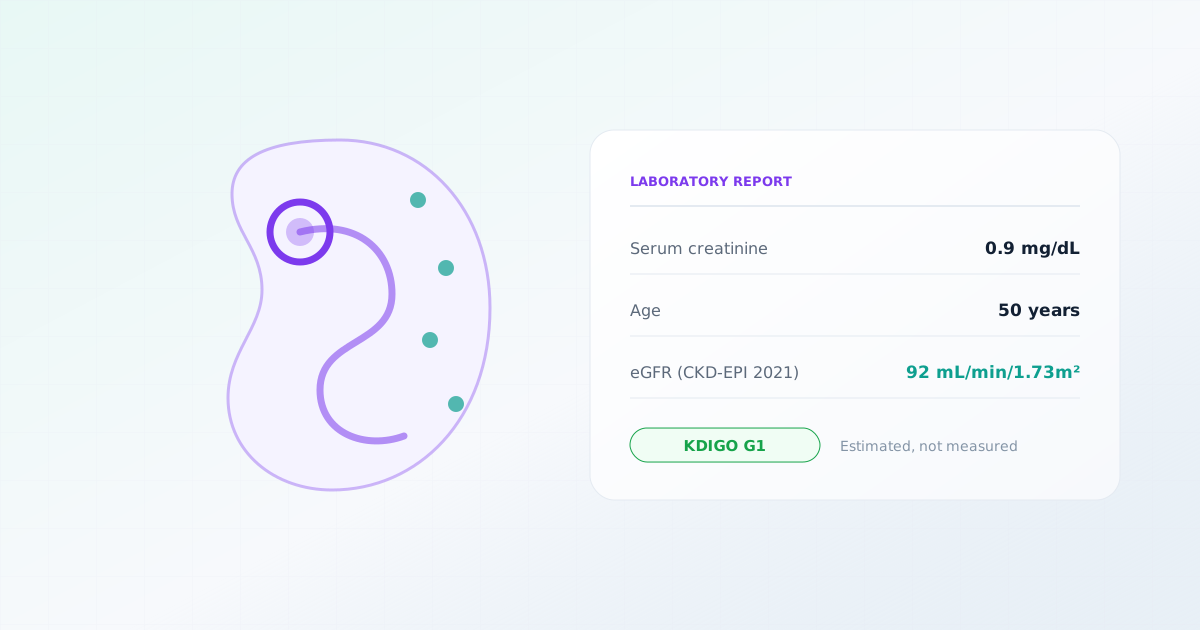
The current recommended equation for adults is CKD-EPI 2021, published in the New England Journal of Medicine. It takes creatinine, age and sex, and applies different constants depending on whether creatinine sits above or below a sex-specific inflection point.
eGFR = 142 × min(Scr/κ, 1)^α × max(Scr/κ, 1)^−1.200 × 0.9938^age × 1.012 if female
The sex-specific constants exist because average muscle mass differs, so as described above, the same creatinine implies different filtration. The age term reflects that measured GFR declines gradually through adult life even in entirely healthy kidneys.
One detail in the units is easy to skim past. eGFR is reported per 1.73 m² of body surface area, a figure chosen decades ago as an average adult value. The result is therefore already size-adjusted, which is what makes two people of very different builds comparable — and is also why an un-normalized filtration rate is the one a pharmacist wants when sizing a dose to an actual body.
Try the calculatorCalculate eGFR with the CKD-EPI 2021 equationTry the calculatorWork out the body surface area that figure is scaled toWhy race is no longer in the equation
The earlier CKD-EPI 2009 equation included a coefficient that multiplied the estimate upward for patients identified as Black. It had been derived from observed average differences in creatinine between groups in the original study cohorts.
The practical consequence was that a Black patient with a given creatinine received a higher reported eGFR than a non-Black patient with identical values — which could place them the more favorable side of a threshold used for specialist referral, medication dosing, or transplant waiting-list eligibility.
A joint task force of the National Kidney Foundation and the American Society of Nephrology examined this and recommended moving to an equation that does not use race, on the grounds that race is a social rather than biological category and should not function as a clinical variable. The CKD-EPI 2021 equation was developed and validated in response. The race adjustment is deprecated and should not be applied.
GFR categories
| Category | eGFR (mL/min/1.73m²) | Description |
|---|---|---|
| G1 | 90 and above | Normal or high |
| G2 | 60 – 89 | Mildly decreased |
| G3a | 45 – 59 | Mildly to moderately decreased |
| G3b | 30 – 44 | Moderately to severely decreased |
| G4 | 15 – 29 | Severely decreased |
| G5 | Below 15 | Kidney failure |
Why a normal result often reads "greater than 90"
Full staging of chronic kidney disease pairs the GFR category with an albuminuria category, A1 to A3, from a urine albumin-to-creatinine ratio. Someone at G2 with A3 albuminuria is in a substantially different position from someone at G2 with A1, even though their eGFR is identical — which is why the two tests are read together.
Why a kidney number turns up in heart conversations
People are often surprised to find eGFR discussed at a cardiology appointment, or to see it requested alongside a cholesterol panel. There is a specific reason, and it has become more explicit in US guidance over the last three years.
The American Heart Association’s PREVENT risk model, which replaced the older Pooled Cohort Equations and is now used across US cardiovascular guidelines, takes eGFR as a direct input. Kidney function is not an afterthought in that calculation; it sits alongside blood pressure, cholesterol, smoking and diabetes as one of the terms. A lower eGFR raises the estimated risk, which can change where someone falls relative to the treatment thresholds in the blood pressure and cholesterol guidelines.
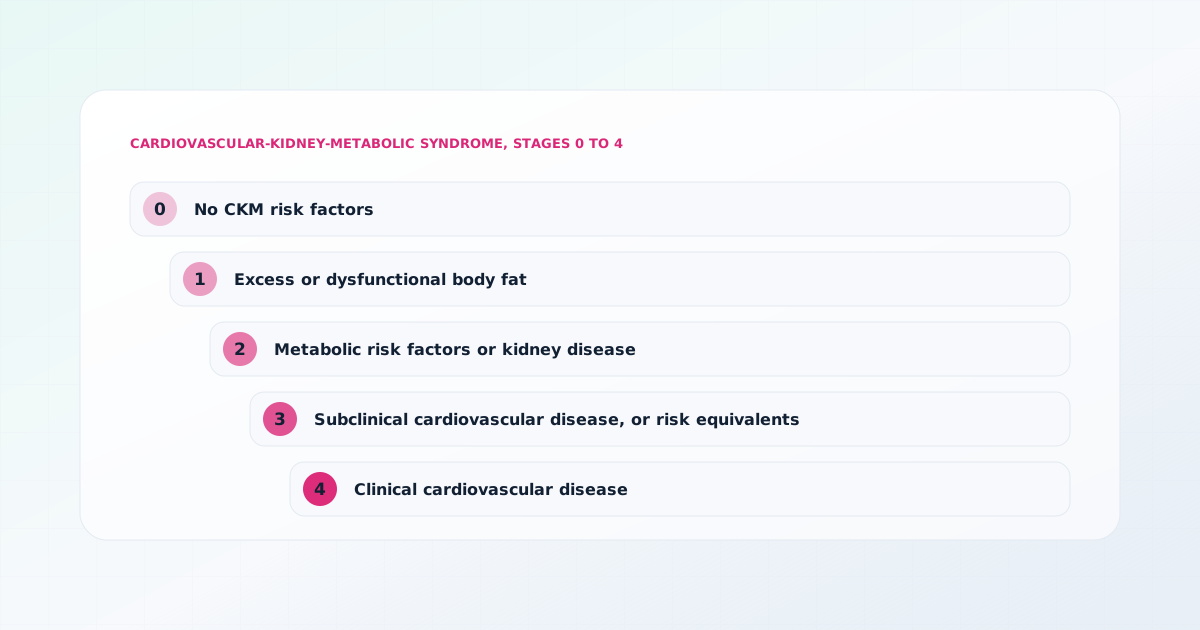
Behind that is a broader reframing. The AHA first defined cardiovascular-kidney-metabolic syndrome in a 2023 advisory, describing how excess weight, raised glucose, abnormal lipids, high blood pressure and reduced kidney filtration tend to arrive together and worsen one another. In June 2026 that became a full guideline from the AHA, ACC, American Diabetes Association and American Society of Nephrology, with stages from 0 to 4 and a recommendation that eGFR and urine albumin be assessed together rather than separately.
Which is why one number is never read alone
Trends matter more than single values
A single eGFR is a snapshot with meaningful measurement noise. Day-to-day variation of a few mL/min/1.73m² is entirely normal, and a change of that size between two results usually reflects variation rather than a real change in kidney function.
What clinicians look for instead is the trajectory across results over months and years. A stable eGFR of 55 in someone who has sat at 55 for a decade is a different clinical picture from an eGFR of 55 in someone who was 85 a year ago — even though the number is identical.
- A gradual decline with age is expected physiology, not disease.
- A sudden drop suggests an acute cause — dehydration, a new medication, an infection, or obstruction — and is investigated differently from a slow decline.
- Comparing results measured in the same laboratory is more reliable, since methods differ slightly between laboratories.
When eGFR misleads
Because eGFR is a calculation from creatinine, anything that changes creatinine independently of filtration changes the estimate without kidney function having moved at all.
| Factor | Effect on creatinine | Effect on eGFR |
|---|---|---|
| High muscle mass | Raises | Underestimates |
| Muscle loss, frailty, amputation | Lowers | Overestimates |
| Cooked red meat before the test | Raises | Underestimates |
| Creatine supplements | Raises | Underestimates |
| Intense exercise beforehand | Raises | Underestimates |
| Dehydration | Raises | Underestimates |
| Trimethoprim, cimetidine | Raises (blocks secretion) | Underestimates |
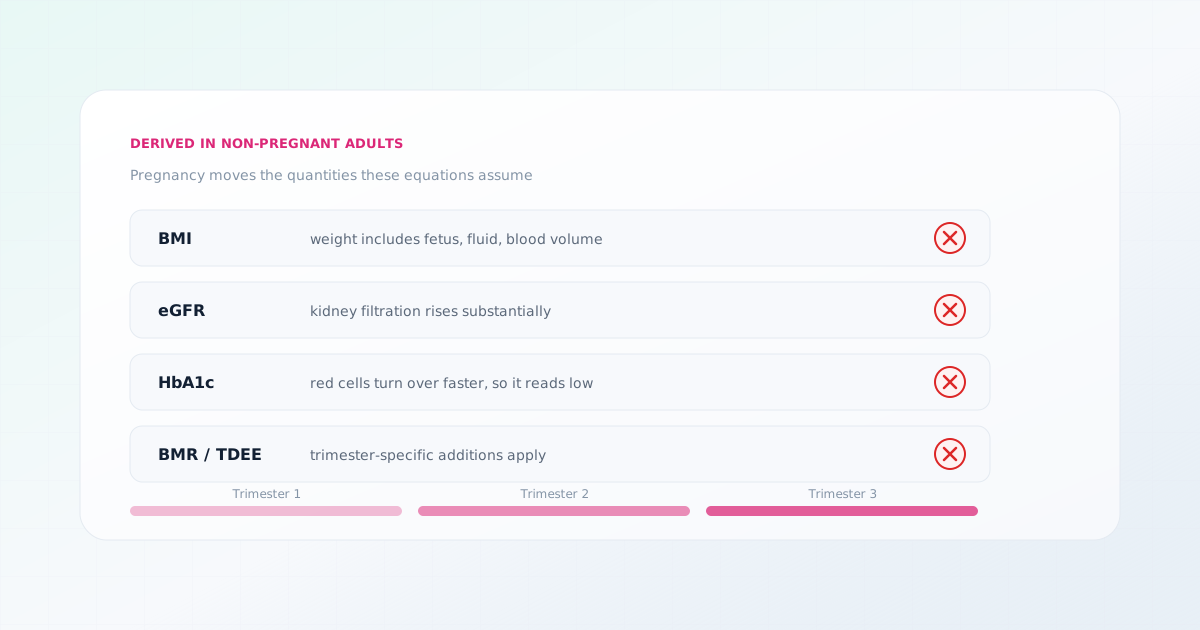
| Pregnancy | Alters substantially | Unreliable |
Where a creatinine-based estimate is likely to be unreliable, guidelines recommend a cystatin C–based equation instead or in addition. Cystatin C is produced by all nucleated cells rather than muscle, so it sidesteps the muscle-mass problem entirely, and a combined creatinine–cystatin C equation is generally the most accurate option available.
You may also meet a second, older number. Creatinine clearance from the 1976 Cockcroft-Gault equation estimates something slightly different, is not size-normalized, and is less accurate than CKD-EPI — but a great many drug dosing instructions were written against it and still name it, so it has not gone away. The two are not interchangeable, and substituting one for the other in a dosing calculation is a real error rather than a rounding difference.
Try the calculatorSee how Cockcroft-Gault differs from CKD-EPIOne result does not establish a diagnosis
Frequently asked questions
Sources
This page is based on the following sources. Each was reviewed on the access date shown.
- New Creatinine- and Cystatin C-Based Equations to Estimate GFR without Race(opens in a new tab)
New England Journal of Medicine
Peer-reviewed articlePublished November 4, 2021Accessed September 27, 2026DOI 10.1056/NEJMoa2102953
- KDIGO 2024 Clinical Practice Guideline for the Evaluation and Management of Chronic Kidney Disease(opens in a new tab)
Kidney Disease: Improving Global Outcomes (KDIGO)
Clinical guidelinePublished March 1, 2024Accessed September 27, 2026
- A Unifying Approach for GFR Estimation: Recommendations of the NKF-ASN Task Force on Reassessing the Inclusion of Race in Diagnosing Kidney Disease(opens in a new tab)
American Journal of Kidney Diseases
Clinical guidelinePublished February 1, 2022Accessed September 27, 2026
- 2026 AHA/ACC/ADA/ASN Guideline for the Prevention, Detection, Evaluation, and Management of Cardiovascular-Kidney-Metabolic Syndrome(opens in a new tab)
Journal of the American College of Cardiology
Clinical guidelinePublished June 9, 2026Accessed October 1, 2026DOI 10.1016/j.jacc.2026.03.056
- Cardiovascular-Kidney-Metabolic Health: A Presidential Advisory From the American Heart Association(opens in a new tab)
Circulation (American Heart Association)
Professional societyAccessed October 1, 2026DOI 10.1161/CIR.0000000000001184
- Development and Validation of the American Heart Association PREVENT Equations(opens in a new tab)
Circulation (American Heart Association)
Peer-reviewed articleAccessed October 1, 2026DOI 10.1161/CIRCULATIONAHA.123.067626
- Estimated Glomerular Filtration Rate (eGFR)(opens in a new tab)
National Kidney Foundation
Professional societyAccessed September 27, 2026
- Chronic Kidney Disease Tests and Diagnosis(opens in a new tab)
National Institute of Diabetes and Digestive and Kidney Diseases (NIH)
Government health agencyAccessed September 27, 2026