Which Health Calculators Do Not Apply During Pregnancy
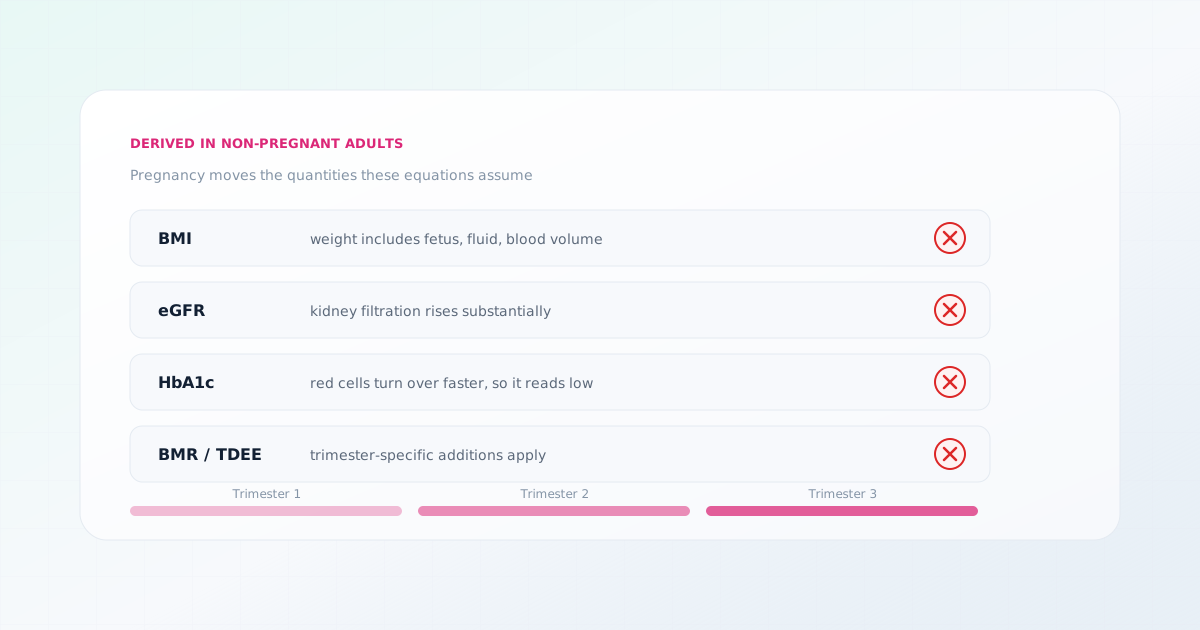
Pregnancy changes blood volume, kidney filtration, red cell turnover and energy requirements, and most everyday health equations were derived in people who were not pregnant. Here is which ones stop working, and why.
Why a validated equation stops being valid
A clinical equation is a line fitted through measurements taken from a particular group of people. It predicts well for people resembling that group, and its accuracy outside that group is unknown rather than merely reduced. Almost all of the equations behind everyday health calculators were fitted in adults who were not pregnant.
Pregnancy is not a small perturbation of the inputs. Plasma volume expands by roughly half, kidney filtration rises substantially, red blood cells turn over faster, and energy requirements increase. Several of those are the exact quantities the equations assume are stable.
Not validated is different from wrong
eGFR and creatinine
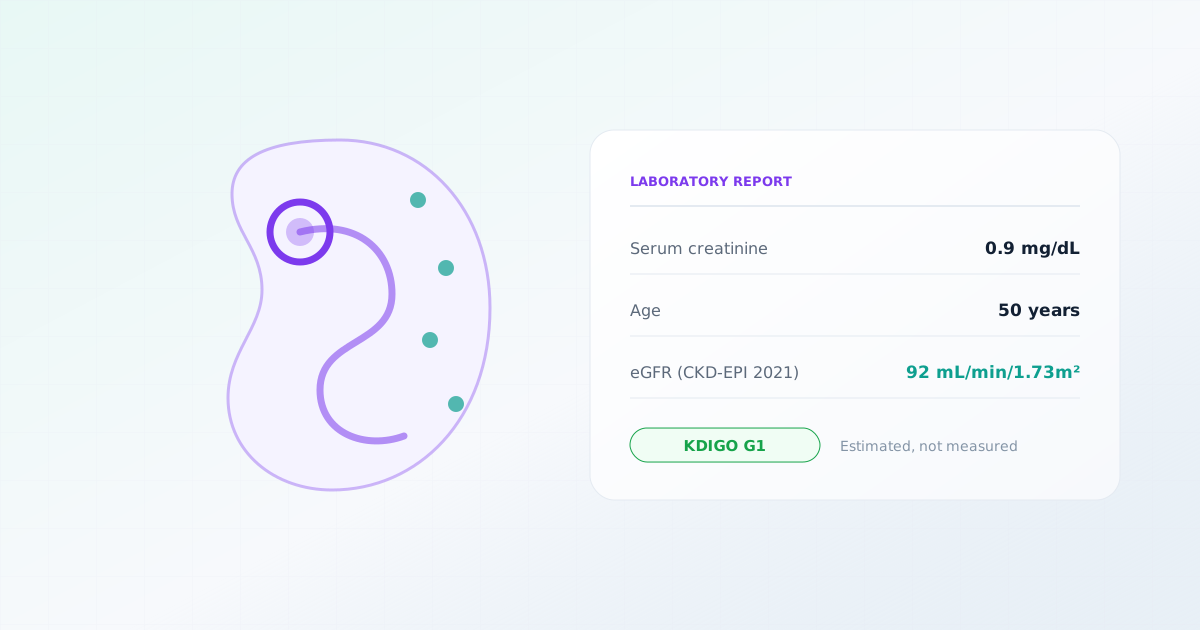
Kidney filtration increases markedly during pregnancy, beginning early and peaking around the middle of gestation. Because creatinine is cleared by the kidneys, a higher filtration rate means a lower blood creatinine — so a creatinine result that would be unremarkable outside pregnancy can be relatively high within it.
The CKD-EPI equations used to estimate glomerular filtration rate were developed and validated in non-pregnant adults, and kidney guidelines are explicit that eGFR should not be used to assess kidney function during pregnancy. Pregnancy assessment uses measured creatinine interpreted against pregnancy-specific expectations, together with other tests, under the care of a maternity team.
- An eGFR figure produced by a general calculator during pregnancy should not be interpreted as a kidney function estimate.
- A falling creatinine in early pregnancy is an expected physiological change, not an improvement in kidney health.
- A creatinine that is not falling, or is rising, is a finding for the maternity team to interpret.
- Pre-existing kidney disease in pregnancy is managed jointly by obstetric and kidney specialists, because the usual monitoring markers all shift.
BMI, and the one place it still does work
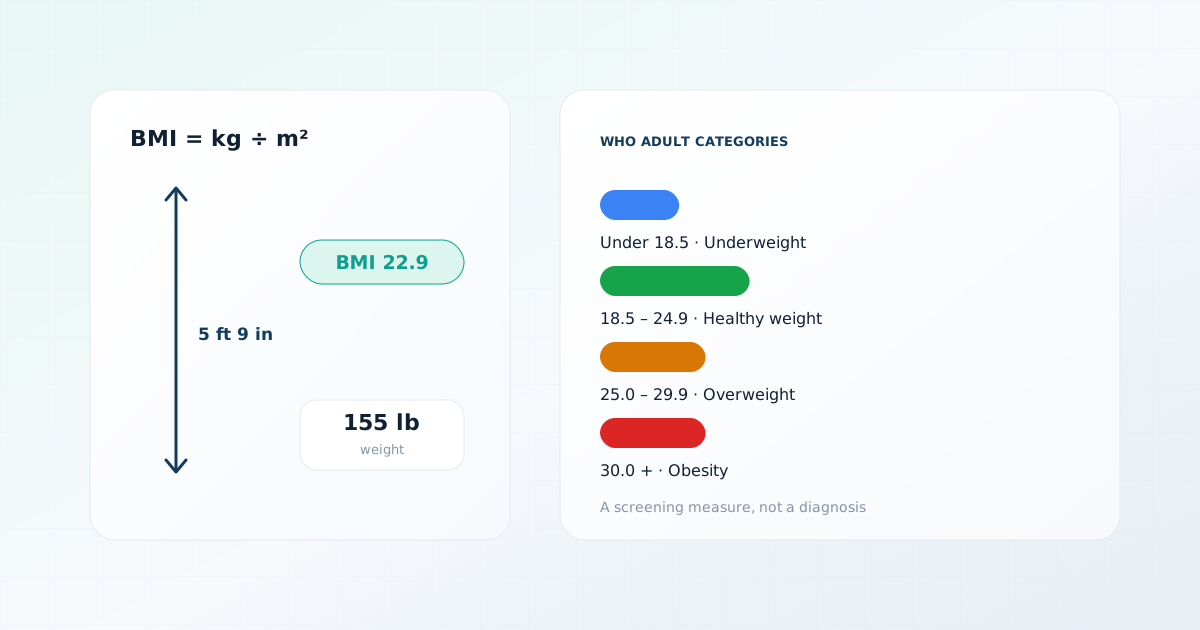
BMI is weight divided by height squared. During pregnancy, weight increases for reasons that have nothing to do with the body composition BMI was designed to screen for — the fetus, placenta, amniotic fluid, expanded blood volume and increased breast tissue all contribute. A BMI calculated at 30 weeks describes none of the things the categories were built to describe.
Pre-pregnancy BMI, by contrast, retains a specific and well-defined role. The Institute of Medicine guidelines use it to set recommended total weight gain ranges across a singleton pregnancy, and those ranges differ by starting category.
| Pre-pregnancy BMI | Category | Recommended total gain |
|---|---|---|
| Below 18.5 | Underweight | 28 – 40 lb (12.5 – 18 kg) |
| 18.5 – 24.9 | Healthy weight | 25 – 35 lb (11.5 – 16 kg) |
| 25.0 – 29.9 | Overweight | 15 – 25 lb (7 – 11.5 kg) |
| 30.0 and above | Obesity | 11 – 20 lb (5 – 9 kg) |
The distinction in one line
HbA1c and glucose
HbA1c reflects the proportion of hemoglobin that has glucose attached, accumulated over the lifespan of circulating red blood cells. Pregnancy shortens that lifespan: red cell turnover increases, so there is less time for glycation to accumulate and HbA1c tends to read lower than the underlying glucose would otherwise produce.
This is one of the reasons gestational diabetes is diagnosed with an oral glucose tolerance test rather than with HbA1c. The American Diabetes Association’s Standards of Care set out the screening approach and the glucose thresholds used in pregnancy, which are lower than the thresholds applied outside it.
- An HbA1c result during pregnancy may understate average glucose, so a reassuring value carries less weight than it would otherwise.
- Gestational diabetes screening is a scheduled part of prenatal care, usually in the second trimester, and uses a glucose challenge rather than HbA1c.
- Glucose targets in pregnancy are tighter than general adult targets, and are set by the maternity or diabetes team.
- Anemia, which is more common in pregnancy, independently affects HbA1c interpretation — another reason the test is a poor fit here.
Blood pressure
Blood pressure measurement works the same way during pregnancy; what changes is the framework the reading is interpreted in. The general adult categories — the 2025 AHA/ACC stages that a blood pressure tool reports against — were not written for pregnancy, and they are not what a maternity team manages against.
Hypertensive disorders of pregnancy, including gestational hypertension and preeclampsia, have their own definitions, their own monitoring schedules and their own thresholds for action. Preeclampsia in particular involves more than a blood pressure reading, which is why protein in the urine and other tests are checked alongside it.
Symptoms that need urgent assessment in pregnancy
Blood pressure is also one of the measurements where home readings genuinely contribute during pregnancy — but as data for the maternity team, taken on a validated upper-arm device and recorded, rather than as something to interpret against a general category chart.
Energy needs and body composition
The Mifflin-St Jeor equation behind most calorie calculators predicts resting energy expenditure in non-pregnant adults. Pregnancy adds a requirement that the equation does not model, and that requirement is smaller than the phrase "eating for two" suggests.
The Institute of Medicine dietary reference intakes put the additional energy requirement at roughly 340 kcal per day in the second trimester and around 450 kcal per day in the third, with no increase generally needed in the first. Those are additions to an individual’s own requirement, not a separate total, and they are population figures rather than a personal prescription.
| Calculator | During pregnancy |
|---|---|
| BMI | Not meaningful; pre-pregnancy BMI is used instead |
| eGFR | Not validated; kidney filtration rises |
| HbA1c interpretation | Reads low; glucose tolerance testing is used instead |
| BMR / TDEE | Not validated; trimester-specific additions apply |
| Body fat from skinfolds or tape | Not validated |
| Ideal body weight equations | Not applicable |
| Waist-to-height and waist-to-hip ratio | Not meaningful |
| Blood pressure measurement | Measurement valid; categories differ |
Circumference-based and skinfold body fat equations assume a body composition that pregnancy changes substantially, and waist measurements lose their meaning entirely. None of these were validated in pregnant populations, and none of them are informative during pregnancy.
Frequently asked questions
Sources
This page is based on the following sources. Each was reviewed on the access date shown.
- Weight Gain During Pregnancy: Reexamining the Guidelines(opens in a new tab)
Institute of Medicine / National Research Council, National Academies
Clinical guidelinePublished May 28, 2009Accessed October 1, 2026
- Diagnosis and Classification of Diabetes: Standards of Care in Diabetes-2026(opens in a new tab)
Diabetes Care (American Diabetes Association)
Clinical guidelinePublished January 1, 2026Accessed October 1, 2026
- New Creatinine- and Cystatin C-Based Equations to Estimate GFR without Race(opens in a new tab)
New England Journal of Medicine
Peer-reviewed articlePublished November 4, 2021Accessed September 27, 2026DOI 10.1056/NEJMoa2102953
- High Blood Pressure During Pregnancy(opens in a new tab)
Centers for Disease Control and Prevention
Government health agencyAccessed October 1, 2026
- Dietary Reference Intakes for Energy, Carbohydrate, Fiber, Fat, Fatty Acids, Cholesterol, Protein, and Amino Acids(opens in a new tab)
Institute of Medicine, Food and Nutrition Board
Reference workPublished January 1, 2005Accessed September 27, 2026