What Does HbA1c Mean?
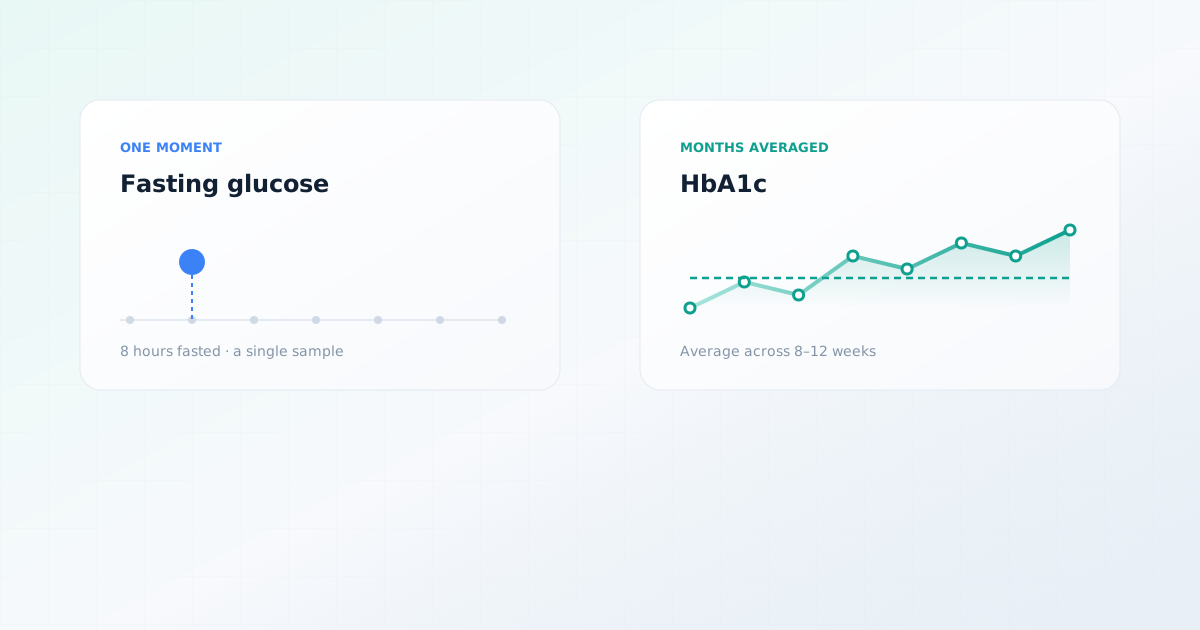
HbA1c measures the percentage of your hemoglobin that has glucose attached to it, which reflects your average blood glucose over roughly the previous two to three months. It is a trend, not a snapshot, and several common conditions can make it misleading.
What HbA1c actually measures
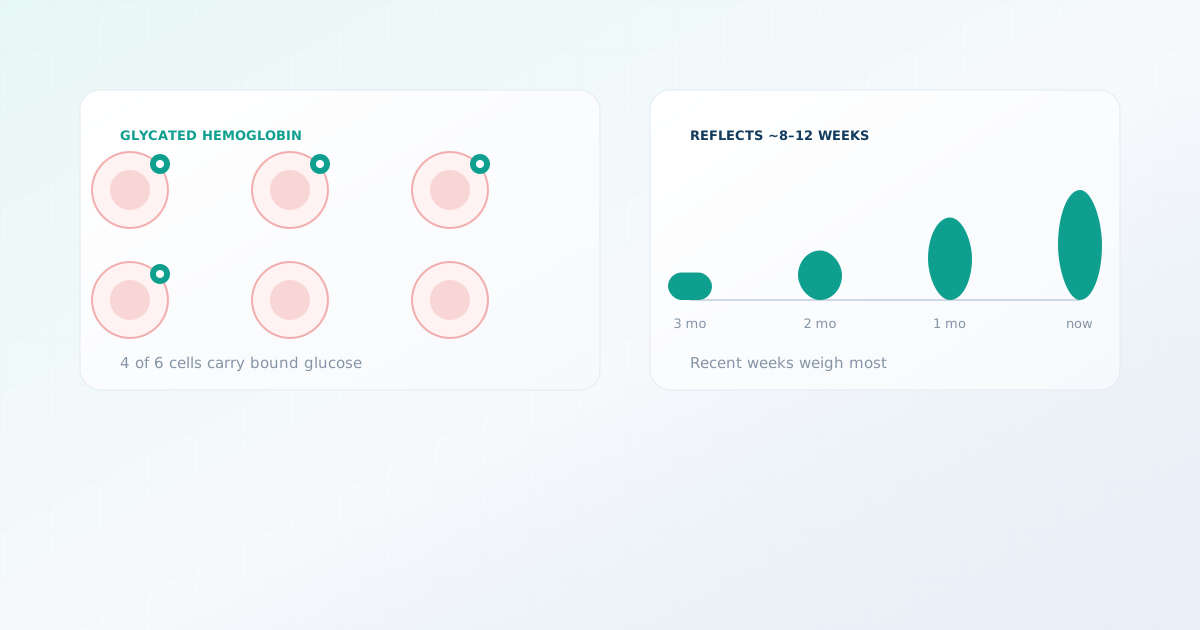
Hemoglobin is the protein inside red blood cells that carries oxygen around your body. When glucose is present in your bloodstream, some of it attaches to hemoglobin in a slow, essentially irreversible chemical reaction called glycation. HbA1c measures what proportion of your hemoglobin has undergone that reaction.
The reaction rate depends on how much glucose is available. More glucose circulating means more glycated hemoglobin, so the percentage rises. Less glucose means the percentage falls. That is the entire mechanism, and it is why a single number can summarize months of glucose exposure without anyone having to take a sample every day.
- HbA1c
- The proportion of hemoglobin A that has glucose attached, reported either as a percentage (NGSP units, common in the United States) or in mmol/mol (IFCC units, used in most of the rest of the world).
The distinction that matters most in practice is this: a blood glucose test measures glucose itself, in the moment. HbA1c measures a consequence of glucose exposure, accumulated over time. They answer different questions, and neither replaces the other.
Why it reflects two to three months
A red blood cell lives about 120 days. Because glycation is effectively permanent for the life of the cell, your bloodstream at any moment contains a mixture of cells of every age — some brand new with almost no glycation, some nearly at the end of their lifespan carrying the accumulated record of the previous four months.
HbA1c averages across that whole population of cells. That is why the conventional description is "the previous two to three months" rather than "the previous 120 days": the average red cell in circulation is roughly 60 days old, so the middle of the window carries the most weight.
The weighting is not even
The practical consequence is that repeating an HbA1c test after two or three weeks tells you very little. Most guidelines suggest an interval of around three months, which is roughly how long it takes for the measurement to catch up with reality.
HbA1c and blood glucose: the relationship
Because HbA1c tracks glucose exposure, it can be translated into an estimated average glucose — the number your glucose would have averaged to produce that HbA1c. The translation comes from the A1c-Derived Average Glucose study, which measured both in the same people and fitted a straight line between them.
That line is: estimated average glucose in mg/dL equals 28.7 times HbA1c, minus 46.7. The American Diabetes Association uses this same equation when reporting an estimated average glucose alongside an HbA1c result.
| HbA1c (%) | IFCC (mmol/mol) | eAG (mg/dL) | eAG (mmol/L) |
|---|---|---|---|
| 5.0 | 31 | 97 | 5.4 |
| 5.7 | 39 | 117 | 6.5 |
| 6.0 | 42 | 126 | 7.0 |
| 6.5 | 48 | 140 | 7.8 |
| 7.0 | 53 | 154 | 8.6 |
| 8.0 | 64 | 183 | 10.2 |
| 9.0 | 75 | 212 | 11.8 |
| 10.0 | 86 | 240 | 13.4 |
One thing worth noticing in that table: each whole percentage point of HbA1c corresponds to roughly 29 mg/dL (about 1.6 mmol/L) of average glucose. The relationship is linear across the usual range, which makes it easy to reason about.
How HbA1c results are commonly grouped
For screening in non-pregnant adults, the American Diabetes Association uses three ranges, unchanged in the 2026 edition of its Standards of Care. It is worth being precise about what they are: they are screening ranges that indicate whether further assessment is warranted, not labels that describe a person.
| Range | HbA1c | IFCC | What it indicates |
|---|---|---|---|
| Within the reference range | Below 5.7% | Below 39 mmol/mol | No further glucose testing usually indicated on this result alone |
| Prediabetes screening range | 5.7% – 6.4% | 39 – 46 mmol/mol | Higher likelihood of developing type 2 diabetes; usually prompts discussion and follow-up |
| Diabetes screening range | 6.5% and above | 48 mmol/mol and above | Meets the screening threshold; diagnosis requires clinician assessment and usually repeat or corroborating testing |
The middle row is larger than most people expect. The CDC counts about 115.2 million US adults — more than two in five — in the prediabetes range, and roughly eight in ten of them do not know it. Of the 40.1 million people with diabetes, more than one in four have not been diagnosed. An HbA1c result is often the first time either shows up.
A result in a range is not a diagnosis
Separately from screening, people already living with diabetes are often given an individual HbA1c target. Those targets vary considerably — by age, by how long someone has had diabetes, by what other conditions they have, and by the risk of hypoglycemia from their treatment. A target that is right for one person can be inappropriate for another, which is why it is set individually rather than read from a table.
What can make HbA1c misleading
HbA1c is a measurement of red blood cells, which means anything that changes how long red blood cells live, or how many there are, can move the result without your glucose having changed at all. This is the single most important caveat to understand.
- Conditions that shorten red cell lifespan — hemolytic anemia, recent significant blood loss, a recent transfusion, or treatment with erythropoietin — tend to lower HbA1c, because cells are replaced before they accumulate much glycation.
- Iron deficiency anemia tends to raise HbA1c, because red cells survive longer than usual.
- Chronic kidney disease can shift HbA1c in either direction, through effects on red cell survival and on the assay itself.
- Pregnancy changes red cell turnover substantially, and HbA1c is not the primary test used to assess glucose in pregnancy for that reason.
- Hemoglobin variants such as HbS (sickle cell), HbC, HbE and raised HbF interfere with some assay methods. A laboratory that detects a variant may need to use an alternative method.
- Splenectomy raises HbA1c; an enlarged spleen lowers it. Both work through red cell lifespan.
There is also natural biological variation between individuals that is not explained by any of the above. Some people consistently run a slightly higher or lower HbA1c than their average glucose would predict — sometimes called being a high or low glycator. It is one reason why HbA1c and glucose readings that appear to disagree are not necessarily evidence that one of them is wrong.
What HbA1c cannot tell you
The most significant blind spot is variability. HbA1c is an average, and averages conceal their distribution. Consider two people who both have an HbA1c of 7.0%, corresponding to an estimated average glucose of about 154 mg/dL (8.6 mmol/L).
- The first person sits between roughly 130 and 180 mg/dL almost all the time — steady, predictable, rarely uncomfortable.
- The second swings between 60 and 300 mg/dL, with hypoglycemic episodes several times a week and sharp post-meal spikes.
Their HbA1c is identical. Their day-to-day experience, and their risk of the complications associated with both hypoglycemia and glucose variability, are not. This is precisely the gap that continuous glucose monitoring was developed to fill, with measures such as time in range and glucose variability reported alongside HbA1c rather than instead of it.
What HbA1c is genuinely good at
Why context decides what a number means
An HbA1c of 6.8% means something quite different depending on the person. In someone who has never been tested before, it is a screening result that warrants follow-up. In someone whose previous reading was 9.5%, it represents a substantial change. In someone whose previous reading was 5.8%, it represents a different kind of change. In someone with iron deficiency anemia, it may partly reflect the anemia.
This is why a clinician interpreting an HbA1c looks at the trend across previous results, at a full blood count to check for anything affecting red cells, at kidney function, at any medications, and at whether the person has symptoms. The number is the starting point of that assessment, not its conclusion.
What to do with a result you do not understand
Frequently asked questions
Sources
This page is based on the following sources. Each was reviewed on the access date shown.
- Diagnosis and Classification of Diabetes: Standards of Care in Diabetes-2026(opens in a new tab)
Diabetes Care (American Diabetes Association)
Clinical guidelinePublished January 1, 2026Accessed October 1, 2026
- Translating the A1C assay into estimated average glucose values(opens in a new tab)
Diabetes Care (American Diabetes Association)
Peer-reviewed articlePublished August 1, 2008Accessed September 27, 2026DOI 10.2337/dc08-0545
- The A1C Test and Diabetes(opens in a new tab)
National Institute of Diabetes and Digestive and Kidney Diseases (NIH)
Government health agencyAccessed September 27, 2026
- Understanding A1C(opens in a new tab)
American Diabetes Association
Professional societyAccessed September 27, 2026
- HbA1c standardization and the NGSP–IFCC master equation(opens in a new tab)
National Glycohemoglobin Standardization Program
Reference workAccessed September 27, 2026
- Diabetes in the United States: A U.S. Report Card(opens in a new tab)
Centers for Disease Control and Prevention
Government health agencyAccessed October 1, 2026
- Testing for Diabetes and Prediabetes(opens in a new tab)
Centers for Disease Control and Prevention
Government health agencyAccessed September 27, 2026