Liver Function Tests Explained: What ALT and AST Results Mean
ALT and AST are enzymes that leak into the blood when liver cells are irritated or damaged. A raised result is a prompt to look for a cause, not a diagnosis, and a result inside the lab range does not rule out liver disease.
What a liver panel is, and what it is not
The phrase "liver function tests" is slightly misleading. The most commonly reported results, ALT and AST, do not measure how well the liver is working. They measure enzymes that sit inside liver cells and escape into the bloodstream when those cells are stressed or damaged. A more accurate name would be liver injury markers, and the distinction matters for interpretation: someone can have a normal ALT and a seriously impaired liver, or a raised ALT with a liver that is working perfectly well.
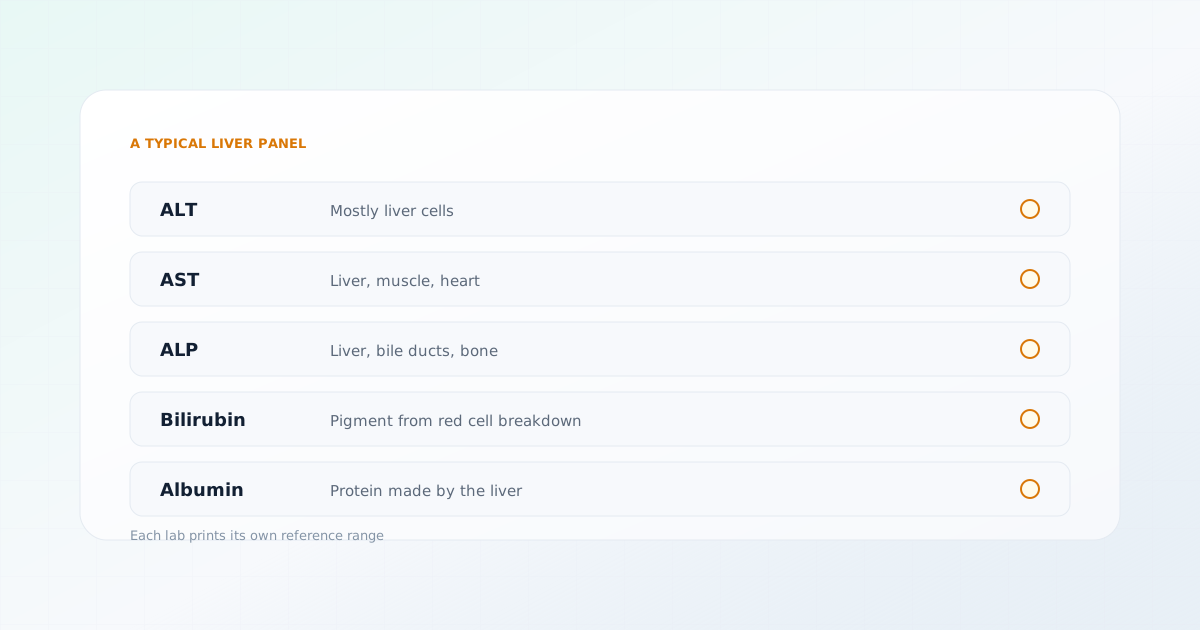
According to MedlinePlus, the National Library of Medicine’s consumer health resource, a liver panel typically combines several measurements. Alongside ALT (alanine aminotransferase) and AST (aspartate aminotransferase), it usually includes alkaline phosphatase (ALP), bilirubin and albumin, and sometimes gamma-glutamyl transferase (GGT). Each of them says something different about the liver and bile system, and the pattern across them is often more informative than any one value.
| Test | What it measures | What an abnormal result can point toward |
|---|---|---|
| ALT | An enzyme found mainly in liver cells | Irritation or injury to liver cells |
| AST | An enzyme found in the liver, muscle, heart and other tissues | Liver injury, but also muscle or heart injury, so it is less specific |
| ALP | An enzyme in the liver, bile ducts and bone | Bile duct problems, or bone conditions |
| Bilirubin | A yellow pigment from the breakdown of red blood cells | Problems clearing bilirubin, bile flow obstruction, or increased red cell breakdown |
| Albumin | A protein made by the liver | Reduced production, which can reflect long-standing liver problems, among other causes |
ALT and AST: why there are two and how they differ
ALT and AST do similar work inside cells, helping to process amino acids, and both rise when cells leak. The practical difference is where they are found. ALT is concentrated in the liver, so a rise in ALT points more specifically toward the liver. AST is also present in skeletal muscle, heart muscle, the kidneys and the brain, so AST can rise after muscle injury or a heart problem even when the liver is untouched.
That difference explains one of the most common reasons for a mildly raised AST in an otherwise healthy person: strenuous exercise. A hard weight session or a long run causes microscopic muscle injury, and AST (and often ALT, to a lesser degree) can be higher in a blood sample drawn a day or two afterward. People who have a panel done and are told that something is slightly high are frequently advised to repeat it after a few days of rest for this reason.
- Transaminases
- The family of enzymes that includes ALT and AST. The name refers to their chemical job, moving amino groups between molecules, and it is the term you may see on a lab report or in a clinician’s note.
Reading the reference range on your own report
There is no single universal "normal" ALT or AST. Each laboratory measures with its own equipment and calibrates against its own population, and it prints a reference range on the report. MedlinePlus notes that reference ranges vary from one laboratory to another, which is why this article gives no cut-off value: the range on your report is the one that applies to your result.
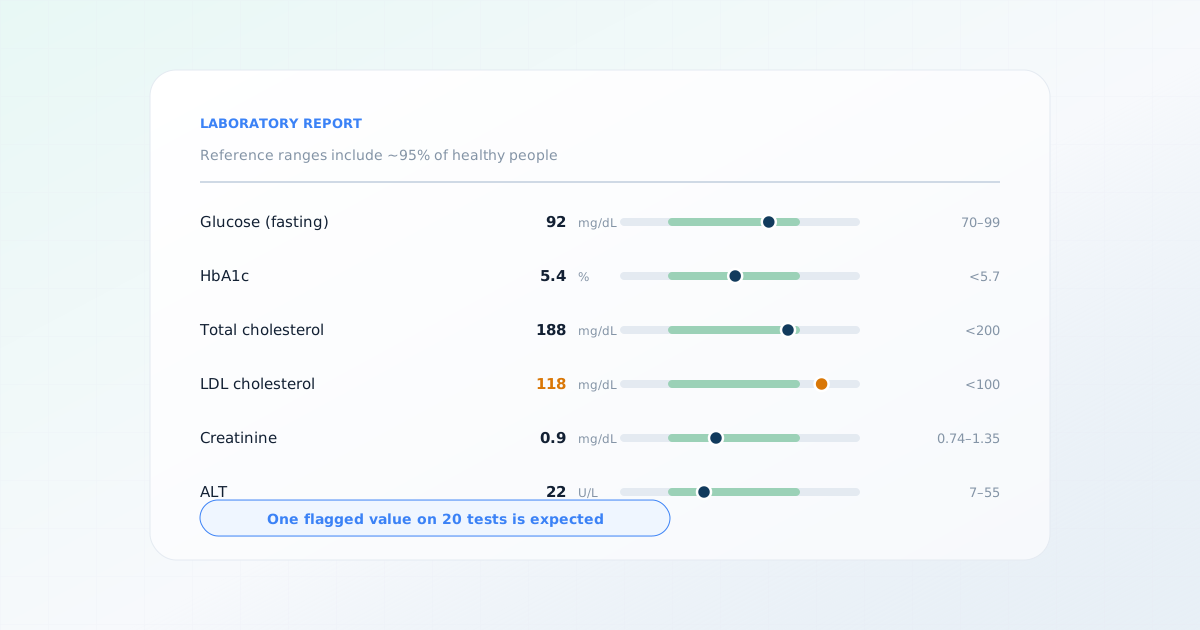
It helps to understand what a reference range is. Typically it is defined so that about 95 percent of a healthy reference group falls inside it, which means that about one in twenty healthy people will have a result outside the range on any single test and that a slightly high value does not necessarily signal disease. By the same logic, a result inside the range does not guarantee that nothing is wrong.
Prefer "within the reference range" to "normal"
Some clinicians and researchers argue that the upper limits printed by many laboratories are higher than they should be, because the reference groups they were derived from included people with undiagnosed fatty liver. Whether to treat a result just inside the printed range as meaningful is a clinical judgment that depends on the person’s risk factors, and it is one reason to discuss a result with a clinician instead of reading it alone.
Common reasons for a raised result
Many different things can raise liver enzymes, and most of the common ones are not dramatic. Because the list is long, clinicians usually begin with a history of medicines, supplements, alcohol, other conditions and recent exercise before ordering anything further.
- Fatty liver disease. The most common chronic cause in the United States is fat accumulation in the liver associated with excess weight, insulin resistance and related metabolic conditions. It is now called metabolic dysfunction-associated steatotic liver disease, or MASLD, having previously been called non-alcoholic fatty liver disease. It often causes no symptoms.
- Alcohol. Regular heavy drinking can raise liver enzymes.
- Medicines. MedlinePlus lists drugs that are toxic to the liver among the causes of a high ALT, and many prescription and over-the-counter medicines can raise liver enzymes in some people.
- Herbal and dietary supplements. Some products have been associated with liver injury, and they are easy to forget to mention to a clinician.
- Viral hepatitis. Infections with hepatitis A, B or C viruses can inflame the liver, and testing for them is a standard follow-up when enzymes are raised without an obvious explanation.
- Strenuous exercise and muscle injury, which mainly affect AST.
- Other conditions on the MedlinePlus list, including cirrhosis, hemochromatosis, reduced blood flow to the liver, liver tumors, mononucleosis and pancreatitis.
Do not stop a prescribed medicine on your own
What usually happens after a raised result
For a mild rise in an otherwise well person, the usual first step is often to repeat the test after a few weeks, with attention to exercise, alcohol and medicines in the days beforehand. Many mild elevations settle on their own. A result that persists, or one that is substantially raised from the start, leads to a more structured search for a cause.
- A review of medicines, supplements, alcohol intake, family history and symptoms such as jaundice, dark urine, pale stools, itching, abdominal pain or unexplained weight loss.
- Further blood tests, which may include hepatitis tests, iron studies, and markers of metabolic health such as glucose or HbA1c and a lipid panel.
- Imaging, most commonly an abdominal ultrasound, which can show fat in the liver and the state of the bile ducts.
- Where fatty liver is suspected, assessment of how much scarring, if any, is present, which is done with a combination of blood-based scores and specialized scans.
Because fatty liver disease is closely tied to weight, blood pressure, glucose and lipids, a raised ALT is often a useful prompt to look at the wider cardiometabolic picture. Body measurements such as waist circumference and BMI, and results such as HbA1c, are part of that picture.
Try the calculatorRelated: a waist measure that reflects central fatWhat a liver panel cannot tell you
Liver disease can be quiet for years, and enzyme levels do not track how much damage there is. People with significant scarring can have ALT and AST values within the reference range, and people with very high values can have a reversible, short-lived problem. A panel is a useful screen and a clue, and it is not a measure of liver function or of liver health.
The sensible way to use a result, especially a flagged one, is as a reason to talk through possible causes with a clinician who knows your medicines, habits and history. Symptoms such as yellowing of the skin or eyes, very dark urine, pale stools, severe abdominal pain or persistent vomiting call for prompt medical attention rather than waiting for a routine appointment.
Frequently asked questions
Sources
This page is based on the following sources. Each was reviewed on the access date shown.
- ALT Blood Test(opens in a new tab)
MedlinePlus (US National Library of Medicine)
Government health agencyAccessed September 27, 2026
- Liver Function Tests(opens in a new tab)
MedlinePlus (US National Library of Medicine)
Government health agencyAccessed September 27, 2026
- Medical Tests(opens in a new tab)
MedlinePlus (US National Library of Medicine)
Government health agencyAccessed September 27, 2026
- ACG Clinical Guideline: Evaluation of Abnormal Liver Chemistries(opens in a new tab)
American Journal of Gastroenterology (American College of Gastroenterology)
Clinical guidelinePublished January 1, 2017Accessed October 12, 2026DOI 10.1038/ajg.2016.517