Understanding Blood Pressure Numbers
The top number is the pressure as your heart contracts, the bottom number is the pressure between beats. In the United States the categories come from the 2025 AHA/ACC guideline, technique changes a reading by several mmHg, and no single measurement settles anything.
What the two numbers represent
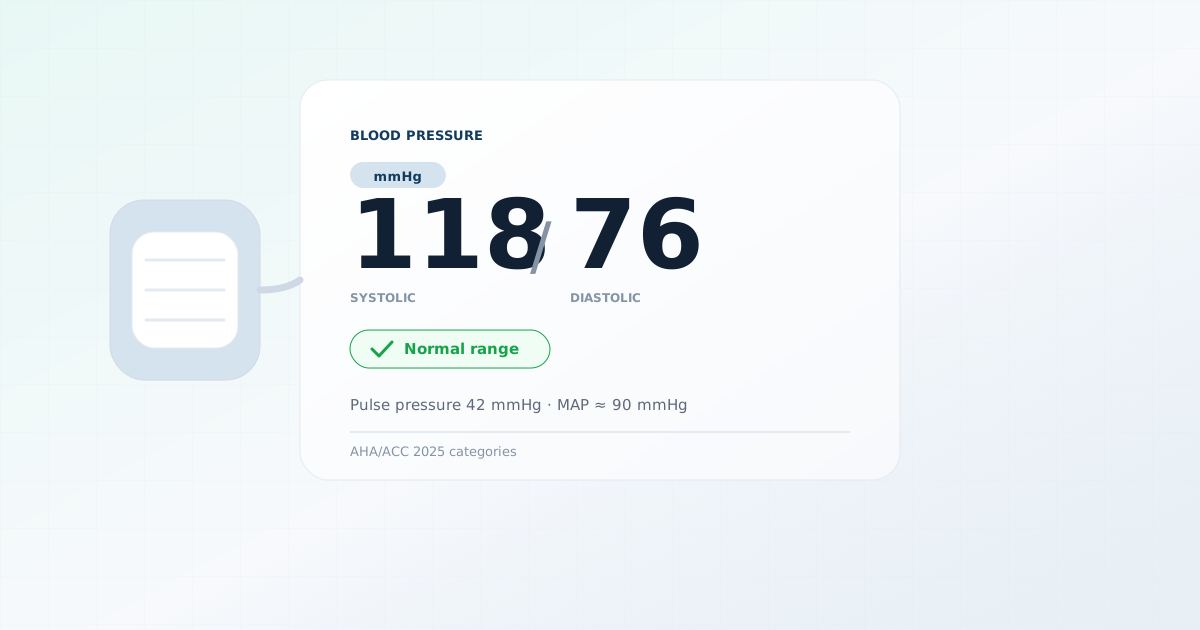
Blood pressure is written as one number over another — 120/80 mmHg, spoken as "120 over 80". The unit, millimeters of mercury, is a historical artifact of the original mercury-column instruments, and it has stuck.
- Systolic pressure (the top number)
- The peak pressure in your arteries at the moment your heart contracts and pushes blood out. It is always the higher of the two.
- Diastolic pressure (the bottom number)
- The lowest pressure in your arteries while your heart relaxes and refills between beats. Your arteries are never at zero pressure, which is why this number is not small.
One point that is rarely made explicit: your heart spends more of each cycle relaxed than contracting. At a resting heart rate, roughly two thirds of the cycle is diastole. So although the systolic peak is the higher number, the diastolic pressure is what your arteries experience for most of the time.
This is not a rare thing to be looking up. The American Heart Association’s 2026 statistical update puts the number of US adults with high blood pressure at about 125.9 million, close to half the adult population. Most of them found out from exactly the kind of number you are reading about here.
The US categories, from the 2025 AHA/ACC guideline
In August 2025 the American Heart Association and the American College of Cardiology, with eleven other professional bodies, published a new guideline for high blood pressure in adults. It replaced the 2017 edition that most American blood pressure charts were built on.
What the 2025 guideline changed, and what it did not
| Category | Systolic (mmHg) | Combination | Diastolic (mmHg) |
|---|---|---|---|
| Normal | Below 120 | and | Below 80 |
| Elevated | 120 – 129 | and | Below 80 |
| Hypertension Stage 1 | 130 – 139 | or | 80 – 89 |
| Hypertension Stage 2 | 140 or above | or | 90 or above |
| Needs prompt attention | Above 180 | and/or | Above 120 |
One rule travels with the table: when the systolic and diastolic numbers fall into different bands, the higher category applies. A reading of 125/95 mmHg is categorized on the diastolic value, not the systolic one.
Try the calculatorCheck a reading against the 2025 AHA/ACC categoriesThe target, and why the reading alone does not decide anything
The 2025 guideline sets one overarching treatment target for most adults: below 130/80 mmHg, with encouragement toward below 120/80 where that can be reached comfortably. Separate considerations apply in pregnancy, in people receiving institutional care, and where life expectancy is limited.
A target is not the same as a threshold for starting treatment, and this is the part most charts leave out. Under the 2025 guideline, sustained readings at or above 140/90 mmHg are treated with medication alongside lifestyle change. Between 130/80 and 140/90 — Stage 1 — the decision depends on the rest of the picture: existing cardiovascular disease, prior stroke, diabetes, chronic kidney disease, or an estimated 10-year cardiovascular risk of 7.5% or more.
- PREVENT
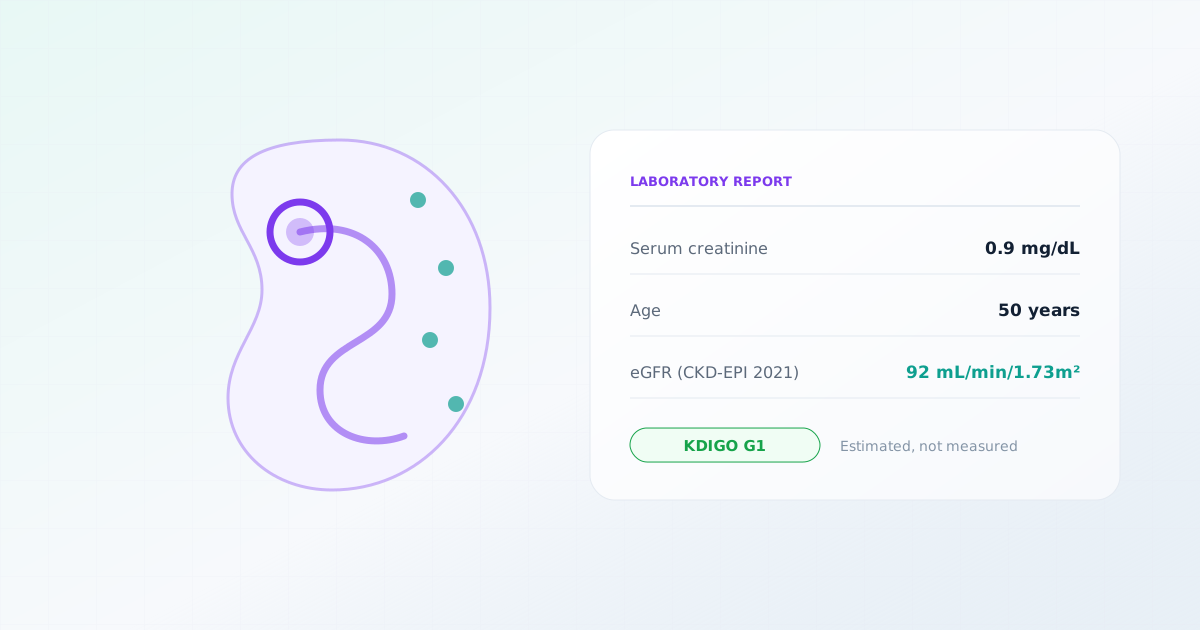
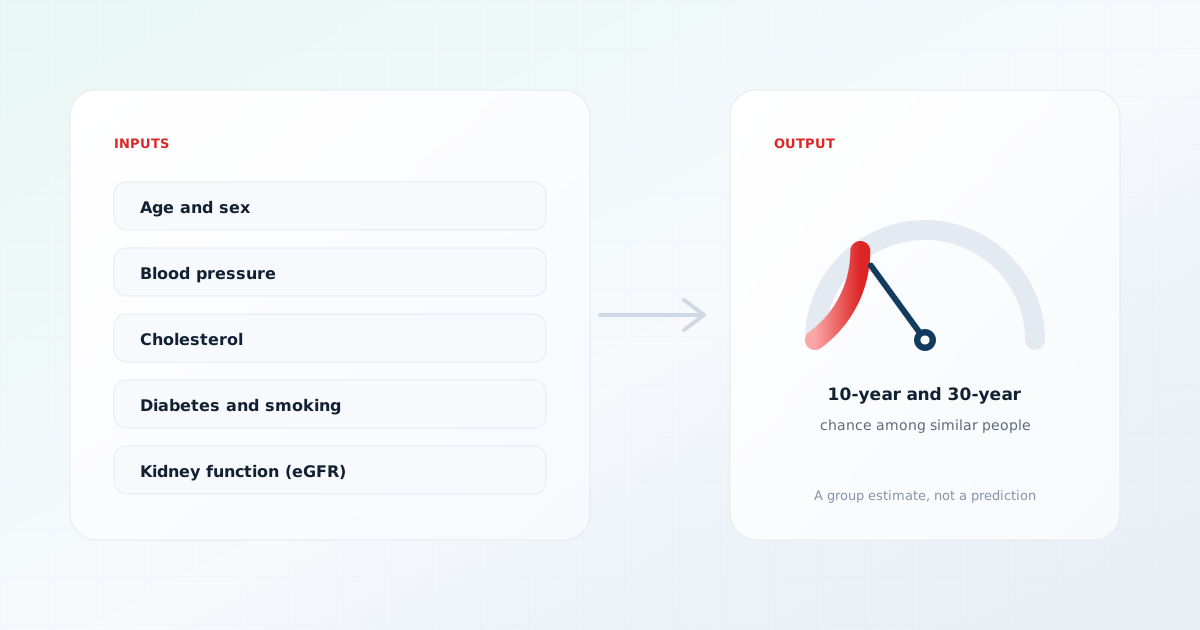
- The American Heart Association’s risk model, which replaced the older Pooled Cohort Equations in US guidelines. It estimates 10-year and 30-year risk of cardiovascular disease for adults aged 30 to 79, and it takes kidney function (eGFR) as an input alongside blood pressure, cholesterol, smoking and diabetes.
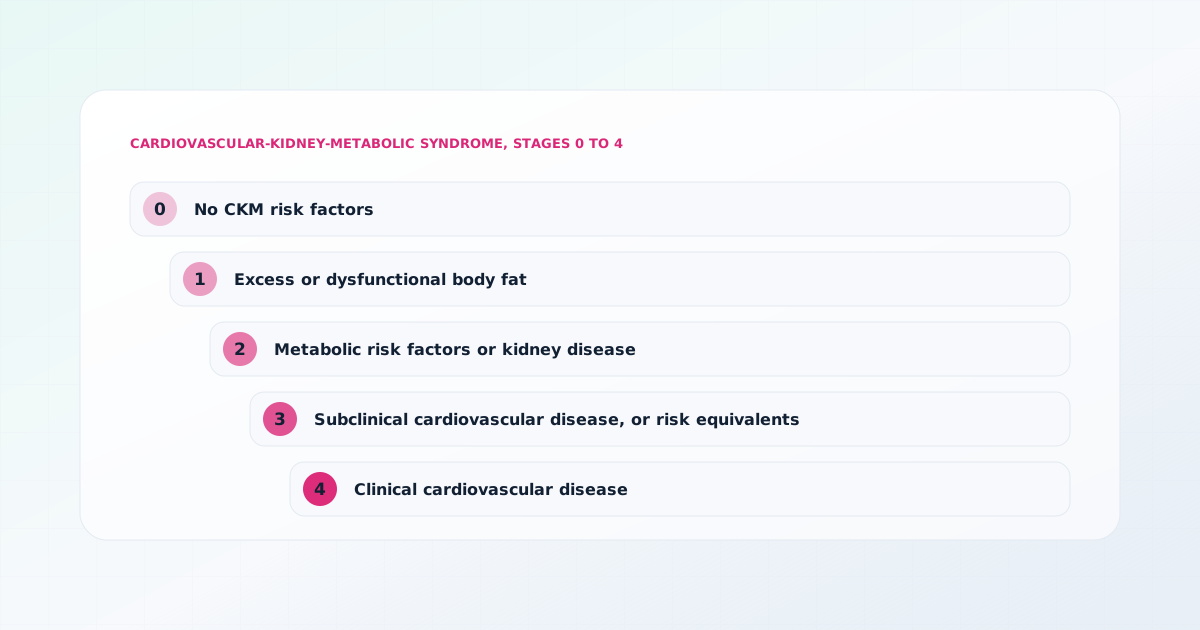
That eGFR term is worth pausing on. It is the reason a blood pressure conversation often arrives with a kidney number attached, and the reason the 2026 cardiovascular-kidney-metabolic guideline treats blood pressure, cholesterol, blood sugar, weight and kidney function as one connected picture rather than five separate ones. Your blood pressure reading is one input into a risk estimate; the risk estimate is one input into a decision.
What this site can and cannot do with a reading
Why a reading gets a different label outside the US
There is no single global blood pressure classification, and the differences are large enough to change what a given reading is called. If you have seen a chart that disagrees with the one above, it is probably not wrong — it is probably European.
| Category | Systolic (mmHg) | Combination | Diastolic (mmHg) |
|---|---|---|---|
| Non-elevated | Below 120 | and | Below 70 |
| Elevated blood pressure | 120 – 139 | or | 70 – 89 |
| Hypertension | 140 or above | or | 90 or above |
The same reading, two different labels
The United Kingdom adds a third frame. NICE guidance uses a clinic threshold of 140/90 mmHg but places considerable weight on home or ambulatory readings, which run lower — a threshold of 135/85 mmHg is applied to those. So the same person can be described differently depending on which country’s framework and which measurement setting is used. The tool here offers both the AHA/ACC and ESC categories as an explicit choice, rather than hiding one behind a default.
Pulse pressure: the gap between the numbers
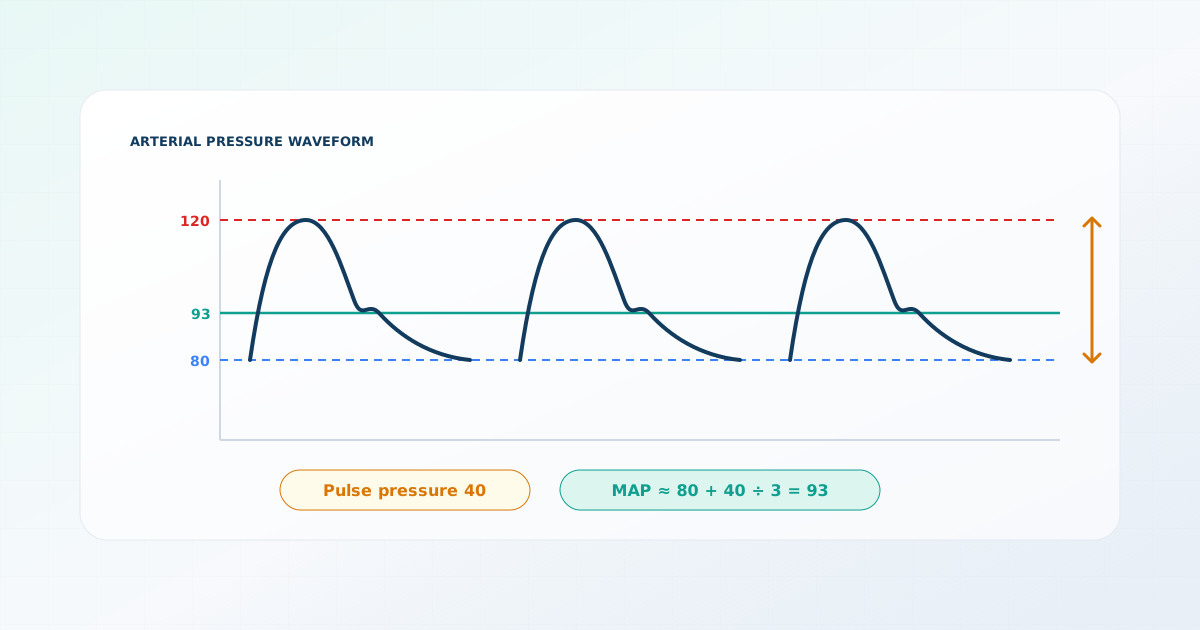
Subtracting the diastolic number from the systolic gives the pulse pressure — how much the pressure in your arteries rises and falls with each beat. For 120/80 mmHg, it is 40 mmHg.
Pulse pressure reflects the stiffness of your large arteries, particularly the aorta. A young, elastic aorta absorbs much of the pressure surge from each heartbeat. As arteries stiffen with age they absorb less, so systolic pressure rises while diastolic pressure levels off or even falls, widening the gap. A pulse pressure of roughly 30 to 50 mmHg is typical in adults, and a gradual widening with age is expected physiology rather than a sign of disease.
It is worth noting that pulse pressure has no single agreed clinical cut-point in the way blood pressure stages do. It is a population-level risk marker studied in research cohorts, not a number with a pass mark.
Try the calculatorCalculate pulse pressure and mean arterial pressureTechnique changes the number
Blood pressure is unusually sensitive to how it is measured. Several of the common errors shift a reading by more than the width of an entire guideline category, which means poor technique can genuinely change which label a reading receives. The 2025 guideline puts home and 24-hour monitoring at the center of both diagnosis and follow-up, which makes the technique below worth getting right.
| Error | Typical effect |
|---|---|
| Cuff too small for the arm | Overestimates, sometimes substantially |
| Arm unsupported or below heart level | Overestimates by up to about 10 mmHg |
| Back unsupported | Raises diastolic pressure |
| Legs crossed | Raises systolic pressure |
| Talking during measurement | Raises both numbers |
| No rest period before measuring | Overestimates |
| Cuff over a sleeve | Unpredictable, generally overestimates |
| Full bladder | Raises both numbers |
- Empty your bladder, and avoid caffeine, nicotine and exercise for at least 30 minutes beforehand.
- Sit with your back supported and both feet flat on the floor, legs uncrossed.
- Rest quietly for five minutes without talking or looking at a screen.
- Rest your arm on a table so the cuff is at roughly heart height.
- Use a correctly sized cuff on bare skin, positioned about an inch above the elbow crease.
- Stay silent during the measurement.
- Take two or three readings a minute apart and record all of them, not just the lowest.
- Measure at the same times of day so readings are comparable.
Upper arm, not wrist
Why readings vary so much
Blood pressure is not a fixed property like your height. It is a control variable that your body adjusts continuously, and it changes minute to minute in response to posture, activity, temperature, emotion, breathing and the time of day.
There is a predictable daily rhythm: blood pressure is usually lowest during sleep, rises sharply in the hours around waking, and drifts down through the evening. Beyond that rhythm, two specific patterns matter enough to have their own names.
- White-coat hypertension
- Blood pressure that is raised in a clinical setting but within the usual range at home. Common, and a reason clinic readings alone can overestimate.
- Masked hypertension
- Blood pressure that is unremarkable in clinic but raised at home or over 24 hours. The more concerning of the two, because it is easily missed.
Both patterns are why the 2025 guideline leans so heavily on measurements taken outside the clinic. Ambulatory monitoring — a device worn for 24 hours taking readings automatically, including during sleep — gives the fullest picture, and a series of careful home readings over a week comes close.
The lifestyle numbers the 2025 guideline actually names
"Eat less salt" is advice without a number, and a number is what makes advice checkable. The 2025 guideline gives several, for adults with and without hypertension alike.
| Factor | What the guideline says |
|---|---|
| Sodium | Under 2,300 mg a day, moving toward an ideal limit of under 1,500 mg |
| Alcohol | Abstinence is the recommended goal; otherwise at most 1 drink a day for women and 2 for men |
| Blood pressure target | Below 130/80 mmHg for most adults |
| Risk estimate | PREVENT 10-year cardiovascular risk of 7.5% or more marks increased risk |
For scale: 2,300 mg of sodium is roughly one teaspoon of table salt, and most of it in a typical American diet arrives already in packaged and restaurant food rather than from the shaker. The gap between 2,300 mg and the ideal 1,500 mg is where reading labels starts to matter.
Why a diagnosis needs more than one reading
Given all of the above, it follows that no single reading can establish whether someone has high blood pressure. Both major guidelines are explicit on this point: a diagnosis rests on repeated readings on separate occasions, usually supported by home or ambulatory monitoring.
What happens after a raised reading is generally a process rather than a decision. A clinician may ask for a series of home readings over a week or two, or arrange 24-hour monitoring, and will look at your overall cardiovascular risk — age, cholesterol, smoking, diabetes, family history, kidney function — before discussing whether anything needs to change. Blood pressure is one input into that assessment.
When a reading needs prompt attention
What blood pressure numbers cannot tell you
- A category is not a diagnosis, and a diagnosis is not a treatment decision. The 2025 guideline bases treatment on overall cardiovascular risk, not on the reading alone.
- Guideline categories are drawn for the general adult population. Targets differ in pregnancy, in older adults, in chronic kidney disease, in diabetes and after a stroke.
- Home monitors vary in accuracy. Devices should be validated models, and worth checking against a clinic measurement occasionally.
- A single low reading is usually not a concern in someone who feels well; low blood pressure matters mainly when it causes symptoms such as dizziness or fainting.
- These numbers say nothing about *why* blood pressure is where it is. Kidney conditions, thyroid disorders, sleep apnea and several medications can all raise blood pressure, and identifying a cause requires investigation.
Frequently asked questions
Sources
This page is based on the following sources. Each was reviewed on the access date shown.
- 2025 AHA/ACC Guideline for the Prevention, Detection, Evaluation and Management of High Blood Pressure in Adults(opens in a new tab)
Circulation (American Heart Association)
Clinical guidelinePublished August 14, 2025Accessed October 1, 2026DOI 10.1161/CIR.0000000000001356
- 2017 ACC/AHA Guideline for the Prevention, Detection, Evaluation, and Management of High Blood Pressure in Adults(opens in a new tab)
Hypertension (American Heart Association)
Clinical guidelinePublished June 1, 2018Accessed September 27, 2026DOI 10.1161/HYP.0000000000000065
- Development and Validation of the American Heart Association PREVENT Equations(opens in a new tab)
Circulation (American Heart Association)
Peer-reviewed articleAccessed October 1, 2026DOI 10.1161/CIRCULATIONAHA.123.067626
- 2026 Heart Disease and Stroke Statistics: A Report of US and Global Data(opens in a new tab)
Circulation (American Heart Association)
Professional societyPublished January 21, 2026Accessed October 1, 2026
- 2024 ESC Guidelines for the management of elevated blood pressure and hypertension(opens in a new tab)
European Heart Journal (European Society of Cardiology)
Clinical guidelinePublished October 7, 2024Accessed September 27, 2026DOI 10.1093/eurheartj/ehae178
- High blood pressure (hypertension)(opens in a new tab)
NHS (United Kingdom)
Government health agencyAccessed September 27, 2026
- High Blood Pressure(opens in a new tab)
National Heart, Lung, and Blood Institute (NIH)
Government health agencyAccessed September 27, 2026