What Is a Normal Resting Heart Rate?
A resting heart rate of 60 to 100 beats per minute is the commonly cited adult range, though trained athletes often sit well below it. What matters more than the absolute number is your own baseline and what moves it.
The commonly cited range, and what it is worth
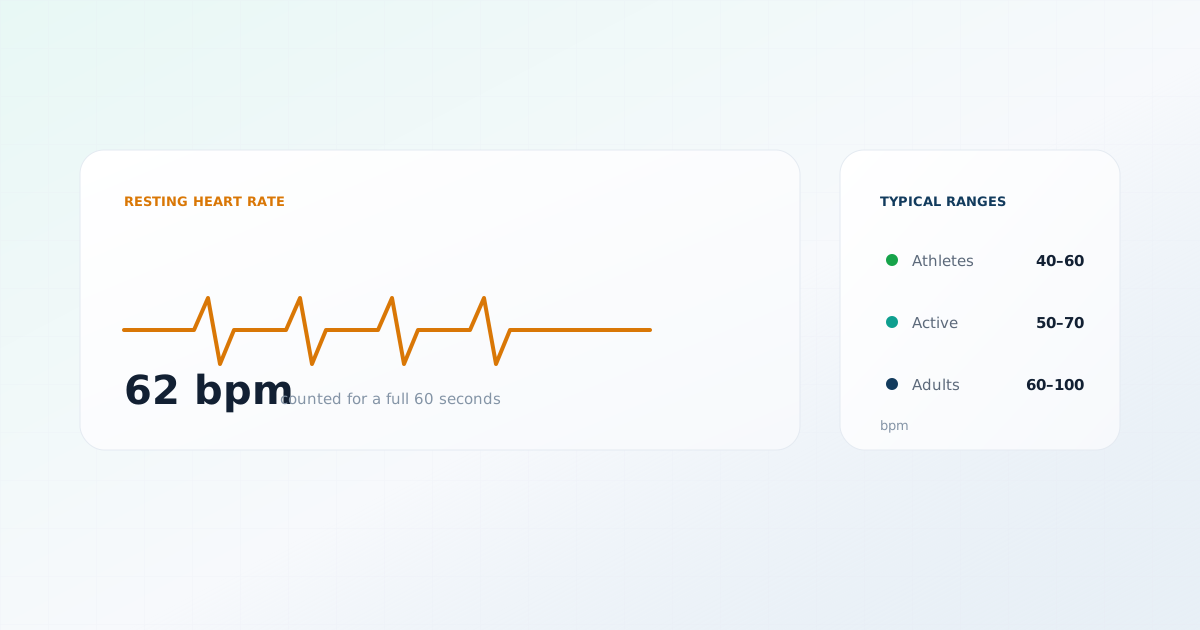
Most sources give 60 to 100 beats per minute as the normal adult resting heart rate. That figure is genuinely useful as an orientation, and it is also unusually wide — a 40-beat spread, meaning the top of the range is two thirds higher than the bottom.
A range that broad cannot be very discriminating. Someone resting at 62 bpm and someone at 96 bpm are both "normal" by this standard, while having quite different cardiovascular profiles. Within the normal range, a lower resting heart rate is generally associated with better cardiovascular fitness at a population level.
| Group | Typical resting heart rate |
|---|---|
| Adults generally | 60 – 100 bpm |
| Physically active adults | 50 – 70 bpm |
| Trained endurance athletes | 40 – 60 bpm |
| Newborns | 100 – 160 bpm |
| Children aged 1 – 10 | 70 – 130 bpm |
Why fit people rest lower
The amount of blood your body needs at rest is roughly fixed — enough to supply your brain, organs and tissues. That total is the product of two things: how much blood the heart ejects per beat, and how many beats per minute.
- Stroke volume
- The volume of blood the heart ejects with each contraction. Endurance training increases it, partly by enlarging the left ventricle and partly by strengthening the muscle.
If stroke volume rises and the required total stays the same, heart rate must fall. A trained heart moving 50% more blood per beat needs proportionally fewer beats to do the same job. Endurance training also increases the influence of the parasympathetic nervous system on the heart, which slows it further at rest.
This is why a resting heart rate in the 40s is entirely unremarkable in a trained cyclist or distance runner and would be investigated in a sedentary person with symptoms. The number means different things in different contexts.
How to measure it properly
Most people who think they know their resting heart rate have actually measured their sitting-quietly heart rate, which is typically several beats higher. A true resting measurement requires being genuinely at rest.
- Measure first thing in the morning, while still in bed, before sitting up.
- Place two fingers — not your thumb, which has its own pulse — on the inside of your wrist below the base of the thumb.
- Count every beat for a full 60 seconds. Counting for 15 seconds and multiplying by four amplifies any counting error fourfold.
- Repeat on several consecutive mornings and take the average, since single-day variation is normal.
Wearables and overnight readings
While counting, it is also worth noticing whether the rhythm is regular. An irregular pulse — beats that come unevenly, or occasional apparent skips — is worth mentioning to a clinician, because it is something a number alone does not capture.
Try the calculatorUse your resting heart rate to calculate training zonesWhat moves resting heart rate
Resting heart rate is a responsive signal rather than a fixed trait. Understanding what shifts it is what makes a change interpretable.
| Influence | Typical direction | Notes |
|---|---|---|
| Cardiovascular fitness | Lowers | The largest modifiable influence; develops over months |
| Caffeine | Raises | Effects can persist for several hours |
| Acute stress or anxiety | Raises | Via sympathetic nervous system activation |
| Fever or infection | Raises | Roughly 10 bpm per 1 °C of fever is a common rule of thumb |
| Dehydration | Raises | Lower blood volume means more beats to compensate |
| Heat | Raises | Blood is redirected to the skin for cooling |
| Alcohol | Raises | Often most noticeable overnight after drinking |
| Poor or short sleep | Raises | A consistent finding in tracker data |
| Hard training the previous day | Raises | A recognized marker of incomplete recovery |
| Beta blockers | Lowers | Directly blunt the heart rate response |
| Thyroid overactivity | Raises | Underactivity lowers it |
| Pregnancy | Raises | Blood volume increases substantially |
| Menstrual cycle phase | Varies | Often slightly higher in the luteal phase |
This list explains why an isolated elevated reading rarely means much. It also explains why tracking resting heart rate over time is genuinely useful: when your own baseline is established, a sustained rise of five or ten beats is a real signal that something — training load, sleep, alcohol, or an infection coming on — has changed.
Your baseline beats the population range
Because the normal range is so wide, position within it tells you less than deviation from your own usual value. Someone who normally rests at 58 bpm and now consistently rests at 74 has changed meaningfully, even though both figures sit comfortably inside the normal range.
This is the main argument for measuring it more than once. A single reading gives you a number with no reference point. A few weeks of morning measurements give you a baseline, and a baseline is what makes any future reading interpretable.
Resting heart rate is not a substitute for other measurements
When a heart rate warrants medical attention
The general principle is that symptoms matter more than the number. A low heart rate in a fit person with no symptoms is usually a sign of fitness. A low heart rate accompanied by dizziness or fainting is a different situation.
- A resting heart rate consistently above 100 bpm, or consistently below 60 in someone who is not physically trained, is worth discussing with a clinician.
- An irregular pulse, or one that feels as though it skips or flutters, should be mentioned — the rhythm matters as much as the rate.
- A sustained unexplained change from your own baseline is worth raising, particularly if it persists for more than a week or two.
- A heart rate change with breathlessness, reduced exercise tolerance, or swelling in the ankles should be assessed.
Signs needing urgent attention
Frequently asked questions
Sources
This page is based on the following sources. Each was reviewed on the access date shown.
- All About Heart Rate (Pulse)(opens in a new tab)
American Heart Association
Professional societyAccessed September 27, 2026
- Target Heart Rates Chart(opens in a new tab)
American Heart Association
Professional societyAccessed September 27, 2026
- Age-predicted maximal heart rate revisited(opens in a new tab)
Journal of the American College of Cardiology
Peer-reviewed articlePublished January 1, 2001Accessed September 27, 2026DOI 10.1016/s0735-1097(00)01054-8
- High Blood Pressure(opens in a new tab)
National Heart, Lung, and Blood Institute (NIH)
Government health agencyAccessed September 27, 2026