Heart Rate Zones and Maximum Heart Rate: How the Estimates Work
Maximum heart rate is usually estimated from age, using formulas such as 208 minus 0.7 times age, and training zones are percentages of that estimate. The estimate can be off by around ten beats a minute for an individual, so zones are a guide, not a measurement.
What maximum heart rate is, and what it is not
Maximum heart rate is the highest number of beats per minute your heart can reach when you are working as hard as you possibly can. It is largely set by age and genetics, and it tends to decline gradually over adult life. It is not a measure of fitness: a very fit person and an untrained person of the same age can have similar maximum heart rates, and a higher maximum does not mean a stronger heart.
Measuring it properly means an exercise test pushed to exhaustion, ideally supervised, with the heart rate recorded at peak effort. That is unpleasant, not appropriate for everyone, and unnecessary for most recreational exercisers, so formulas stand in for it. The important thing to hold onto is that these are predictions, and the prediction is an average across many people.
Why there is more than one formula
The formula most people know is 220 minus age. It is easy to remember and, for a century of gym posters, universal. It was never derived from a rigorous study of healthy adults; it came from a compilation of earlier data and became standard through repetition.
In 2001, Hirofumi Tanaka and colleagues published a meta-analysis and a laboratory study in the Journal of the American College of Cardiology, titled "Age-predicted maximal heart rate revisited". They concluded that maximum heart rate in healthy adults is better described by 208 minus 0.7 times age. The difference grows with age: the two formulas agree around age 40 and the older formula under-predicts for older adults.
| Age | 220 minus age | 208 minus 0.7 times age |
|---|---|---|
| 25 | 195 | 190.5 |
| 40 | 180 | 180 |
| 55 | 165 | 169.5 |
| 70 | 150 | 159 |
For a 70-year-old, the two formulas differ by nine beats per minute. That matters, because a person who uses the older formula and exercises to a calculated 85 percent of a maximum that is too low is working somewhat below their intended intensity.
Both are averages with wide scatter
How zones are built from the estimate
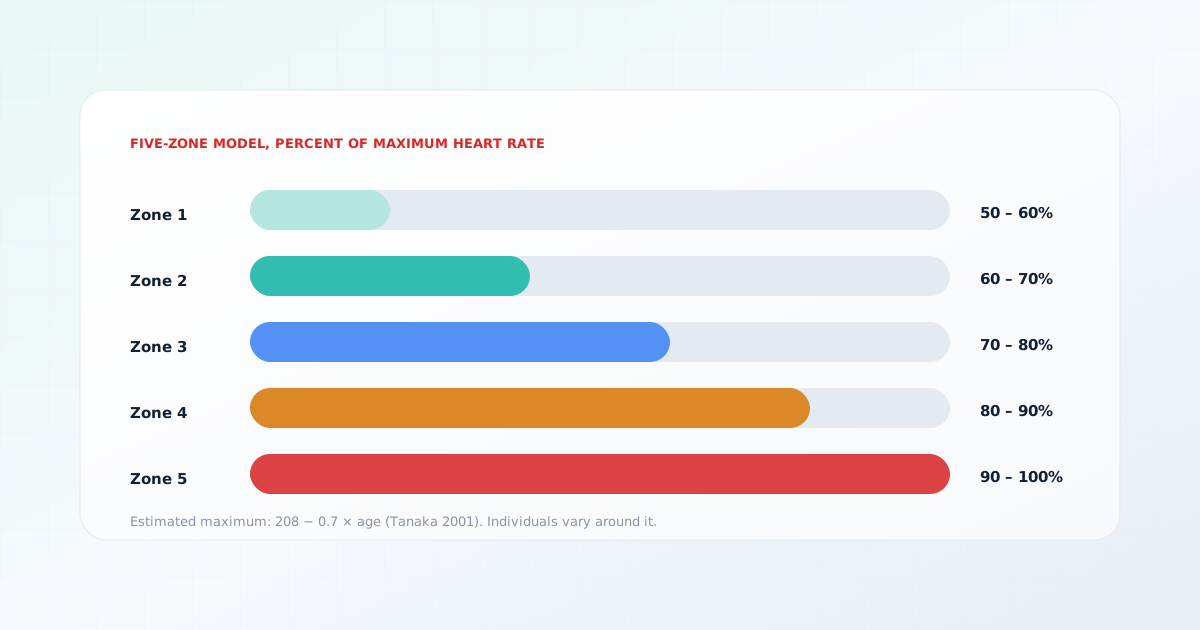
Training zones are percentages of maximum heart rate. The American Heart Association describes a target heart rate during moderate-intensity activity as roughly 50 to 70 percent of maximum, and during vigorous activity as roughly 70 to 85 percent. A common five-zone model divides the range more finely.
| Zone | Percent of maximum | How it usually feels |
|---|---|---|
| 1 | 50 to 60 percent | Very light; easy conversation |
| 2 | 60 to 70 percent | Light to moderate; can talk in full sentences |
| 3 | 70 to 80 percent | Moderate to hard; short sentences |
| 4 | 80 to 90 percent | Hard; only a few words at a time |
| 5 | 90 to 100 percent | Maximal effort; cannot sustain |
Worked example: a 40-year-old with an estimated maximum of 180 beats per minute has a moderate-intensity range of roughly 90 to 126 beats per minute (50 to 70 percent) and a vigorous range of roughly 126 to 153 (70 to 85 percent). Someone using the 220 formula gets the same answer at 40 and a different answer at other ages.
Try the calculatorWork out zones from your ageA check that needs no formula: the talk test
Because estimates carry roughly ten beats per minute of error, effort you can feel is a useful cross-check. The talk test is the simplest version. At moderate intensity you can speak in full sentences but not sing; at vigorous intensity you can manage only a few words before needing a breath.
If your calculated zone says moderate but you are gasping, trust the gasping and treat the number as an overestimate for you, or consider that heat, caffeine, illness, poor sleep or dehydration can raise heart rate at a given effort. If a calculated hard zone feels easy, your own maximum may be higher than predicted.
When percentage-of-maximum zones mislead
Several circumstances make age-based zones a poor guide, and the American Heart Association notes the most important one: medications that lower heart rate.
- Beta blockers and some other heart rate-limiting medicines reduce the heart rate you can reach, so percentage-of-maximum zones calculated from age will overshoot. People taking them are usually advised to use perceived exertion instead, and to follow their clinician’s guidance.
- Heart conditions, including some arrhythmias, can make heart rate an unreliable guide to effort.
- Pregnancy changes resting and exercise heart rate and has its own exercise guidance.
- Wrist-worn optical sensors are less accurate during high-intensity or irregular movement than a chest strap, which can mean the number on your wrist is not the number your heart produced.
- Heat, altitude, illness, dehydration and lack of sleep all raise heart rate at a given effort.
Warning signs are not a zone question
A refinement: heart rate reserve
The percentage-of-maximum method ignores how fit you are, and a more individual version uses heart rate reserve, the gap between your maximum and your resting heart rate. The target is calculated as resting heart rate plus a chosen percentage of the reserve. This is often called the Karvonen method, after the researcher who described it, and it gives a higher target for anyone whose resting rate is low.
Worked example: a 40-year-old with an estimated maximum of 180 and a resting rate of 60 has a reserve of 120. At 60 percent of reserve the target is 60 plus 72, or 132 beats per minute, while 60 percent of maximum alone would give 108. The two methods answer slightly different questions and neither is a measurement of how hard your body is actually working, which is one more reason to cross-check with the talk test.
For most people this extra step is not worth the complexity. It matters mainly for people who are very fit, whose resting rate may sit in the 40s or 50s, or for anyone who finds that percentage-of-maximum zones feel consistently too easy.
How zones relate to weekly activity targets
Zones describe the intensity of a single session, and public health guidance is expressed over a week. The American Heart Association recommends at least 150 minutes of moderate-intensity activity a week, or 75 minutes of vigorous activity, or an equivalent combination, which is why its target heart rate guidance is organized around those two intensity bands.
In practice, that means most people do not need to spend long in the hardest zones to meet the guidance. Brisk walking, cycling at a conversational pace and similar activities fall in the moderate band for many adults, and a vigorous minute counts for roughly two moderate minutes in the usual accounting. Someone new to exercise can reasonably start at the lower end of the moderate range and build up gradually.
Consistency beats precision
Resting heart rate is a separate question
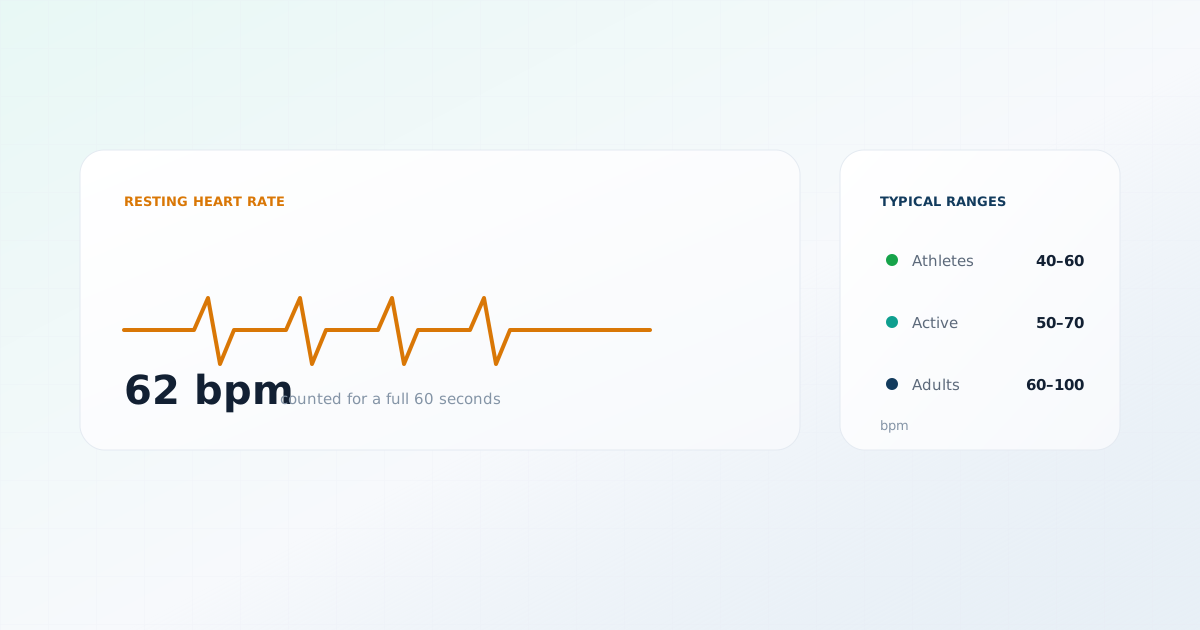
Training zones concern heart rate during effort. Resting heart rate, usually measured on waking and before getting out of bed, is a different number with its own interpretation. The American Heart Association gives a typical adult resting range of 60 to 100 beats per minute, with athletes often lower, and a resting rate that drifts upward over days can reflect illness, stress or poor recovery.
The two are related in one practical way: some training methods use heart rate reserve, the difference between maximum and resting rate, rather than a simple percentage of maximum. That is a refinement for people who track closely and not something a casual exerciser needs.
Frequently asked questions
Sources
This page is based on the following sources. Each was reviewed on the access date shown.
- Age-predicted maximal heart rate revisited(opens in a new tab)
Journal of the American College of Cardiology
Peer-reviewed articlePublished January 1, 2001Accessed September 27, 2026DOI 10.1016/s0735-1097(00)01054-8
- Target Heart Rates Chart(opens in a new tab)
American Heart Association
Professional societyAccessed September 27, 2026
- All About Heart Rate (Pulse)(opens in a new tab)
American Heart Association
Professional societyAccessed September 27, 2026