How Much Sleep Do Adults Actually Need?
Seven or more hours a night is the figure US sleep and public health bodies converge on for adults. It is a floor rather than a target, the evidence behind it is associative, and how you function during the day remains the more practical test.
The number, and who sets it
The most widely cited figure in the United States comes from a joint consensus statement published in 2015 by the American Academy of Sleep Medicine and the Sleep Research Society: adults should sleep seven or more hours per night on a regular basis to promote optimal health. That panel reviewed the published evidence on sleep duration and health outcomes and voted on the wording.
A separate panel convened by the National Sleep Foundation reached a compatible conclusion in the same year, expressed as a range rather than a floor: 7 to 9 hours for adults aged 18 to 64, and 7 to 8 hours for adults aged 65 and over. The two exercises were independent, used different methods, and landed in the same place, which is part of why the figure is quoted as confidently as it is.
| Age group | Recommended | May be appropriate |
|---|---|---|
| Teenagers (14–17) | 8 – 10 hours | 7 – 11 hours |
| Young adults (18–25) | 7 – 9 hours | 6 – 11 hours |
| Adults (26–64) | 7 – 9 hours | 6 – 10 hours |
| Older adults (65+) | 7 – 8 hours | 5 – 9 hours |
Seven is a floor, not a goal
What the evidence behind it actually is
Habitually short sleep is associated in population studies with higher rates of obesity, type 2 diabetes, high blood pressure, cardiovascular disease, stroke, depression and all-cause mortality. The Centers for Disease Control and Prevention summarizes this association in its public health guidance, and it is the basis for treating sleep as a health behavior alongside diet and physical activity.
The shape of that evidence matters for how much weight to put on it. Most of it is observational: large groups of people report how long they sleep, and researchers follow what happens to them. That design can establish a reliable association, but it does not establish that short sleep caused the outcome.
- Reverse causation is plausible in both directions. Early illness, pain, depression and sleep apnea all disturb sleep, so short sleep may sometimes be a consequence of a developing condition rather than its cause.
- Self-reported sleep duration and measured sleep duration differ, often substantially, and most of the large studies rely on what people reported — a limitation the authors generally acknowledge.
- Shift work, socioeconomic circumstances and caregiving load all affect both sleep and health, which makes them difficult to disentangle statistically.
- The association with long sleep is harder still to interpret, because regularly sleeping a great deal is itself frequently a symptom of something else.
None of this makes the recommendation unsound. It makes it what the panels themselves said it was: a population-level recommendation drawn from associative evidence, not a personal prescription with a measurable individual effect size behind it.
How much individual variation is real
Sleep need varies between people, and the recommendation bands are explicit about it — the National Sleep Foundation panel published a wider "may be appropriate" range precisely because the recommended band does not fit everyone.
The practical consequence is that the number on its own is a weak individual signal. Two people who both sleep seven hours can be in very different positions: one waking unprompted and alert, the other waking to an alarm and relying on caffeine to get through the morning. The duration is identical and the situations are not.
- Sleep debt
- The accumulated shortfall between the sleep obtained and the sleep needed. It builds across consecutive short nights and shows up as daytime sleepiness. Extra sleep on days off recovers some of it, and recovery is generally partial rather than complete.
Short sleep claims deserve skepticism
The more useful question than duration
Because the recommended range is broad and individual need varies within it, daytime function is usually a better guide than overnight duration. It is also the question a clinician will ask.
- Do you wake most mornings feeling that the sleep was sufficient, rather than cut short?
- Can you get through the day without fighting sleepiness during quiet or sedentary periods?
- Do you rely on caffeine to function rather than to enjoy it?
- On days without an alarm, do you sleep very much longer than usual — which suggests an accumulated shortfall during the week?
- Does it take you roughly 15 to 20 minutes to fall asleep, rather than either seconds or an hour?
Falling asleep the instant your head touches the pillow is sometimes described as a sign of good sleep. It is more often a sign of sleep deprivation: a well-rested person usually takes a little while.
Try the calculatorRelated: what your resting and training heart rates meanRegularity, and why the phrase matters
The AASM/SRS statement recommends seven or more hours "on a regular basis". That qualifier carries weight. A single short night is an ordinary event with mild and short-lived effects; a pattern of short nights is the thing the research is about.
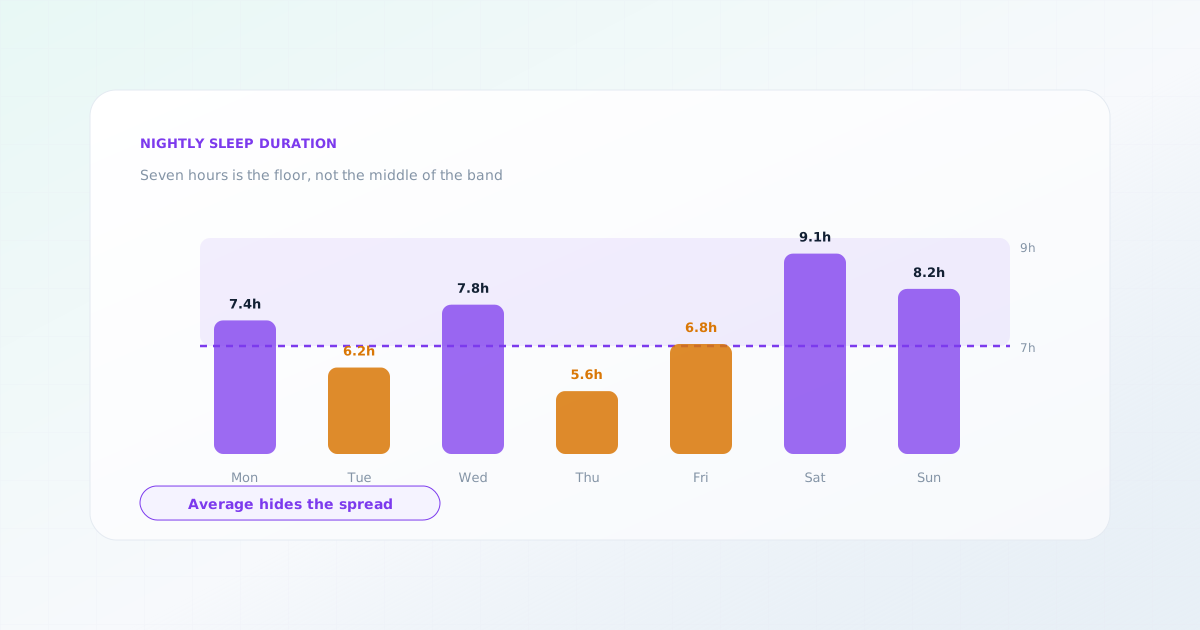
Consistency of timing is a separate matter from duration, and one that averages hide. Someone sleeping seven hours every night and someone averaging seven hours across nights of four and ten are not in the same position, even though a weekly average reports them identically. If you track sleep at all, the spread across the week is worth as much attention as the mean.
What a weekly average conceals
When sleep is worth raising with a clinician
Sleep difficulties are common, treatable, and frequently caused by something specific rather than by habits. A number of conditions present as "poor sleep" and will not respond to sleep hygiene advice because that is not what is wrong.
- Loud snoring, gasping or choking at night, or witnessed pauses in breathing — these are the characteristic features of obstructive sleep apnea, which needs a validated test rather than a wearable.
- Persistent daytime sleepiness despite adequate time in bed, particularly if it has lasted weeks.
- Difficulty falling or staying asleep on most nights for three months or more.
- Unpleasant leg sensations at rest that improve with movement, which may indicate restless legs syndrome.
- Sleep problems alongside low mood, loss of interest or anxiety, since sleep and mood disorders frequently travel together and treating one often helps the other.
Sleepiness while driving
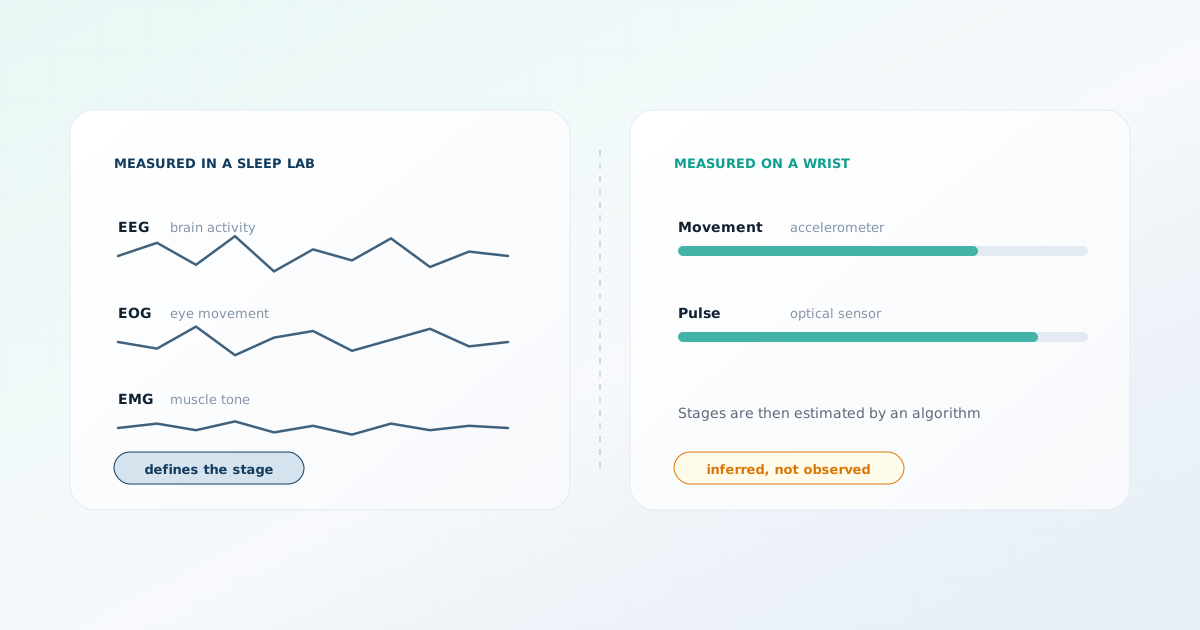
A consumer sleep tracker cannot diagnose any of these. What it can reasonably do is give you a record of your own nights to bring to the conversation, which is a genuine if modest contribution.
Frequently asked questions
Sources
This page is based on the following sources. Each was reviewed on the access date shown.
- Recommended Amount of Sleep for a Healthy Adult: A Joint Consensus Statement of the American Academy of Sleep Medicine and Sleep Research Society(opens in a new tab)
SLEEP (American Academy of Sleep Medicine / Sleep Research Society)
Clinical guidelinePublished June 1, 2015Accessed October 1, 2026DOI 10.5665/sleep.4716
- National Sleep Foundation's sleep time duration recommendations: methodology and results summary(opens in a new tab)
Sleep Health (National Sleep Foundation)
Professional societyPublished March 1, 2015Accessed October 1, 2026DOI 10.1016/j.sleh.2014.12.010
- About Sleep(opens in a new tab)
Centers for Disease Control and Prevention
Government health agencyAccessed October 1, 2026
- How Much Sleep Is Enough?(opens in a new tab)
National Heart, Lung, and Blood Institute (NIH)
Government health agencyAccessed October 1, 2026