Sleep Stages Explained: Light, Deep and REM Sleep
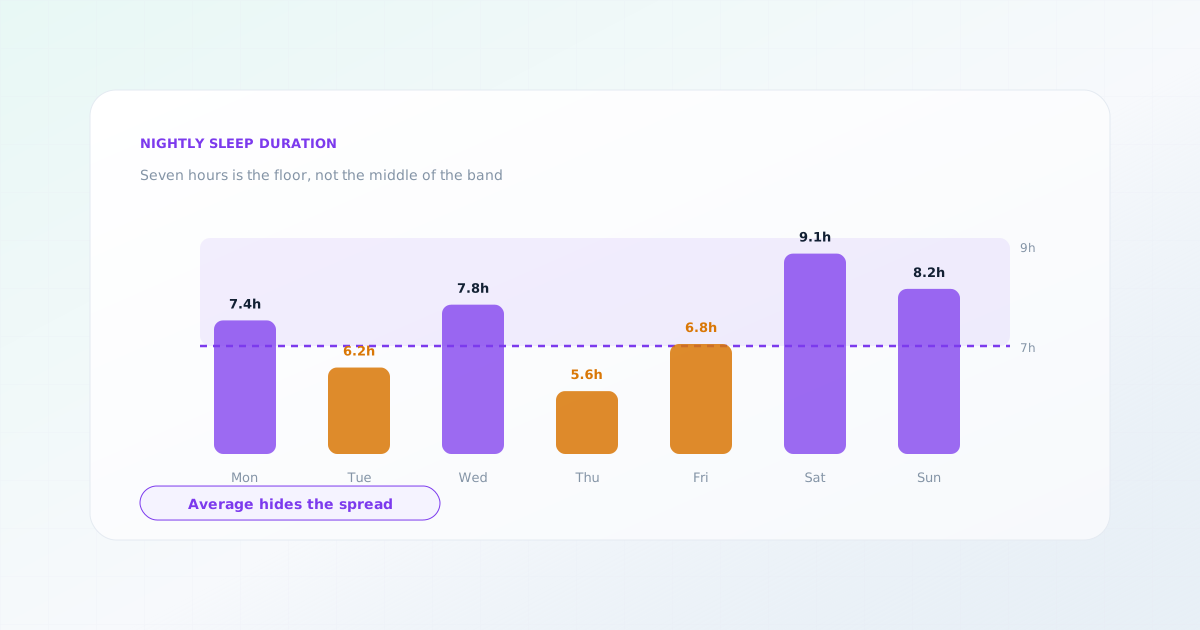
Sleep cycles through NREM stages and REM sleep, each defined by brain and muscle activity. Understanding what the stages are, and why a wrist device can only estimate them, helps you read a sleep report without over-interpreting it.
Two kinds of sleep, defined by what the brain is doing
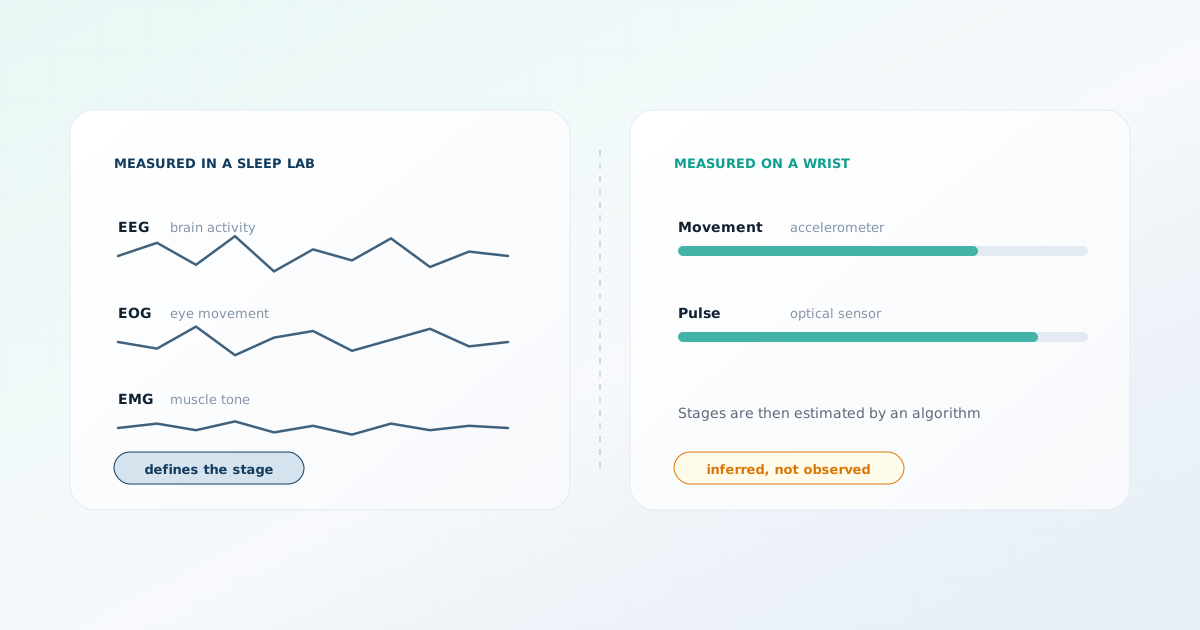
Sleep is not a uniform state. The National Heart, Lung, and Blood Institute describes two main types: non-rapid eye movement (NREM) sleep, which is subdivided into stages, and rapid eye movement (REM) sleep. The classification is based on what is happening in the brain and muscles, measured by electrodes in a sleep laboratory, a test called polysomnography.
That definition matters because it explains why consumer devices cannot see sleep stages directly. A wrist device does not record brain waves. It measures movement and, in many models, heart rate and its variation, and uses an algorithm to infer which stage is likely. That is a reasonable thing to try and an imperfect one, which is the subject of the final section.
- Polysomnography
- An overnight sleep study that records brain activity, eye movements, muscle tone, heart rhythm, breathing and oxygen levels. It is the reference method against which consumer devices are compared.
The NREM stages
In the current clinical scoring system, NREM sleep has three stages, numbered N1, N2 and N3. They run from the lightest transition into sleep to the deepest.
| Stage | Common name | What happens |
|---|---|---|
| N1 | Light sleep | A transition between being awake and being asleep. |
| N2 | Light sleep | The point at which a person is asleep, in the Institute’s description. |
| N3 | Deep or slow-wave sleep | Named for a specific slow pattern of brain activity. People spend more time in this stage early in the night. |
REM sleep
REM sleep is the stage in which most vivid dreaming occurs. The brain is highly active, resembling wakefulness on a recording, the eyes move rapidly beneath the lids, and the body’s voluntary muscles are largely switched off, which prevents people from acting out their dreams. Breathing and heart rate become more variable.
How the stages fit together across a night
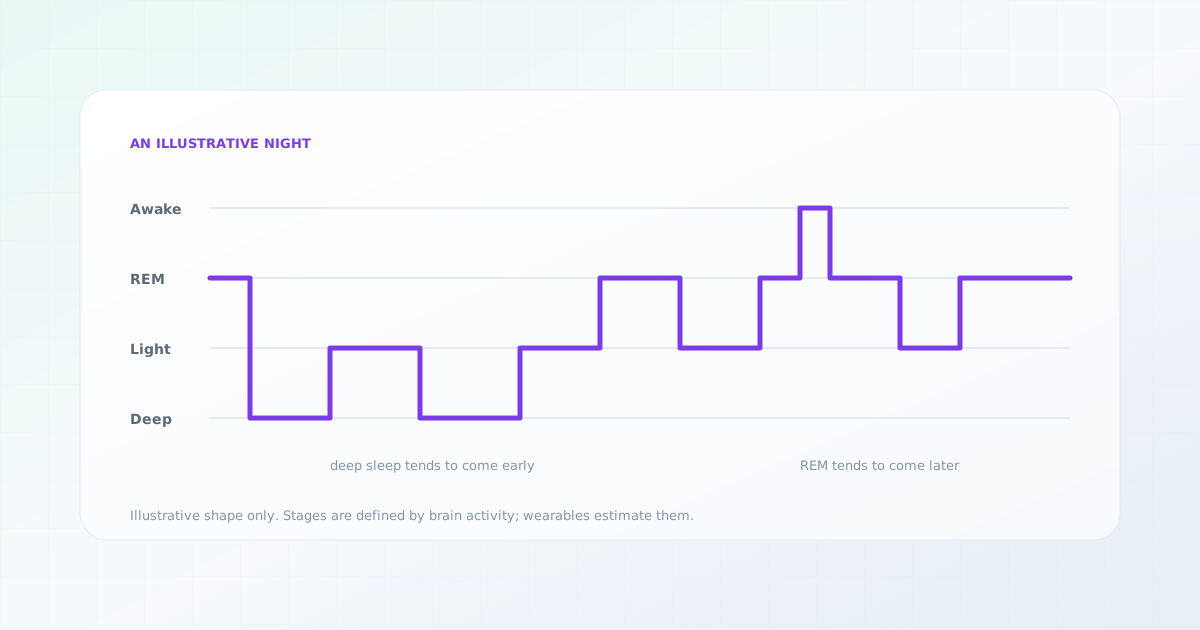
A night of sleep is a series of cycles, each moving from light NREM sleep through deeper stages and into REM sleep before the pattern repeats. The National Heart, Lung, and Blood Institute describes a cycle as starting over every 80 to 100 minutes, which gives four to six cycles on most nights, and cycle length varies between people and across the night.
The composition of the cycles changes as the night progresses. Deep slow-wave sleep is concentrated in the first half of the night, and REM periods become longer toward morning. That is why cutting a night short by an hour or two at the end tends to remove a disproportionate share of REM sleep, and why going to bed very late can shorten deep sleep less than people expect.
Waking during the night is normal
How to read a stage chart without over-reading it
A sleep report usually shows a chart of stages across the night, sometimes called a hypnogram, along with a percentage for each stage. Two things are worth keeping in mind. First, the National Heart, Lung, and Blood Institute notes that most nights include four to six cycles and that deep sleep tends to come earlier in the night while REM tends to come later, so the shape of the chart is expected to be lopsided and is not a sign that something is wrong.
Second, a consumer device is estimating the stages rather than measuring them. A single night’s chart therefore combines the device’s estimation error with ordinary night-to-night variation, which is why a pattern across several weeks says more than any one morning’s report. There is no clinical guideline that gives a target percentage for each stage, so a published "ideal" split on an app or website is a convention and not a standard.
Be wary of stage targets
When the stages are not the point
Understanding stages is useful background, but it is not a route to diagnosing a sleep problem. The symptoms that warrant medical attention are things a person notices rather than things a chart reveals.
- Loud snoring with gasping, choking or pauses in breathing noticed by a partner, which are characteristic of obstructive sleep apnea and need a validated test.
- Persistent daytime sleepiness despite spending enough hours in bed.
- Acting out dreams, shouting or moving violently during sleep, which can indicate a REM sleep behavior disorder and should be assessed by a clinician.
- Difficulty falling or staying asleep on most nights for three months or longer.
- Unrefreshing sleep alongside low mood or anxiety, since sleep and mood problems often travel together.
If any of these apply, the stage breakdown from a wearable is at most a supporting detail to bring to the appointment. The position statement from the American Academy of Sleep Medicine is explicit that such devices are not a substitute for medical evaluation.
What a wearable can and cannot tell you
Consumer sleep trackers are reasonably good at one thing: telling when you were probably asleep and when you were awake, and so estimating total sleep time. Their stage breakdowns are weaker, because the stage is inferred from signals that only loosely follow it.
The American Academy of Sleep Medicine published a position statement on consumer sleep technology in 2018 that makes two points worth keeping together. The devices are not cleared to diagnose sleep disorders and are not a substitute for medical evaluation, and the data they produce can nonetheless be useful in a conversation with a clinician as a record of patterns over time.
- Look at trends over weeks rather than a single night, since night-to-night stage percentages vary a great deal.
- Treat the stage split as a rough indicator and total sleep time and regularity as the more dependable parts of a report.
- A low "deep sleep" figure is not a diagnosis, and a high "sleep score" does not certify that sleep is healthy.
- Loud snoring, witnessed pauses in breathing or severe daytime sleepiness need a medical assessment, not a better tracker.
The risk of chasing the numbers
Researchers writing in the Journal of Clinical Sleep Medicine in 2017 described a pattern they called orthosomnia: people whose sleep worsened while they pursued the numbers their tracker reported, becoming anxious about scores and spending more time in bed to improve them. The case series was small and descriptive, but the observation is widely recognized by sleep clinicians.
If a tracker is making you anxious about sleep, the practical response is to stop checking it, or to look at it weekly rather than every morning. How you feel and function during the day is a better guide than any stage percentage, and it is the question a clinician will ask.
Try the calculatorRelated: heart rate measurements and what they meanFrequently asked questions
Sources
This page is based on the following sources. Each was reviewed on the access date shown.
- Sleep Phases and Stages(opens in a new tab)
National Heart, Lung, and Blood Institute (NIH)
Government health agencyAccessed October 1, 2026
- Consumer Sleep Technology: An American Academy of Sleep Medicine Position Statement(opens in a new tab)
Journal of Clinical Sleep Medicine (American Academy of Sleep Medicine)
Professional societyPublished May 15, 2018Accessed October 1, 2026DOI 10.5664/jcsm.7128
- Orthosomnia: Are Some Patients Taking the Quest for Perfect Sleep Too Far?(opens in a new tab)
Journal of Clinical Sleep Medicine (American Academy of Sleep Medicine)
Peer-reviewed articlePublished February 15, 2017Accessed October 1, 2026DOI 10.5664/jcsm.6472
- About Sleep(opens in a new tab)
Centers for Disease Control and Prevention
Government health agencyAccessed October 1, 2026