LDL, HDL, Triglycerides and Total Cholesterol Explained
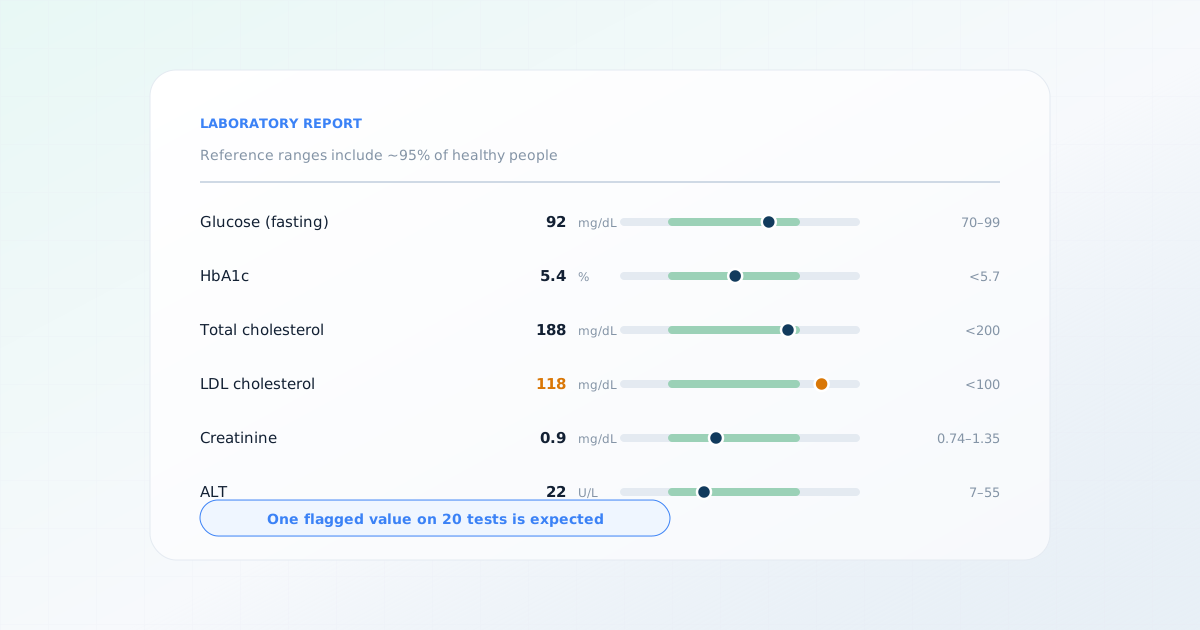
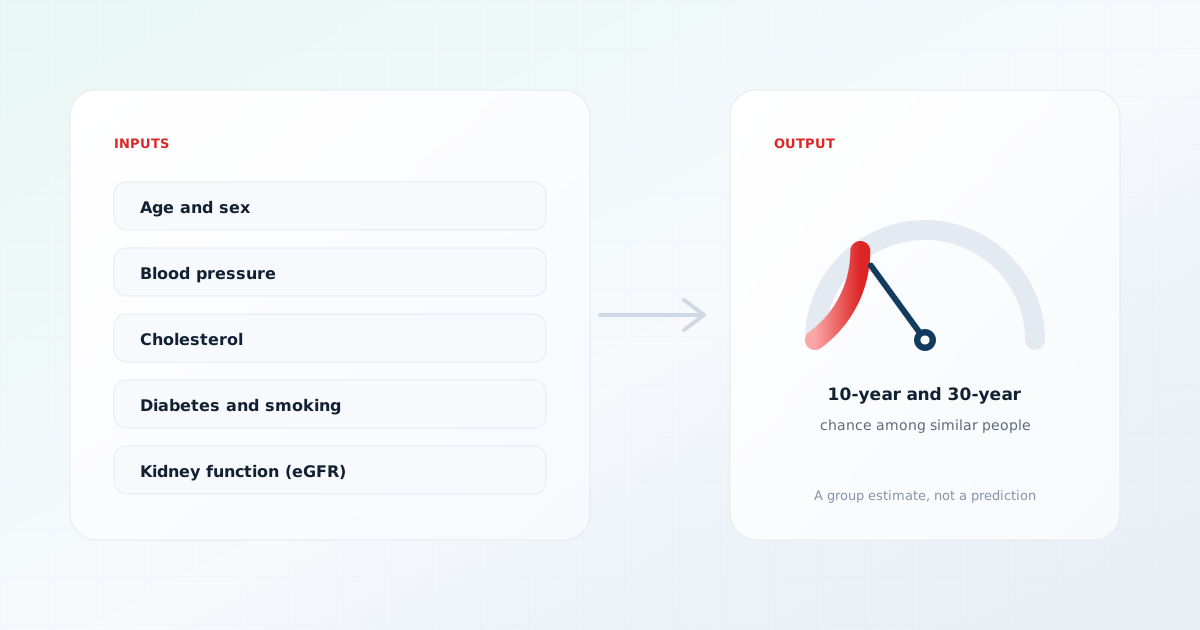
Cholesterol travels in the blood inside particles. LDL carries it toward artery walls, HDL carries it away, and triglycerides are a separate fat in their own particles. The 2026 ACC/AHA guideline brought back numeric LDL and non-HDL goals, so what counts as high now depends on your risk tier.
Why cholesterol travels in particles
Cholesterol is a fat. Blood is mostly water. Fats do not dissolve in water, which creates a transport problem: the body needs cholesterol in every cell membrane, and in the production of vitamin D, bile acids and several hormones, but it cannot simply dissolve it and let it circulate.
The solution is packaging. Cholesterol is carried inside spherical particles called lipoproteins, which have a water-friendly protein and phospholipid shell around a fat-filled core. The names on a lipid panel — LDL, HDL, VLDL — are these particles, classified by their density.
The most useful thing to understand about a lipid panel
What counts as high: the 2026 goals
For most of the last decade, US cholesterol guidance avoided giving anyone a number to hit. The 2018 guideline worked in percentage reductions — lower LDL by 30%, or by 50% — which is a sound way to prescribe and a frustrating way to read your own lab report.
That changed in March 2026. The ACC, the AHA and nine other societies published a new dyslipidemia guideline replacing the 2018 edition, and it brought numeric goals back. The goals are not one chart for everyone: they depend on which risk tier you fall into.
| Situation | LDL-C goal | Non-HDL-C goal |
|---|---|---|
| Primary prevention, PREVENT 10-year risk under 10% | Below 100 mg/dL | Below 130 mg/dL |
| Primary prevention, PREVENT 10-year risk 10% or above | Below 70 mg/dL | Below 100 mg/dL |
| Established cardiovascular disease | Below 70 mg/dL | Below 100 mg/dL |
| Established cardiovascular disease, very high risk | Below 55 mg/dL | Below 85 mg/dL |
- PREVENT risk tiers
- The 2026 guideline sorts primary prevention by estimated 10-year cardiovascular risk from the American Heart Association’s PREVENT model: low is under 3%, borderline 3% to under 5%, intermediate 5% to under 10%, and high 10% or more. PREVENT replaced the older Pooled Cohort Equations and is used for adults aged 30 to 79.
Why the table does not tell you your goal
The guideline also moved screening earlier, on the reasoning that what damages arteries is cumulative exposure over decades rather than a level reached at 50. A lipid panel is now recommended for all children aged 9 to 11, from age 2 where there is a family history of premature cardiovascular disease or familial hypercholesterolemia, and at least every five years in adults from age 19.
LDL — low-density lipoprotein
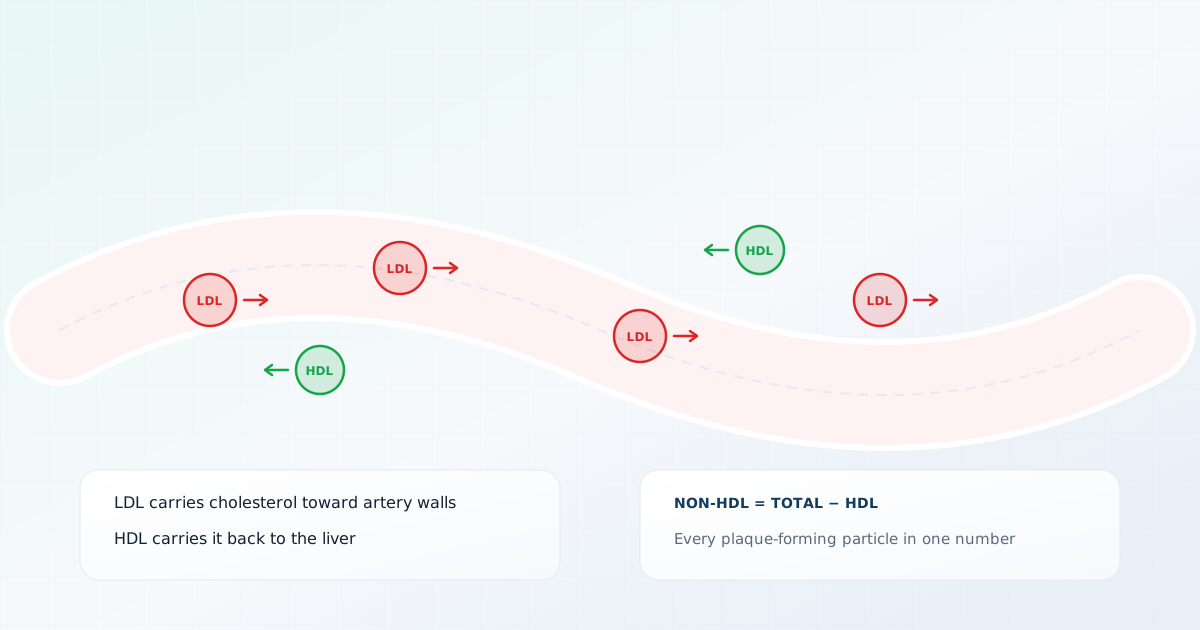
LDL particles carry cholesterol from the liver out to the tissues that need it. This is a necessary job. The problem arises when LDL particles are numerous enough, and remain in circulation long enough, to penetrate the inner lining of an artery wall.
Once inside the wall, the cholesterol they carry can be retained, become oxidized, and provoke an inflammatory response. Immune cells arrive, engulf the modified particles, and accumulate as foam cells. Over years this builds an atherosclerotic plaque — the process that narrows arteries and, if a plaque ruptures, causes heart attacks and many strokes.
This mechanism is why LDL is the primary target in cholesterol guidelines: lowering LDL has been shown across many large randomized trials to reduce cardiovascular events, and the relationship holds consistently across different ways of achieving the reduction.
| Range | mg/dL | mmol/L |
|---|---|---|
| Optimal | Below 100 | Below 2.6 |
| Near optimal | 100 – 129 | 2.6 – 3.3 |
| Borderline high | 130 – 159 | 3.4 – 4.1 |
| High | 160 – 189 | 4.1 – 4.9 |
| Very high | 190 and above | 4.9 and above |
One nuance worth knowing: most laboratories do not measure LDL directly. They calculate it from the other values on the panel, and different equations give different answers from the same sample.
Try the calculatorCalculate LDL with NIH Equation 2 or FriedewaldHDL — high-density lipoprotein
HDL particles work in the opposite direction. They collect excess cholesterol from tissues — including from developing plaques in artery walls — and transport it back to the liver for disposal, a process called reverse cholesterol transport.
This is why higher HDL has long been associated with lower cardiovascular risk in observational studies. But the story turned out to be more complicated, and this is one of the more instructive reversals in cardiovascular medicine.
Why "higher HDL is better" no longer holds as stated
| Level | mg/dL | mmol/L |
|---|---|---|
| Lower than desirable (men) | Below 40 | Below 1.0 |
| Lower than desirable (women) | Below 50 | Below 1.3 |
| Generally favorable | 60 and above | 1.5 and above |
Triglycerides — a different molecule
Triglycerides are frequently lumped in with cholesterol, but they are chemically distinct: three fatty acids attached to a glycerol backbone. They are the main form in which the body stores and transports energy from fat, and they are what body fat largely consists of.
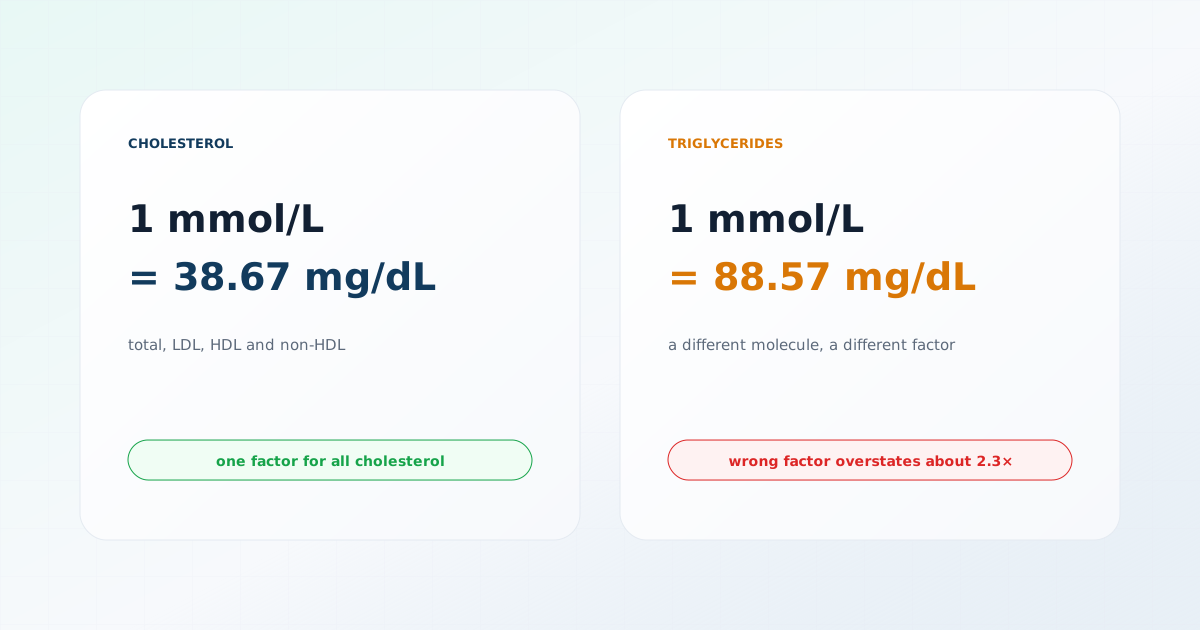
The distinction matters practically as well as chemically. Because triglycerides are a different molecule with a different molar mass, converting them between mg/dL and mmol/L uses a different factor from cholesterol — 88.57 rather than 38.67. Applying one factor to both is a real and easy error, and it is the reason a converter is worth using on a report from outside the US rather than reaching for a single multiplier.
Try the calculatorConvert a lipid panel between mg/dL and mmol/L| Range | mg/dL | mmol/L |
|---|---|---|
| Normal | Below 150 | Below 1.7 |
| Borderline high | 150 – 199 | 1.7 – 2.2 |
| High | 200 – 499 | 2.3 – 5.6 |
| Very high | 500 and above | 5.6 and above |
Raised triglycerides are associated with cardiovascular risk, though the relationship appears to work largely through the cholesterol carried in triglyceride-rich particles rather than the triglycerides themselves. They are also strongly linked to insulin resistance, alcohol intake, obesity and poorly controlled diabetes — which makes them a useful metabolic signal as well as a lipid measurement. Very high levels carry a separate risk of pancreatitis.
Total cholesterol — and its problem
Total cholesterol is the sum of the cholesterol carried in all your lipoprotein particles: LDL, HDL, VLDL and the rest. It was the first cholesterol measurement widely available, which is why it remains familiar.
Its weakness follows directly from being a sum. It adds together fractions that behave in opposite ways, so the same total can mean quite different things.
| Measurement | Person A | Person B |
|---|---|---|
| Total cholesterol | 240 mg/dL | 240 mg/dL |
| HDL | 85 mg/dL | 35 mg/dL |
| LDL | 135 mg/dL | 175 mg/dL |
| Non-HDL | 155 mg/dL | 205 mg/dL |
| Total/HDL ratio | 2.8 | 6.9 |
This is also why a raised total cholesterol on its own tells a clinician relatively little, and why a full panel reporting the fractions has become standard.
Non-HDL cholesterol and ratios
Non-HDL cholesterol is total cholesterol minus HDL. What remains is the cholesterol in every particle associated with plaque formation — LDL plus the cholesterol carried in triglyceride-rich remnant particles, which LDL alone misses.
Non-HDL has two practical advantages. It captures more of the atherogenic burden than LDL alone, and because it does not involve the triglyceride-dependent equations used to calculate LDL, it does not require a fasting sample. The 2026 ACC/AHA guideline gives it a goal of its own at every risk tier — below 130, below 100 or below 85 mg/dL — which is a promotion from the secondary-target role it had under the 2018 edition.
- Remnant cholesterol
- Non-HDL minus LDL — the cholesterol carried in triglyceride-rich lipoprotein remnants. Increasingly recognized as contributing to cardiovascular risk independently of LDL.
The total-to-HDL ratio is easy to calculate and widely quoted, but it is not a target in current major guidelines. Because it compresses two numbers into one, it can look reassuring when a high HDL offsets a raised LDL — and the underlying LDL still matters. It is better read alongside the individual fractions than instead of them.
Try the calculatorWork out non-HDL cholesterol from a panel you already haveTwo numbers the 2026 guideline added: Lp(a) and ApoB
A standard lipid panel reports four things. The 2026 guideline asks for two more, and neither is on most people’s results.
- Lipoprotein(a), written Lp(a)
- An LDL-like particle with an extra protein attached. The level you have is set largely by genetics, stays close to constant through adult life, and barely moves with diet or exercise. The 2026 guideline recommends that every adult have it measured at least once; because it does not change, once is usually enough.
That stability is the point. An Lp(a) at or above 50 mg/dL is associated with roughly a 1.4-fold increase in cardiovascular risk, and it is invisible on a standard panel — someone can have an unremarkable LDL and still carry an inherited risk nobody has looked for. It is also the one lipid number where a single lifetime measurement is genuinely useful, which is unusual enough to be worth asking about.
- Apolipoprotein B, written ApoB
- One ApoB molecule sits on each plaque-forming particle, so measuring ApoB counts particles rather than the cholesterol inside them. The 2026 guideline positions it selectively rather than universally: it is used to assess the risk that remains after LDL-C and non-HDL-C goals have already been met, particularly in type 2 diabetes, raised triglycerides, cardiovascular-kidney-metabolic syndrome or established cardiovascular disease.
Why particle count can disagree with cholesterol content
Neither number is calculated from the others, so neither can be worked out from a panel you already have. Both are laboratory measurements, and this site has no calculator for either — which is itself the useful information.
Why cholesterol is interpreted in context
The most common misunderstanding about a lipid panel is that a number above a range automatically means treatment. Current guidelines do not work that way. The 2026 guideline assesses overall cardiovascular risk first, then sets a goal from the tier that risk falls into — so the same LDL value leads to different conversations for different people.
- A 35-year-old non-smoker with normal blood pressure and no family history, with an LDL of 145 mg/dL, is in a very different position from a 68-year-old with diabetes, hypertension and the same LDL.
- Someone with established cardiovascular disease is given a goal far below the general ranges — below 70 mg/dL under the 2026 guideline, and below 55 where risk is very high.
- Familial hypercholesterolemia, a genetic condition affecting roughly 1 in 250 people, produces high LDL from birth and is managed differently from LDL raised by other causes.
- Kidney function, thyroid function and inflammatory conditions all affect lipid interpretation.
Lipid values also move for reasons unrelated to any long-term change. Recent illness or infection can lower cholesterol temporarily. Pregnancy raises it substantially. An underactive thyroid raises it. Alcohol raises triglycerides. Significant weight change moves everything. A single panel is a snapshot, and a trend across several is more informative.
On medication decisions
Frequently asked questions
Sources
This page is based on the following sources. Each was reviewed on the access date shown.
- 2026 ACC/AHA/Multisociety Guideline on the Management of Dyslipidemia(opens in a new tab)
Journal of the American College of Cardiology
Clinical guidelinePublished March 13, 2026Accessed October 1, 2026DOI 10.1016/j.jacc.2025.11.016
- Development and Validation of the American Heart Association PREVENT Equations(opens in a new tab)
Circulation (American Heart Association)
Peer-reviewed articleAccessed October 1, 2026DOI 10.1161/CIRCULATIONAHA.123.067626
- 2018 AHA/ACC Guideline on the Management of Blood Cholesterol(opens in a new tab)
Circulation (American Heart Association)
Clinical guidelinePublished June 18, 2019Accessed September 27, 2026DOI 10.1161/CIR.0000000000000625
- Blood Cholesterol(opens in a new tab)
National Heart, Lung, and Blood Institute (NIH)
Government health agencyAccessed September 27, 2026
- 2019 ESC/EAS Guidelines for the management of dyslipidemias(opens in a new tab)
European Heart Journal (European Society of Cardiology)
Clinical guidelinePublished January 1, 2020Accessed September 27, 2026DOI 10.1093/eurheartj/ehz455
- A New Equation for Calculation of Low-Density Lipoprotein Cholesterol in Patients With Normolipidemia and/or Hypertriglyceridemia(opens in a new tab)
JAMA Cardiology
Peer-reviewed articlePublished May 1, 2020Accessed September 27, 2026DOI 10.1001/jamacardio.2020.0013