How Much Protein Do Adults Need? Three Different Answers
The US Recommended Dietary Allowance is 0.8 grams per kilogram a day, but the figure is a minimum for avoiding deficiency, and position statements for older adults and people who train suggest higher ranges. Here is how the three fit together.
The baseline: 0.8 grams per kilogram
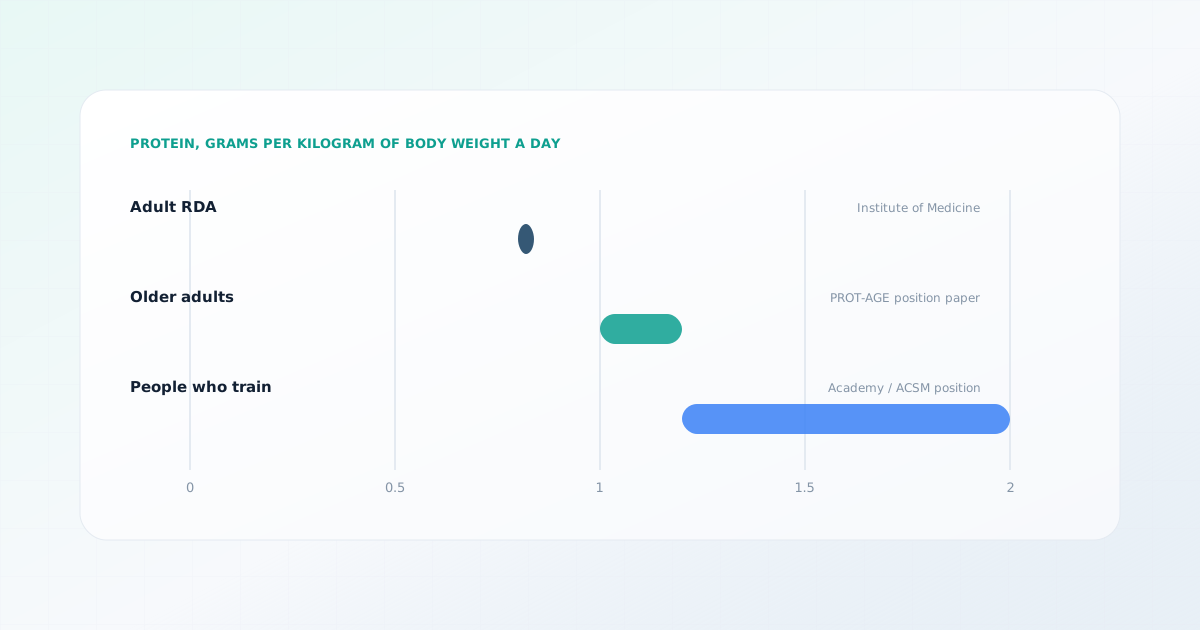
The figure behind most protein advice in the United States is the Recommended Dietary Allowance of 0.8 grams of protein per kilogram of body weight per day for adults, set by the Institute of Medicine in its 2005 Dietary Reference Intakes for macronutrients. For someone weighing 70 kilograms (about 154 pounds), that works out to 56 grams a day.
The way that number is defined matters for reading it correctly. A Recommended Dietary Allowance is set to cover the needs of nearly all healthy people in a group, which means it sits above the average requirement by design. It is a threshold for avoiding deficiency in a healthy adult, and it was never intended to describe the intake at which muscle, strength or recovery is maximized.
- Recommended Dietary Allowance (RDA)
- The average daily intake that is sufficient to meet the nutrient requirement of nearly all (97 to 98 percent) healthy individuals in a particular life stage and sex group.
The same Institute of Medicine report also set an Acceptable Macronutrient Distribution Range for protein of 10 to 35 percent of total calories. This range describes the share of an eating pattern, not a requirement. Someone eating 2,000 calories a day at 10 percent protein would take in about 50 grams, while someone at 35 percent would take in about 175 grams. The width of the band reflects that no single point is known to be correct for everyone.
How the per-kilogram calculation works
Protein targets are expressed per kilogram of body weight because needs scale with body size, particularly with lean tissue. The arithmetic is simple: convert your weight to kilograms by dividing pounds by 2.2, then multiply by the grams per kilogram that apply.
| Grams per kilogram | Daily protein | Context |
|---|---|---|
| 0.8 | 56 g | General adult RDA |
| 1.0 to 1.2 | 70 to 84 g | Range in the PROT-AGE position paper for healthy older adults |
| 1.2 to 2.0 | 84 to 140 g | Range for people who train regularly |
The weight used in the calculation raises a genuine question for people with a high body weight, since lean mass rather than total mass drives protein requirements. Guidelines are written for body weight in the typical range, and for people well outside it a clinician or registered dietitian can say whether to use current weight, a healthy-weight reference, or something else.
Why older adults are given a higher range
The PROT-AGE Study Group, an international group of researchers in geriatrics and nutrition, published a position paper in 2013 on protein intake in older people. It concluded that healthy adults aged 65 and over should consume an average of 1.0 to 1.2 grams per kilogram of body weight per day, and more for those who are physically active or who have acute or chronic illness, with exceptions for severe kidney disease.
The reasoning is that older muscle responds less efficiently to a given amount of protein, a phenomenon sometimes called anabolic resistance, and that loss of muscle and strength with age carries real consequences for mobility and independence. A higher intake is one input to counter that, alongside resistance exercise, which the same literature treats as at least as important.
A position paper is not a guideline
People who train regularly
The joint position statement of the Academy of Nutrition and Dietetics, Dietitians of Canada and the American College of Sports Medicine on nutrition and athletic performance recommends a protein intake of 1.2 to 2.0 grams per kilogram of body weight per day for athletes, depending on the type and intensity of training and on total energy intake.
Two details of that statement are easy to miss when it is shortened to a headline. First, the range is wide for a reason: endurance and strength training have different demands, and someone in an energy deficit may need more to preserve lean mass. Second, the statement emphasizes that total energy intake matters and that spreading protein across meals, rather than concentrating it in one, is a reasonable approach.
Training a few times a week at a recreational level does not automatically place someone at the top of that range. Most people who exercise moderately are comfortably covered by the lower end, and many already eat above it without trying.
What these amounts look like on a plate
Grams of protein are not grams of food. A chicken breast, a cup of cooked lentils, an egg, a serving of yogurt and a slice of bread all contain different amounts, and food labels list protein per serving. As a rough orientation, many people reach the general RDA with modest portions of animal or plant protein spread across the day.
- Animal foods such as eggs, dairy, fish, poultry and meat are common protein sources.
- Beans, lentils, tofu, tempeh, nuts and seeds are common protein sources in plant-based eating patterns.
- Grains and vegetables contribute smaller but meaningful amounts that add up over a day.
- Protein powders and bars are convenient but not required, and their protein content and ingredient quality vary widely between products.
The Dietary Guidelines for Americans, 2025 to 2030, the current federal edition, is the best starting point for what a full eating pattern looks like. Protein is one part of a pattern that also includes vegetables, fruit, whole grains, dairy or alternatives, and limits on added sugars and sodium.
Try the calculatorSee how the three ranges apply to your weightA worked example: spreading 84 grams across a day
To make the arithmetic concrete, take a 70 kilogram adult aiming for 1.2 grams per kilogram, which is 84 grams a day. Divided across three meals and one snack, that is about 21 grams each. Rather than quote protein values for particular foods, which vary by product and preparation, it is better to read the label of what you actually eat or look foods up in the USDA FoodData Central database, and then add up the day.
| Step | Calculation | Result |
|---|---|---|
| Choose a per-kilogram value | 1.2 g/kg | — |
| Multiply by body weight | 1.2 × 70 kg | 84 g a day |
| Spread across four eating occasions | 84 ÷ 4 | About 21 g each |
Any such target is an approximation and not a substitute for individual advice, since needs vary with age, health and activity. A plant-based pattern can also meet a protein target, and a registered dietitian can help with planning for vegetarian and vegan diets, particularly for people with higher needs such as older adults or those who train.
When a higher number is the wrong number
For a healthy adult with normal kidney function, an intake above the RDA is generally considered well tolerated within the ranges discussed here. The same is not true for everyone, and a general range should not override individual medical advice.
Kidney disease changes the advice
Pregnancy, breastfeeding, recovery from surgery or serious illness, and some metabolic conditions also change protein needs. Children and adolescents have requirements that differ from adult values and are not covered by the figures in this article.
The sensible summary is to treat 0.8 grams per kilogram as the floor for a healthy adult, to recognize that older adults and people who train are given higher ranges by their respective expert groups, and to leave individual targets, especially in illness, to a clinician or dietitian.
Frequently asked questions
Sources
This page is based on the following sources. Each was reviewed on the access date shown.
- Dietary Reference Intakes for Energy, Carbohydrate, Fiber, Fat, Fatty Acids, Cholesterol, Protein, and Amino Acids(opens in a new tab)
Institute of Medicine, Food and Nutrition Board
Reference workPublished January 1, 2005Accessed September 27, 2026
- Evidence-based recommendations for optimal dietary protein intake in older people: a position paper from the PROT-AGE Study Group(opens in a new tab)
Journal of the American Medical Directors Association
Professional societyPublished August 1, 2013Accessed September 27, 2026DOI 10.1016/j.jamda.2013.05.021
- Position of the Academy of Nutrition and Dietetics, Dietitians of Canada, and the American College of Sports Medicine: Nutrition and Athletic Performance(opens in a new tab)
Journal of the Academy of Nutrition and Dietetics
Professional societyPublished March 1, 2016Accessed September 27, 2026
- Dietary Guidelines for Americans, 2025-2030(opens in a new tab)
US Department of Agriculture and US Department of Health and Human Services
Clinical guidelinePublished January 7, 2026Accessed October 1, 2026