How to Judge an Online Health Calculator: A Checklist for Readers and Clinics
A health calculator is only as trustworthy as its equation, its limits and what it does with your data. This checklist shows how to tell a transparent tool from a risky one, with real examples of common errors.
Why it is worth checking a calculator at all
Health calculators look authoritative. They have a form, a button and a result with several decimal places, and that precision invites trust. Behind the form is an equation that someone chose, implemented and may have implemented wrongly, and nothing in the appearance of the page tells you whether any of that was done carefully.
The stakes vary. A calorie estimate that is off by a few hundred calories is a nuisance. A kidney function estimate that uses the wrong equation, or a drug-related figure that applies the wrong weight, can mislead someone who is making a real decision. People in small clinics, community health settings and administrative roles also use online calculators because they are quick, and for them the question of whether to trust one is practical.
This checklist is written so that a careful reader can apply it in a few minutes. It uses examples from equations that have well-documented quirks, because those are the places where tools most often go wrong.
1. Does it name the equation and cite where it came from?
The first test is whether the page tells you which equation it uses. "Our proprietary algorithm" is not an answer. A transparent tool names the method, such as Mosteller, Cockcroft-Gault or the Friedewald equation, and points to the publication or standard behind it.
The reason is that many health quantities have several competing equations that give different answers. The four ideal body weight equations typically differ by around five kilograms at the same height. The creatinine clearance calculated with Cockcroft-Gault and the eGFR from the CKD-EPI 2021 equation are different quantities in different units and routinely disagree. A body surface area figure depends on which of four published formulas is used, and the spread grows at higher body weight. A calculator that does not say which equation it used cannot be checked against anything.
- Look for the equation name and the year, and whether a paper or guideline is cited.
- Prefer sources from government health agencies, professional societies and peer-reviewed publications.
- Be wary of pages that cite only other calculator websites, since errors propagate that way.
2. Can you check the arithmetic yourself?
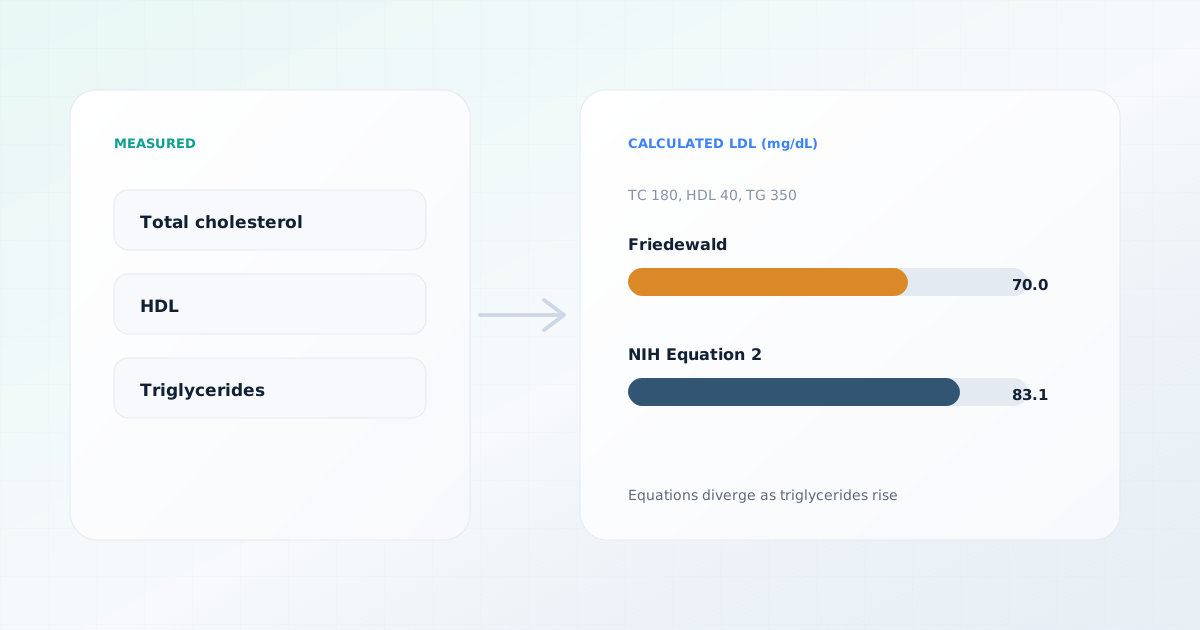
A good tool shows the formula, and you can test it with a pocket calculator. The Mosteller body surface area equation is the square root of height in centimeters times weight in kilograms divided by 3600. The Friedewald LDL equation is total cholesterol minus HDL minus triglycerides divided by five. If you can reproduce a result by hand, you have verified the implementation and not merely trusted it.
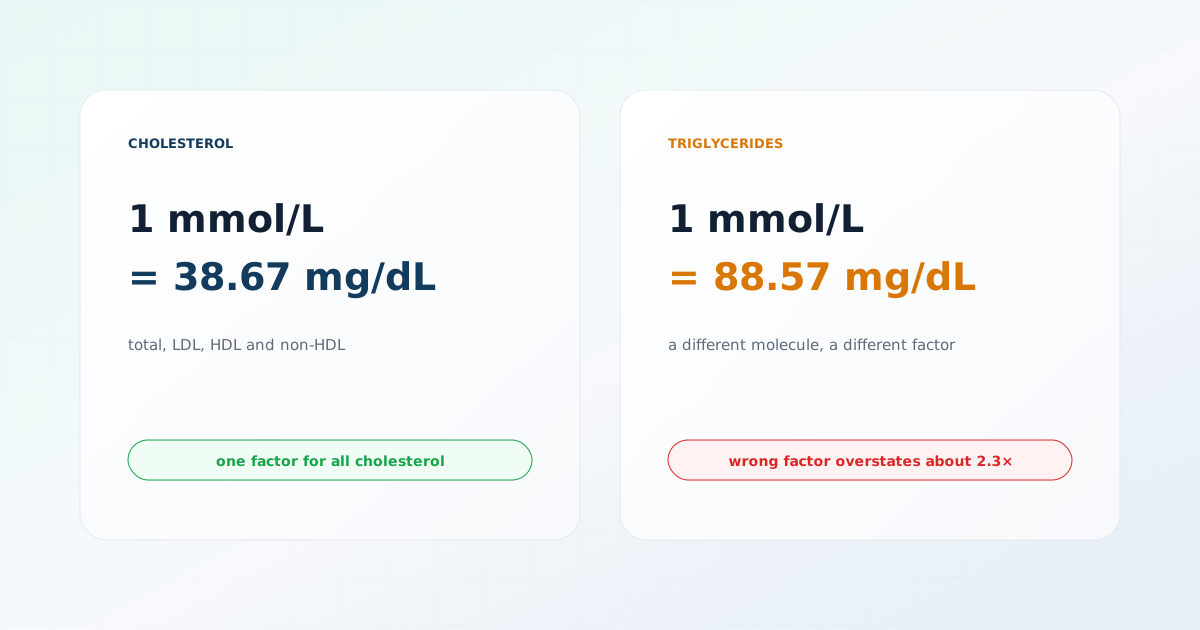
Unit handling is the most common implementation error, and it is worth testing directly. Cholesterol converts between mg/dL and mmol/L with a factor of 38.67, and triglycerides with 88.57, because they are different molecules. Using the cholesterol factor on triglycerides overstates the value by a factor of about 2.3, and the mistake appears in hand conversions and in more than a few online converters. Try a value you know, such as 1.7 mmol/L of triglycerides, which should come out as about 150.6 mg/dL.
Run a test case before trusting a tool
3. Does it say what it cannot do?
Every health equation was built in a particular population, for a particular purpose, and breaks down outside them. A trustworthy tool says so. Look for a section on limitations that is specific and not boilerplate.
- Who it was developed in. The Navy body fat equations were fitted on US military personnel and are less accurate in older adults and at higher body weights.
- What it assumes. The Friedewald equation needs a fasting sample and is not valid at triglycerides of 400 mg/dL or above, and a good calculator refuses to return a number past that limit.
- Who it should not be used for. Many equations are not validated in pregnancy, in children, or after limb amputation.
- What its output means. A result in mL/min is not the same as one in mL/min/1.73 m², and they cannot be read against each other’s categories.
A tool that presents a single number with no caveats is either simplifying to the point of misleading or does not know the limits of its own equation. Neither is reassuring.
4. Does it avoid diagnosing and prescribing?
A calculator can say that a value falls in a published category. It cannot say whether a person has a condition, whether their health is fine, or what to do about a medicine. A tool that announces a diagnosis in plain words, or that issues instructions about taking a medicine, has stepped beyond what its method can support.
- Language such as "may", "is commonly interpreted as" and "is one factor clinicians consider" reflects what the numbers can actually claim.
- Be cautious of any tool that gives instructions about starting, stopping or changing a medicine.
- Prefer pages that describe a result as within or outside a reference range and that say where the range comes from.
In clinic and administrative settings the same rule applies. A calculator is a way to check or understand a number. It does not make the clinical decision, and dosing in particular follows the label or protocol for the specific drug, which may name an equation and a weight basis of its own.
5. What does it do with the numbers you enter?
Health values are sensitive. A tool might send your inputs to a server, record them in analytics, or keep them in a database, and it is not always obvious from the page. A calculation that is simple arithmetic can run entirely inside your browser, which means the numbers never leave your device.
- Check the privacy policy for whether health inputs are stored or transmitted.
- Be wary of tools that require an account or an email address to run a basic calculation.
- Notice whether sharing a result puts the numbers into a link, since a link that encodes a result carries it wherever the link goes.
- Consider whether advertising and analytics on the page are described honestly, and whether you can decline optional cookies.
The calculators on this site run in your browser, so no health value you enter is sent to a server or stored, and analytics record which tool was used and never the numbers. That design is one example of what to look for, and you should check any tool you rely on for the same property.
6. Is it current, and does it say so?
Health guidance is reissued. US guidelines for blood pressure, cholesterol and diabetes have all been updated recently, and the American Diabetes Association reissues its Standards of Care every January. A calculator built on a superseded threshold can be confidently out of date.
- Look for a visible date showing when the page was last revised.
- Check that the guideline named is the current edition and not a historical one.
- Notice whether the page acknowledges where guidelines disagree between countries, instead of presenting one set of thresholds as universal.
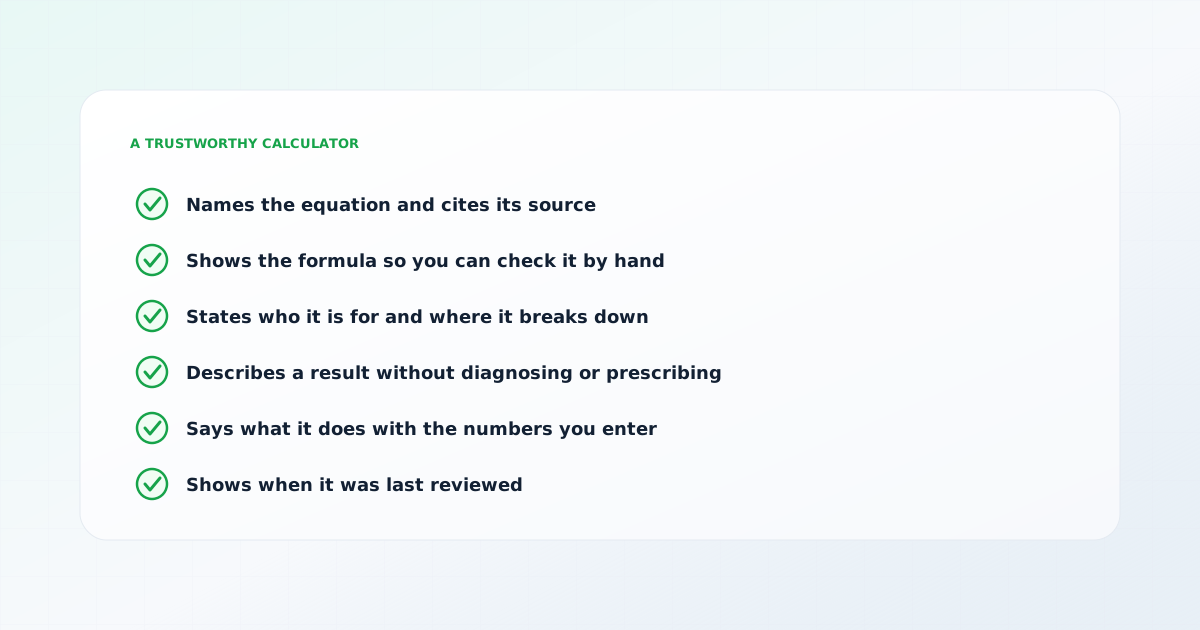
A quick summary of the whole checklist is that a trustworthy tool is transparent about its method, honest about its limits, careful in its language, light on your data and clear about when it was last reviewed. A result from a tool like that is useful to bring to a clinician. It is not a substitute for one.
Frequently asked questions
Sources
This page is based on the following sources. Each was reviewed on the access date shown.
- The origin of the ideal body weight equations(opens in a new tab)
Annals of Pharmacotherapy
Peer-reviewed articlePublished September 1, 2000Accessed September 27, 2026DOI 10.1345/aph.19381
- Not All Body Surface Area Formulas Are the Same, but Does It Matter?(opens in a new tab)
Journal of Global Oncology
Peer-reviewed articlePublished December 1, 2016Accessed September 27, 2026DOI 10.1200/JGO.2016.005876
- Estimation of the concentration of low-density lipoprotein cholesterol in plasma, without use of the preparative ultracentrifuge(opens in a new tab)
Clinical Chemistry
Peer-reviewed articlePublished June 1, 1972Accessed September 27, 2026
- Cockcroft-Gault Equation for Estimating Creatinine Clearance(opens in a new tab)
National Kidney Foundation
Professional societyAccessed September 27, 2026