How LDL Cholesterol Is Calculated: Friedewald, NIH and Martin-Hopkins
Most labs calculate LDL cholesterol rather than measure it. The Friedewald equation from 1972 and the newer NIH Equation 2 can return different numbers for the same blood sample, especially when triglycerides are raised or LDL is low.
Why LDL is usually calculated, not measured
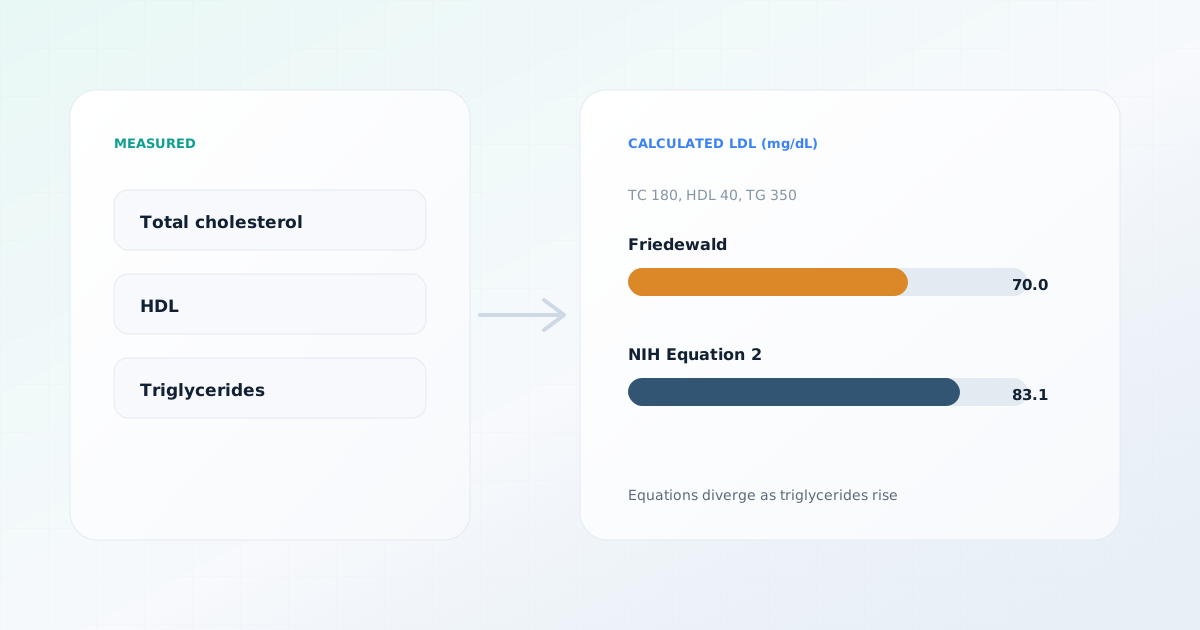
On a standard lipid panel, three numbers are measured directly: total cholesterol, HDL cholesterol and triglycerides. The LDL cholesterol that appears on the same report is usually not measured. It is calculated from those three values with an equation, because measuring LDL directly is more expensive and until recently required methods that were impractical for routine screening.
That is worth understanding, because it means the LDL on your report is only as good as the equation behind it and the three measurements that went into it. It also means two laboratories can print different LDL values for what is essentially the same blood sample, without either of them making a mistake.
- Calculated LDL
- An estimate of LDL cholesterol derived from total cholesterol, HDL cholesterol and triglycerides using an equation, rather than a direct laboratory measurement of LDL particles.
The Friedewald equation
In 1972, Friedewald, Levy and Fredrickson published a method in Clinical Chemistry for estimating LDL without using an ultracentrifuge. Their equation is simple enough to do by hand and has been the default in most laboratories for half a century: LDL equals total cholesterol minus HDL minus triglycerides divided by five, with every value in mg/dL.
The division by five is an estimate of the cholesterol carried in very low-density lipoprotein (VLDL), which is assumed to be a fixed fifth of the triglyceride value. That assumption holds reasonably well when triglycerides are moderate and breaks down as they rise, which is why the equation has firm limits.
- It requires a fasting sample, typically 9 to 12 hours, because eating raises triglycerides and distorts the fixed-ratio assumption.
- It is not valid when triglycerides are 400 mg/dL or above. A well-designed calculator refuses to return a number past that limit instead of producing one that looks plausible.
- It tends to underestimate LDL when triglycerides are raised and when LDL itself is very low, which are exactly the situations where an accurate number can matter most.
NIH Equation 2 (the Sampson equation)
In 2020, Sampson and colleagues published a new equation in JAMA Cardiology, derived and validated against beta-quantification, the laboratory reference method. It is often called NIH Equation 2. It is more complicated than Friedewald, which is the price of its accuracy, and it was designed for patients with normal lipids and with raised triglycerides alike.
Its published form is LDL = TC ÷ 0.948 − HDL ÷ 0.971 − (TG ÷ 8.56 + TG × non-HDL ÷ 2140 − TG² ÷ 16100) − 9.44, with TC the total cholesterol and non-HDL equal to TC − HDL, all in mg/dL. The practical differences from Friedewald are that it remains usable up to 800 mg/dL of triglycerides, and that it is more accurate than the older equation when LDL is low or triglycerides are raised.
| Total cholesterol | HDL | Triglycerides | Friedewald LDL | NIH Equation 2 LDL |
|---|---|---|---|---|
| 200 | 50 | 150 | 120.0 | 123.4 |
| 200 | 50 | 300 | 90.0 | 99.6 |
| 180 | 40 | 350 | 70.0 | 83.1 |
The table shows the pattern. At moderate triglycerides the two agree to within a few mg/dL. At 350 mg/dL of triglycerides, the Friedewald result of 70 is 13 mg/dL lower than the NIH figure of 83, and a gap of that size could change which side of a treatment threshold a number falls on. That is why the choice of equation matters most when triglycerides are high.
This does not mean the older equation is wrong in general. For most people with moderate triglycerides, the two methods agree closely enough that the choice is unlikely to change anything. The point of knowing about the difference is to recognize the situations where it matters, so that a surprising result is checked and not simply accepted.
The Martin-Hopkins method, and why it is not shown here
A third method, published by Martin and colleagues in JAMA in 2013, replaces the fixed divisor of five with an adjustable factor chosen from a lookup table based on the person’s triglyceride and non-HDL levels. It was developed and adopted by a number of large laboratories and is now widely used, especially in the United States.
The table behind the method has 180 cells, and an approximation of it would give wrong answers that a reader could not detect. For that reason the calculators on this site do not implement it, and we name it so that you know why a result from your own laboratory may differ from one produced here. If a report states that it used the Martin-Hopkins method, that is a recognized, peer-reviewed approach and the number should be read on its own terms.
Why the same blood can produce different LDL values
When a directly measured LDL is preferable
Every calculated LDL carries the measurement error of all three values it is built from. For most people most of the time that error is small enough not to matter. There are situations where it can matter, and where a directly measured LDL is the better choice.
- When triglycerides are high, because every equation is least reliable there.
- When LDL is very low, because small absolute errors become large relative ones.
- In people with known genetic lipid disorders.
- When a treatment decision turns on a precise value and the calculated figure sits close to a threshold.
Whether to order a direct measurement is a clinical decision that depends on the person and the question being asked. A reader noticing that two equations disagree on their own numbers should raise it with the clinician and not conclude that either result is wrong.
Reading your own report with this in mind
- Check whether the sample was fasting, since Friedewald requires it and a non-fasting sample makes it less reliable.
- Look at the triglyceride value. If it is raised, the LDL is more likely to depend on which equation was used.
- Treat small differences between two reports as expected, since laboratories use different equations and analytical methods.
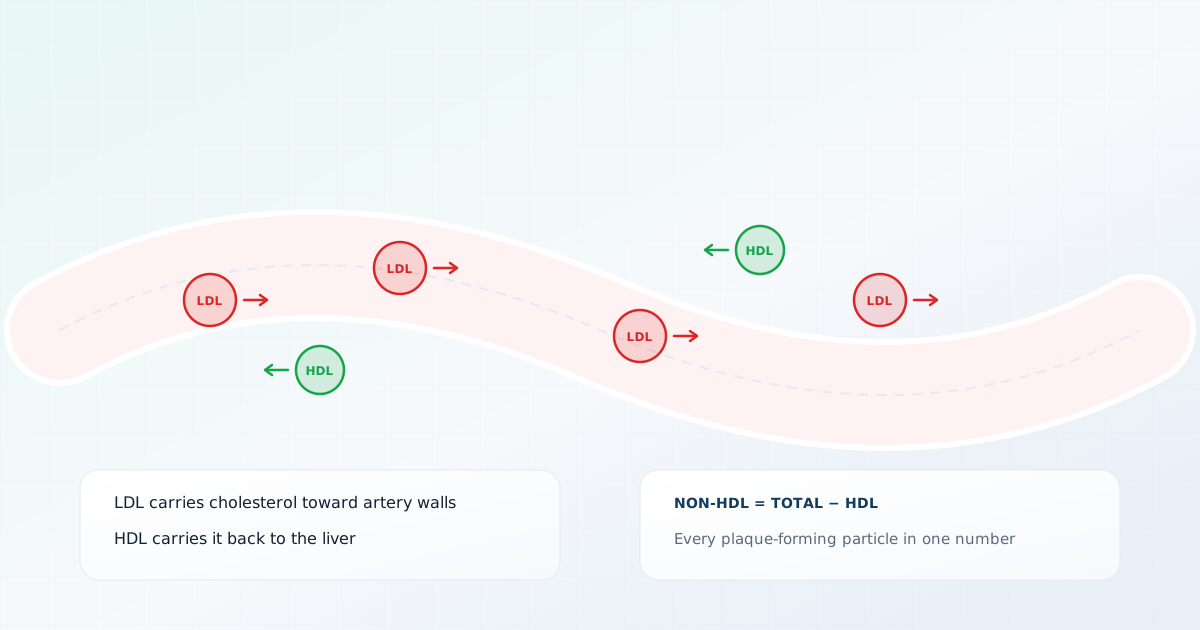
- Look at non-HDL cholesterol, which is total cholesterol minus HDL, because it needs no equation and is not distorted by triglyceride-related assumptions in the same way.
- Remember that guideline LDL targets are risk-based, so the number on its own does not say whether treatment is needed.
An LDL value is not a diagnosis and does not by itself determine whether treatment is needed. It is one factor a clinician weighs alongside blood pressure, diabetes, smoking, age and family history.
Frequently asked questions
Sources
This page is based on the following sources. Each was reviewed on the access date shown.
- Estimation of the concentration of low-density lipoprotein cholesterol in plasma, without use of the preparative ultracentrifuge(opens in a new tab)
Clinical Chemistry
Peer-reviewed articlePublished June 1, 1972Accessed September 27, 2026
- A New Equation for Calculation of Low-Density Lipoprotein Cholesterol in Patients With Normolipidemia and/or Hypertriglyceridemia(opens in a new tab)
JAMA Cardiology
Peer-reviewed articlePublished May 1, 2020Accessed September 27, 2026DOI 10.1001/jamacardio.2020.0013
- Comparison of a novel method vs the Friedewald equation for estimating low-density lipoprotein cholesterol levels from the standard lipid profile(opens in a new tab)
JAMA
Peer-reviewed articlePublished November 20, 2013Accessed September 27, 2026
- 2026 ACC/AHA/Multisociety Guideline on the Management of Dyslipidemia(opens in a new tab)
Journal of the American College of Cardiology
Clinical guidelinePublished March 13, 2026Accessed October 1, 2026DOI 10.1016/j.jacc.2025.11.016