Ideal Body Weight Formulas: Where Devine, Robinson, Miller and Hamwi Came From
The four ideal body weight equations in common use were written to size drug doses, not to say what weight is healthiest. They disagree by several kilograms at the same height, which is why the BMI-based range is usually the more useful reference.
What an ideal body weight equation is
An ideal body weight equation takes a person’s height, and for most versions their sex, and returns a single weight in kilograms or pounds. The result is called ideal body weight, or IBW, and it is easy to read it as a verdict on what a person should weigh. That reading is not what the equations were built for, and understanding their origin explains why.
The shape is the same in every version. There is a base weight for a person who is five feet tall, and an increment for every inch above five feet. A taller person simply gets more kilograms added in a straight line. The versions differ in the base weights and in the size of the increment, and those differences are what produce different answers.
The four equations
Each equation was published by a different author at a different time. The coefficients below are the ones documented in the review by Pai and Paloucek, which traced them to their sources.
| Equation | Men | Women |
|---|---|---|
| Devine (1974) | 50.0 kg + 2.3 kg per inch | 45.5 kg + 2.3 kg per inch |
| Robinson (1983) | 52.0 kg + 1.9 kg per inch | 49.0 kg + 1.7 kg per inch |
| Miller (1983) | 56.2 kg + 1.41 kg per inch | 53.1 kg + 1.36 kg per inch |
| Hamwi (1964) | 106 lb + 6 lb per inch | 100 lb + 5 lb per inch |
Hamwi’s equation is worth a note. It was published in pounds, and there are several rounded metric versions in circulation that do not agree with each other. Applying it in its original form and converting the result is more faithful than using one of those restatements.
A worked example: the same person, four answers
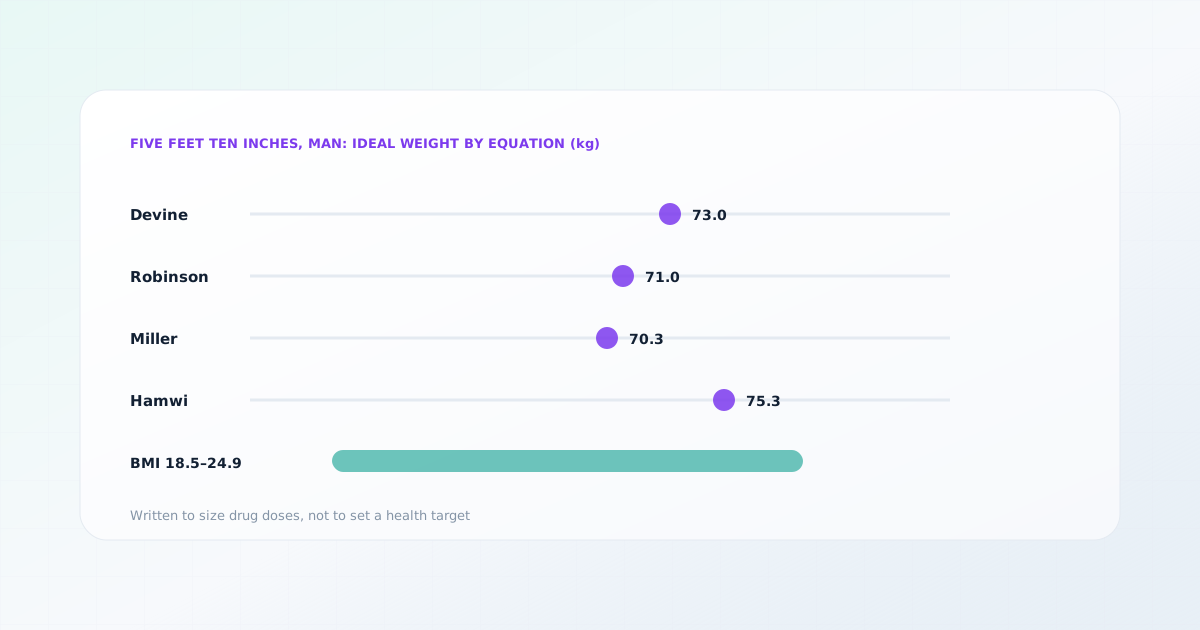
Take a man who is five feet ten inches tall, which is ten inches above five feet, and a woman who is five feet four inches tall, which is four inches above. The four equations give these results.
| Equation | Man, 5 ft 10 in | Woman, 5 ft 4 in |
|---|---|---|
| Devine | 73.0 | 54.7 |
| Robinson | 71.0 | 55.8 |
| Miller | 70.3 | 58.5 |
| Hamwi | 75.3 | 54.4 |
The spread is about five kilograms for the man and about four for the woman, and none of the four answers is more correct than the others. That is not a flaw in the arithmetic. Each equation was a different author’s adjustment to an earlier rule of thumb, and not a new measurement study that could be checked against evidence.
A useful way to see the problem is to ask which of the four answers a clinician would act on. In dosing, the prescriber follows whichever equation the drug reference names, which is why the choice is written into protocols. Outside dosing there is no reference that tells you to prefer one equation, so any single figure should be read as one plausible value in a band and not as a precise answer.
Try the calculatorCompare all four equations at your heightWhere the equations came from
The review by Pai and Paloucek in the Annals of Pharmacotherapy is the key reference. It traces the four equations to their sources and shows that they came out of drug-dosing practice. Devine’s 1974 equation, for instance, appeared in a paper on dosing the antibiotic gentamicin, where the aim was to pick a sensible weight to scale a dose by, not to describe a healthy body.
That history matters because of how the equations are often used today. Many websites present the result as the weight a person should aim for, which is a claim the original authors did not make and the evidence does not support. No study behind these equations asked which weight at a given height is associated with the best health outcomes.
Devine published only a male equation
Adjusted body weight and the BMI-based range
Two related quantities appear alongside ideal body weight in clinical references. Adjusted body weight is used in some dosing calculations when a person’s actual weight is well above their ideal weight. A common form is the ideal body weight plus 0.4 times the difference between actual and ideal weight. A person with an ideal weight of 73 kg and an actual weight of 110 kg has an adjusted weight of 73 + 0.4 × 37, or 87.8 kg.
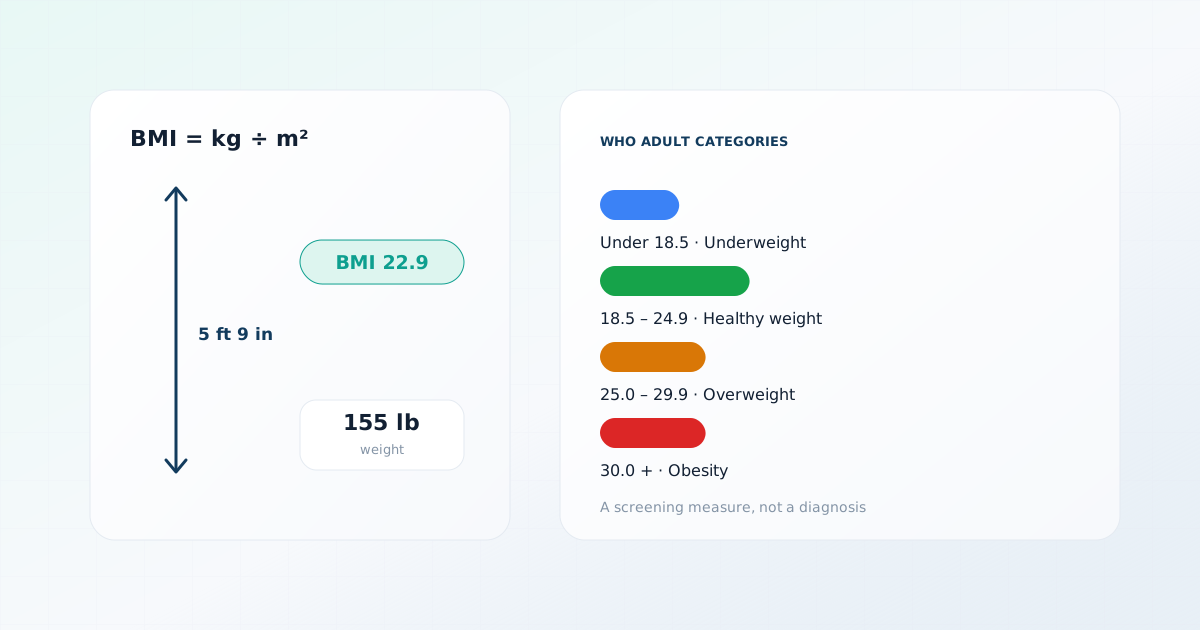
The second is the weight range corresponding to a BMI of 18.5 to 24.9. That is the World Health Organization adult classification’s range between underweight and overweight, and it is what most people mean when they ask about a healthy weight. It is a range, which is more honest than a single number, but it is also a population screening range and not a personal target.
- A BMI-based range spans about twenty kilograms at typical adult heights, which reflects the real variation between healthy people of the same height.
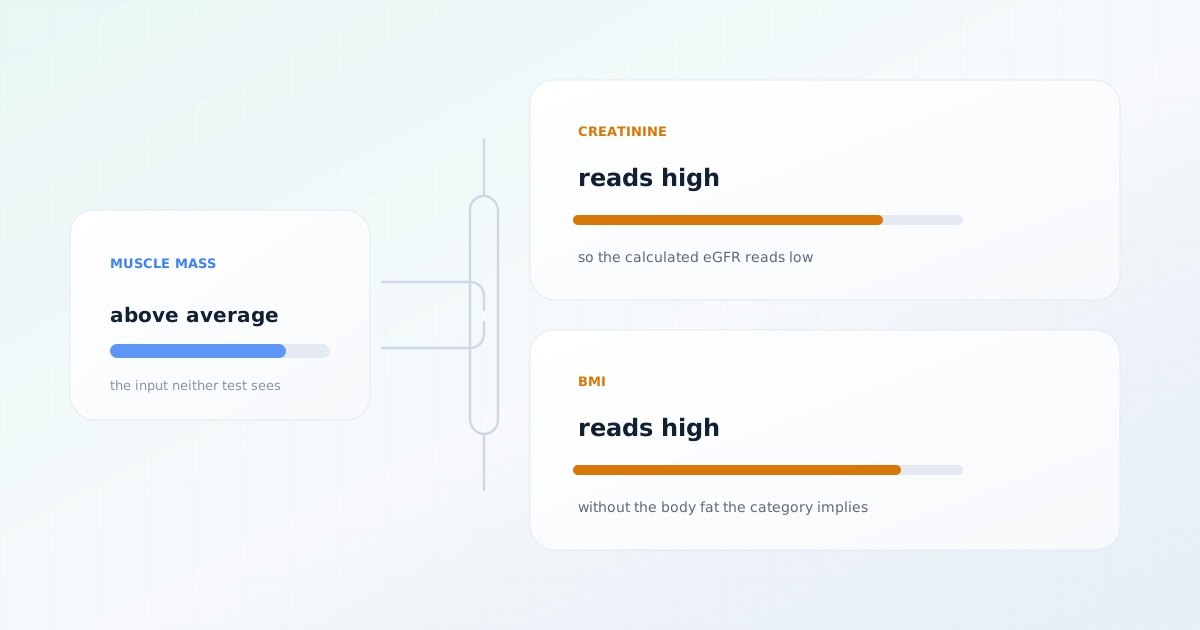
- It does not account for frame size, muscle mass, age or ethnicity, and BMI cannot distinguish muscle from fat.
- For some Asian populations the World Health Organization has suggested additional action points at lower BMI values, which would shift the range.
Limits of every ideal weight equation
- They are not health targets. They were written for dosing, and none was derived from evidence about the healthiest weight.
- They disagree with one another, often by five kilograms or more at the same height.
- They are defined from five feet upward, and below that height they are being extrapolated backward, which the original papers did not intend.
- They ignore frame size, muscle mass, age and ethnicity.
- They are not validated for children, during pregnancy, or after limb amputation.
The practical uses that remain are narrow but real. A clinician or pharmacist may use ideal or adjusted body weight to scale a drug dose, following the specific reference for that drug. For personal goals, a conversation about health, fitness and habits is a better basis than any single weight.
If you only remember one thing from this page, it is that a single ideal weight figure is a convention with a documented history, not a finding about your body, and a range that acknowledges variation is a more honest way to describe a healthy weight.
Frequently asked questions
Sources
This page is based on the following sources. Each was reviewed on the access date shown.
- The origin of the ideal body weight equations(opens in a new tab)
Annals of Pharmacotherapy
Peer-reviewed articlePublished September 1, 2000Accessed September 27, 2026DOI 10.1345/aph.19381
- A healthy lifestyle — WHO recommendations(opens in a new tab)
World Health Organization
Government health agencyAccessed September 27, 2026
- About Adult BMI(opens in a new tab)
Centers for Disease Control and Prevention
Government health agencyAccessed September 27, 2026