Vitamin D and Vitamin B12 Blood Tests: Units, Ranges and Limits
Vitamin D is measured as 25-hydroxyvitamin D and reported in ng/mL or nmol/L, while B12 is judged from a blood level that sometimes needs a second test to interpret. Here is how to read both results and why the thresholds are debated.
Why these two vitamins are tested so often
Vitamin D and vitamin B12 are among the most frequently requested nutrient tests, partly because deficiency can be vague in its effects and partly because both are easy to measure. They are measured differently, interpreted differently and carry different cautions, and this article takes them in turn. Neither test is part of every routine blood panel, and neither is recommended for everyone, so the more useful question is usually who is likely to have a reason to be tested.
The reference points here come mainly from the NIH Office of Dietary Supplements, which publishes health professional fact sheets on both vitamins. Those sheets are authoritative on units and conventions, and they also acknowledge uncertainty where it exists, which is useful for a reader trying to make sense of a result.
Vitamin D: what is measured and in which units
Vitamin D comes from sunlight on skin, from some foods such as fatty fish and fortified milk, and from supplements. The body converts it in the liver to 25-hydroxyvitamin D, written 25(OH)D, and then in the kidney to its active form. The blood test measures 25(OH)D, because it reflects total intake from all sources and has a relatively long half-life. The active form is tightly regulated and is not a good indicator of status.
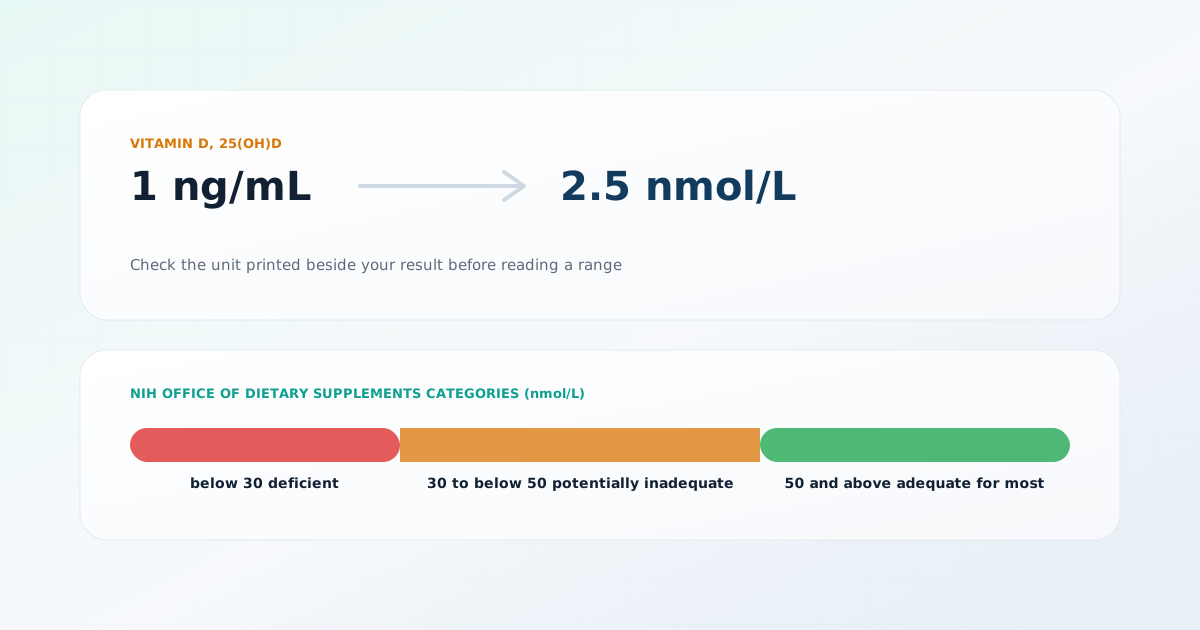
Laboratories in the United States usually report the result in nanograms per milliliter (ng/mL), while many other countries and some US labs use nanomoles per liter (nmol/L). The conversion is simple: 1 ng/mL equals 2.5 nmol/L. A result of 20 ng/mL is therefore 50 nmol/L. Reading a result against a reference range in the wrong unit is a common source of confusion, so check the unit printed beside your number.
| 25(OH)D level | In nmol/L | In ng/mL | How the fact sheet describes it |
|---|---|---|---|
| Deficient | Below 30 | Below 12 | Associated with a risk of rickets in infants and children and osteomalacia in adults |
| Potentially inadequate | 30 to below 50 | 12 to below 20 | May be inadequate for bone and overall health in some people |
| Adequate | 50 or above | 20 or above | Generally adequate for most people |
| Potentially harmful | Above 125 | Above 50 | Linked with adverse effects at persistently high levels |
Why the vitamin D threshold is debated
Not every authority draws the line in the same place. The thresholds in the table above reflect the view of the Institute of Medicine committee that set the US intake recommendations, which concluded that a level of 50 nmol/L (20 ng/mL) meets the needs of about 97.5 percent of the population. Some professional societies recommend a higher target, often 75 nmol/L (30 ng/mL), for people at risk of bone problems or for treatment purposes.
The consequence is that the same result can be described as adequate by one authority and low by another. A result of 25 ng/mL, for example, is adequate under the Institute of Medicine approach and below the target some societies use. Neither is wrong, and the disagreement is a good reason to discuss a result with a clinician who can weigh it against your own risk factors, such as osteoporosis, malabsorption, kidney disease or limited sun exposure.
More is not better
It also helps to know that blood levels change with the season, with the latitude where you live and with how much skin is exposed to sun, so a single result is a snapshot. People with darker skin produce vitamin D from sunlight less efficiently, and people who cover most of their skin, spend most of their time indoors or live at northern latitudes tend to have lower levels.
Vitamin B12: what the test shows and where it falls short
Vitamin B12 is needed for nerve function, red blood cell formation and DNA synthesis. The adult Recommended Dietary Allowance is 2.4 micrograms a day. B12 is found naturally only in animal foods, including meat, fish, eggs and dairy, which is why people following vegan diets need a fortified food or a supplement. It is also added to some fortified cereals and plant milks.
The usual test is a serum B12 level, reported in pg/mL or pmol/L. Laboratories mark a result as low below a cut-point that varies between them. The NIH fact sheet says most define a subnormal level as below 200 or 250 pg/mL, and levels in the borderline zone are known to be hard to interpret, because a person can have a low supply of B12 at the tissue level with a blood level that looks acceptable. The NIH fact sheet acknowledges the limits of any single marker of B12 status.
When the result is borderline, or when symptoms suggest deficiency despite an acceptable value, clinicians may order a second test. Methylmalonic acid (MMA) and homocysteine both rise when B12 is functionally low, and a raised MMA supports the diagnosis. The fact sheet describes MMA as the most sensitive marker and notes that it can help confirm deficiency when the serum B12 falls in the 150 to 399 pg/mL range. These follow-up tests have their own caveats: MMA can be affected by reduced kidney function, for instance.
| Group | Why risk is raised |
|---|---|
| Adults aged 50 and over | Absorption of the B12 bound to food falls as stomach acid declines; the fortified or supplement form is absorbed differently and is recommended by the Office of Dietary Supplements |
| People following vegan or vegetarian diets | B12 occurs naturally in animal foods only |
| People with pernicious anemia | An autoimmune condition that prevents absorption from the gut |
| People who have had stomach or bowel surgery, or who have conditions such as celiac or Crohn’s disease | Parts of the gut needed to absorb B12 may be missing or inflamed |
| People who take metformin or long-term acid-reducing medicines | These medicines are associated with lower B12 levels in some people |
Symptoms, treatment and the importance of a diagnosis
Low B12 can cause tiredness, shortness of breath, a sore tongue, pins and needles or numbness in the hands and feet, difficulty with balance, and changes in memory or mood. Those symptoms are common and have many causes, so they do not by themselves point to B12. A low level can also cause a particular form of anemia, with larger-than-normal red blood cells, which a routine blood count can show.
Find the cause before treating the symptoms
Treatment depends on the cause. A person with a dietary shortfall may need a supplement or fortified foods, while a person who cannot absorb B12 may need injections or high-dose oral treatment. That is a decision for a clinician, because the right route depends on why the level is low.
Who might reasonably ask about testing
Most healthy adults without risk factors do not need routine testing for either vitamin. Testing is more often worthwhile for people with symptoms or conditions that raise the likelihood of a problem, and the usual route is a conversation with a clinician rather than an over-the-counter kit.
- For vitamin D: people with osteoporosis or fractures, conditions affecting fat absorption, chronic kidney or liver disease, obesity, or limited sun exposure, and older adults at risk of falls.
- For vitamin B12: older adults with symptoms, people on a vegan diet, people with gut conditions or surgery, and those taking metformin or acid-reducing medicine for a long time.
- For both: unexplained fatigue is a common reason, though it usually has other explanations that a clinician will want to explore at the same time, including anemia, thyroid problems, sleep and mood.
Home test kits exist for both vitamins, and their results face the same interpretation problems described here, with the added difficulty that no one is on hand to place the number in context. If a result is flagged, bring it to a clinician and mention what you take as a supplement.
Frequently asked questions
Sources
This page is based on the following sources. Each was reviewed on the access date shown.
- Vitamin D — Health Professional Fact Sheet(opens in a new tab)
NIH Office of Dietary Supplements
Government health agencyAccessed September 27, 2026
- Vitamin B12 — Health Professional Fact Sheet(opens in a new tab)
NIH Office of Dietary Supplements
Government health agencyAccessed September 27, 2026
- Medical Tests(opens in a new tab)
MedlinePlus (US National Library of Medicine)
Government health agencyAccessed September 27, 2026
- Vitamin D for the Prevention of Disease: An Endocrine Society Clinical Practice Guideline(opens in a new tab)
The Journal of Clinical Endocrinology & Metabolism (Endocrine Society)
Clinical guidelinePublished June 3, 2024Accessed October 12, 2026DOI 10.1210/clinem/dgae290
- Vitamin B12 Deficiency: Recognition and Management(opens in a new tab)
American Family Physician (American Academy of Family Physicians)
Peer-reviewed articlePublished September 15, 2017Accessed October 12, 2026