Blood Glucose Units Explained: mg/dL, mmol/L and A1C in mmol/mol
The same glucose result can be written in mg/dL or mmol/L, and A1C in percent or mmol/mol. The conversions are exact arithmetic, but they change how a number is written, not what it means or which guideline applies.
Why one glucose result has two numbers
If you have ever compared a glucose reading from a US laboratory with one from a clinic in the UK, Canada, Australia or most of Europe, the numbers will not look alike. A US report might say 100 and a European one 5.5, and both can describe exactly the same blood sample. The difference is the unit, not the glucose.
mg/dL stands for milligrams per deciliter and is a mass concentration: how many milligrams of glucose are present in a tenth of a liter of blood. mmol/L stands for millimoles per liter and is a molar concentration: how many millimoles of glucose molecules are present in a liter. A mole is a fixed count of molecules, so a molar unit counts molecules while a mass unit weighs them.
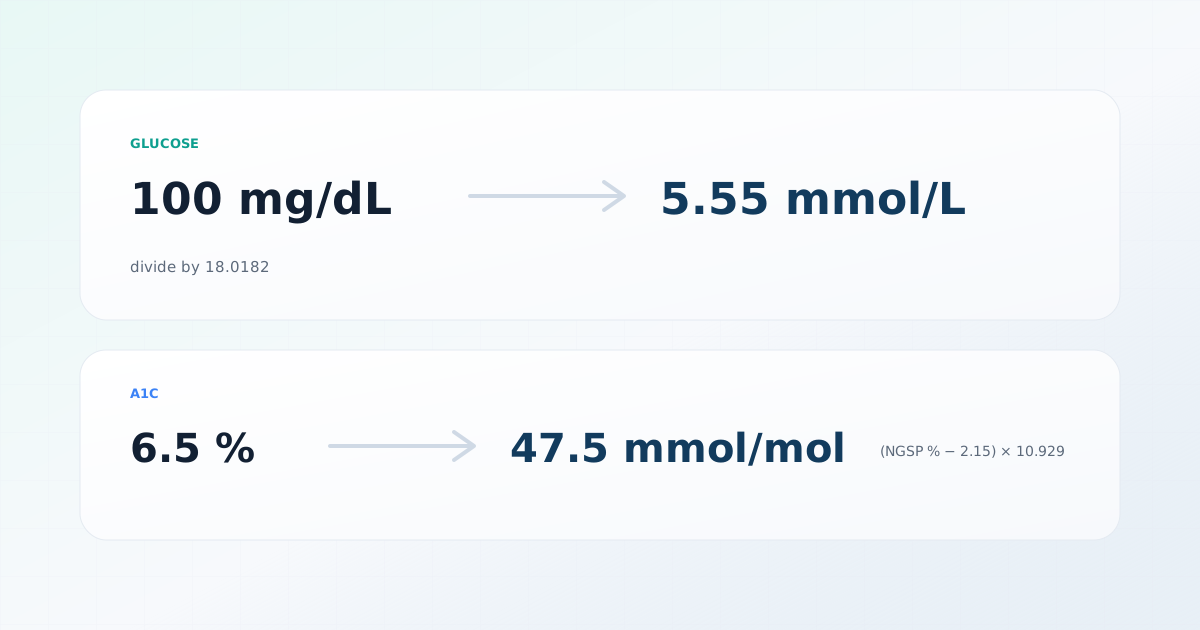
To move between the two you need the molar mass of glucose, which is 180.156 grams per mole. Dividing that by ten, because a deciliter is a tenth of a liter, gives the conversion factor of 18.0182. One mmol/L of glucose equals 18.0182 mg/dL, and the arithmetic runs in both directions.
- Conversion factor
- A fixed number that translates a value from one unit to another. For glucose it is 18.0182, derived from the molar mass of glucose. Other substances have different factors because their molecules have different masses.
How to convert glucose in either direction
To go from mg/dL to mmol/L, divide by 18.0182. To go the other way, multiply. Many people use 18 as a shortcut, which is close enough for a rough sense of scale and is the reason published tables often differ in the last decimal place.
| mg/dL | mmol/L (exact conversion) |
|---|---|
| 70 | 3.88 |
| 100 | 5.55 |
| 126 | 6.99 |
| 140 | 7.77 |
| 180 | 9.99 |
That last point is worth knowing because it explains a common source of confusion. The exact conversion of 100 mg/dL is 5.5499 mmol/L, and a table that rounds to one decimal place can show it as 5.5 or 5.6 depending on how the rounding was done. Neither is wrong. They are two different roundings of the same quantity, and the difference is far smaller than the variation between one meter or one laboratory and another.
Try the calculatorConvert a glucose value between mg/dL and mmol/LA1C in percent and in mmol/mol
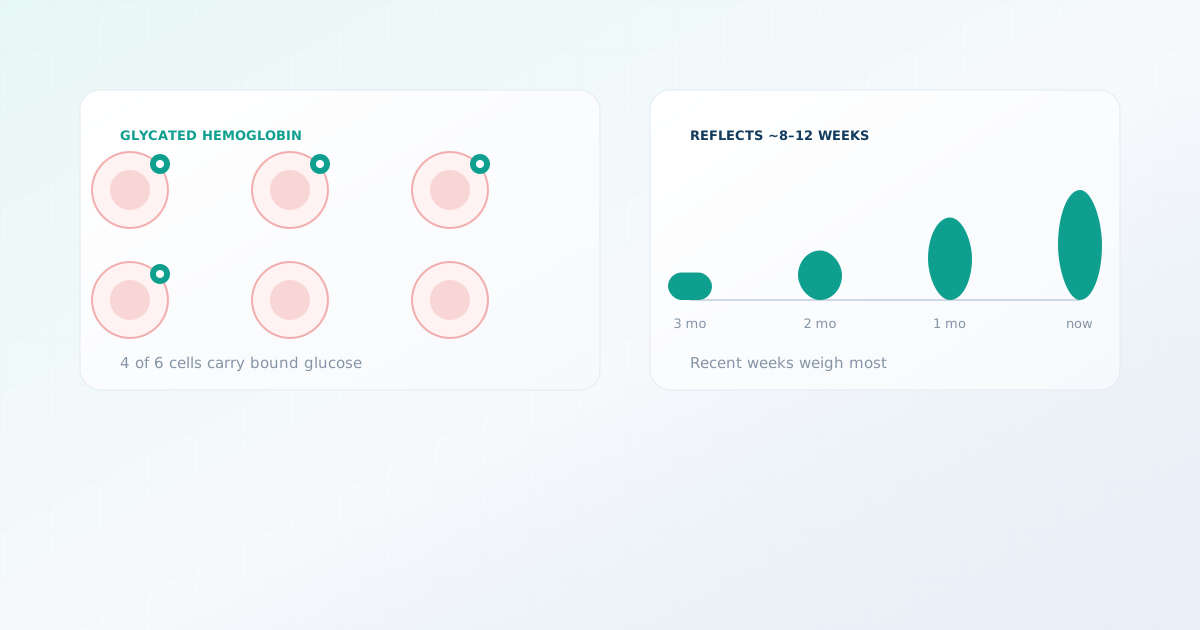
A1C has its own unit split. The United States reports it as a percentage of hemoglobin that has glucose attached, using the standardization of the National Glycohemoglobin Standardization Program (NGSP). Most other countries report it in mmol/mol, following the International Federation of Clinical Chemistry (IFCC) reference method. The two scales measure the same thing and are linked by the NGSP–IFCC master equation.
- NGSP–IFCC master equation
- IFCC (mmol/mol) = (NGSP % − 2.15) × 10.929. The equation lets a laboratory express one standardized A1C result in either unit.
| A1C (%) | A1C (mmol/mol) |
|---|---|
| 5.7 | 38.8 (reported as 39) |
| 6.5 | 47.5 (reported as 48) |
| 7.0 | 53.0 |
| 8.0 | 63.9 (reported as 64) |
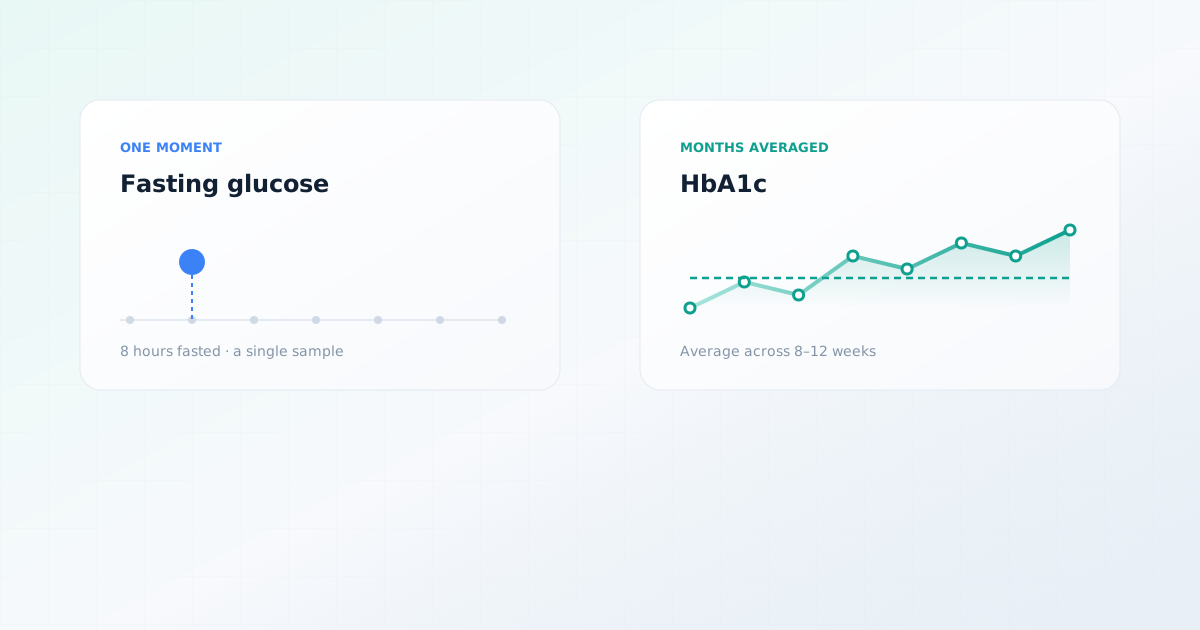
A third conversion links A1C to an estimated average glucose. The A1c-Derived Average Glucose study published in Diabetes Care in 2008 produced the regression estimated average glucose (mg/dL) = 28.7 × A1C − 46.7. An A1C of 7.0 percent corresponds to roughly 154 mg/dL, or 8.6 mmol/L. That figure is an average estimate drawn from a study population, and an individual can sit well above or below it, which is one reason glucose monitoring and A1C do not always agree.
A unit conversion is not a guideline conversion
It is tempting to treat a conversion as an interpretation. Converting 126 mg/dL to 6.99 mmol/L tells you the same fact in a different unit, and nothing more. What the number means depends on when the sample was taken and under what circumstances.
- A fasting sample, a sample taken before a meal, a sample taken after a meal and a random sample are all read against different expectations, so the same value can mean different things.
- The American Diabetes Association Standards of Care give screening ranges for fasting plasma glucose and A1C, and they describe them as screening ranges for non-pregnant adults rather than a stand-alone diagnosis. The ADA reissues the Standards every January, so the volume number is worth checking.
- Guidelines in other countries use their own wording and sometimes their own thresholds, so a European or Australian guideline cannot be read off a US one by converting the units.
- A single reading does not diagnose diabetes. Confirmation, repeat testing and clinical context are part of how clinicians use these numbers.
Same number, same meaning only if the circumstances match
Meters, laboratories and monitors do not read identically
Even in the same unit, two devices can report different numbers for the same person at the same moment. That is a measurement issue and not a conversion one, and it is worth keeping apart from the unit question.
- Home meters and laboratory analyzers are not perfectly interchangeable. Regulatory standards permit home meters a margin of error against a laboratory plasma glucose measurement.
- A fingerstick uses capillary whole blood while a laboratory test usually uses venous plasma. Most modern meters report a plasma-equivalent value, but the samples are not identical.
- Continuous glucose monitors measure glucose in the fluid between cells rather than in blood, and they lag behind blood glucose when levels are changing quickly.
The practical consequence is that a small difference between a meter reading and a laboratory report is not a sign that either is wrong, and not a unit error. When a decision turns on an exact value, a laboratory measurement is the reference.
When the units matter in practice
Unit confusion is most likely to cause trouble when records cross a border, when a meter is bought abroad, or when a person moves between systems. A meter set to mmol/L will display values that look alarmingly low to someone used to mg/dL, and the reverse is equally true. Most meters allow the unit to be changed, and many studies of medication errors list unit confusion as a recognized hazard.
- Check which unit a meter or report uses before comparing it with any number you have read elsewhere.
- Write the unit down with the value when you keep your own records, since a bare number is ambiguous.
- If a result seems wildly different from expectation, check the unit before concluding anything about the number.
- When sharing records with a clinician in another country, include the unit and say whether the sample was fasting.
None of these steps replaces advice from the clinician managing your care. A converter is for understanding what a number says in another unit, and any decision about treatment or monitoring belongs with the person who knows your history.
Frequently asked questions
Sources
This page is based on the following sources. Each was reviewed on the access date shown.
- HbA1c standardization and the NGSP–IFCC master equation(opens in a new tab)
National Glycohemoglobin Standardization Program
Reference workAccessed September 27, 2026
- Translating the A1C assay into estimated average glucose values(opens in a new tab)
Diabetes Care (American Diabetes Association)
Peer-reviewed articlePublished August 1, 2008Accessed September 27, 2026DOI 10.2337/dc08-0545
- Diagnosis and Classification of Diabetes: Standards of Care in Diabetes-2026(opens in a new tab)
Diabetes Care (American Diabetes Association)
Clinical guidelinePublished January 1, 2026Accessed October 1, 2026
- Testing for Diabetes and Prediabetes(opens in a new tab)
Centers for Disease Control and Prevention
Government health agencyAccessed September 27, 2026