Body Fat Percentage and the Navy Tape Method: How Accurate Is It?
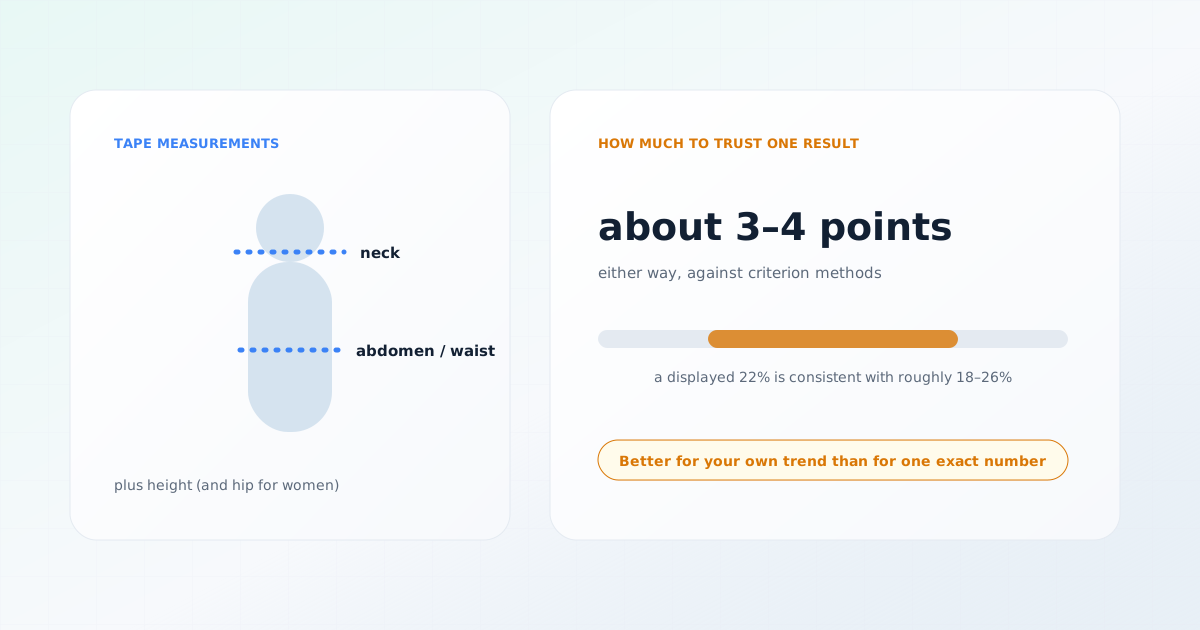
The tape-measure method used by the US military estimates body fat from neck, waist and height, and hip for women. It is typically accurate to within three to four percentage points, which makes it better for tracking a trend than for a single exact number.
Why people estimate body fat at all
Body weight and BMI treat all mass the same. Two people at the same height and weight can have very different proportions of fat and lean tissue, and someone who gains muscle while losing fat can see a scale that barely moves. Body fat percentage tries to separate the two, which is why it appeals to people who train and to anyone following a change in body composition rather than just weight.
Measuring body fat accurately is harder than it looks. The reference methods, which include underwater weighing, air displacement and dual-energy X-ray absorptiometry (DEXA), need specialist equipment and are not available at home. Everything else, from bathroom scales that send a small electrical current through the body to calipers that pinch the skin, is an estimate, and each has its own sources of error.
The tape-measure method is one of the most accessible. It needs a flexible tape, a few minutes and no equipment, and it has a documented provenance: the equations were developed by researchers at the Naval Health Research Center to screen service members for body composition standards.
How the circumference method works
The method is documented in a technical report from the Naval Health Research Center on the development of the Department of Defense body composition estimation equations, and its measurement protocol is specified in Department of Defense Instruction 1308.03. It is often called the Navy method, and the equations are sometimes named after the researchers, Hodgdon and Beckett.
The logic is that circumferences act as a proxy for fat distribution. A larger abdomen relative to height and neck suggests more fat, and the neck serves as a stand-in for lean mass. The equations are logarithmic and were published with measurements in inches, so a measurement in centimeters has to be converted rather than approximated.
| Measurement | Men | Women |
|---|---|---|
| Neck | Below the larynx | Below the larynx |
| Waist or abdomen | At the navel (abdomen) | At the natural waist |
| Hip | Not used | At the widest point of the buttocks |
| Height | Used | Used |
| Group | Equation |
|---|---|
| Men | 86.010 × log10(abdomen − neck) − 70.041 × log10(height) + 36.76 |
| Women | 163.205 × log10(waist + hip − neck) − 97.684 × log10(height) − 78.387 |
A worked example, and how sensitive the result is
Consider a man who is 70 inches tall with a neck of 15 inches and an abdomen of 36 inches. The difference between abdomen and neck is 21 inches. The equation gives 86.010 times the base-10 logarithm of 21 (which is 1.322), minus 70.041 times the logarithm of 70 (1.845), plus 36.76, which works out to about 21.3 percent.
| Measurements | Estimated body fat |
|---|---|
| Neck 15 in, abdomen 36 in | About 21.3 percent |
| Neck 15 in, abdomen 37 in (one inch more) | About 23.0 percent |
| Neck 16 in, abdomen 36 in (neck one inch larger) | About 19.4 percent |
A single inch of tape position moves the answer by close to two percentage points, which is a good fraction of the method’s overall error. Where the tape sits on the abdomen, how tightly it is pulled and whether the person is breathing in or out can each account for an inch. That is why the protocol is specific about landmarks and why repeating the measurement matters.
Try the calculatorEstimate body fat with the Hodgdon-Beckett equationsHow accurate it is, and for whom
The published accuracy of the circumference equations, compared with criterion methods such as underwater weighing, is in the region of three to four percentage points. Practically, that means a displayed 22 percent is consistent with a true value of roughly 18 to 26 percent. For a number people tend to read as exact, that is a wide band.
Accuracy also depends on who is being measured. The equations were fitted on US Navy personnel, who are on average younger and narrower in body composition than the general public, and accuracy falls outside that range. The method is less reliable in older adults, in very lean people and at higher body weights, and it is not validated during pregnancy, in children and adolescents, in people with significant fluid retention, or after limb amputation.
Use it for trends, not for a verdict
Why there is no official healthy range
It is natural to want to know whether a percentage is good or bad, and many websites publish tables with labels such as essential, athletic, fitness, average and obese. It is worth knowing where these come from. Unlike BMI, which has categories from the World Health Organization and the Centers for Disease Control and Prevention, no clinical guideline body publishes comparable categories for body fat percentage. The tables in circulation come from individual organizations and fitness conventions.
The Department of Defense does set maximum body fat standards for service members, but those are occupational standards for a military population and not health recommendations for the public. A body fat figure also says nothing by itself about health: where fat is carried, blood pressure, glucose, lipids and fitness all matter, and a person with a moderate percentage and good fitness can be in a better position than someone with a lower percentage and poor metabolic markers.
For that reason, our body fat calculator shows the estimate without a category label, and this article does the same.
Measuring well enough to learn something
- Measure at the same time of day, ideally in the morning before eating, since meals and hydration change the abdominal measurement.
- Stand relaxed with your weight evenly on both feet and breathe normally. Do not pull the stomach in.
- Keep the tape level and snug against the skin without compressing it, and read at the end of a normal exhalation.
- Measure the neck just below the larynx, with the tape sloping slightly downward at the front and with the shoulders relaxed.
- Take each measurement two or three times and use the average, and record the date and measurements so that later results can be compared.
- Use the same tape and the same landmarks every time. Avoid comparing a measurement taken over clothing with one taken against the skin.
Treat the output as one piece of information alongside weight, waist-to-height ratio, how clothes fit, strength and energy. If those are all moving in the same direction over months, a falling estimate is reasonably reassuring. If they disagree, the tape is more likely to be the source of the noise than the body.
Frequently asked questions
Sources
This page is based on the following sources. Each was reviewed on the access date shown.
- Development of the DoD Body Composition Estimation Equations (Technical Document 99-2B)(opens in a new tab)
Naval Health Research Center, US Department of Defense
Government health agencyPublished January 1, 1999Accessed September 27, 2026
- DoD Instruction 1308.03: DoD Physical Fitness and Body Composition Program(opens in a new tab)
US Department of Defense
Government health agencyAccessed September 27, 2026
- About Adult BMI(opens in a new tab)
Centers for Disease Control and Prevention
Government health agencyAccessed September 27, 2026