Waist Circumference, Waist-to-Height and Waist-to-Hip Ratio Explained
Where weight is carried says something that BMI cannot. Waist circumference, waist-to-height ratio and waist-to-hip ratio each measure central fat in a different way, with cut-points from WHO and NICE that disagree in useful ways.
Why where fat is carried matters
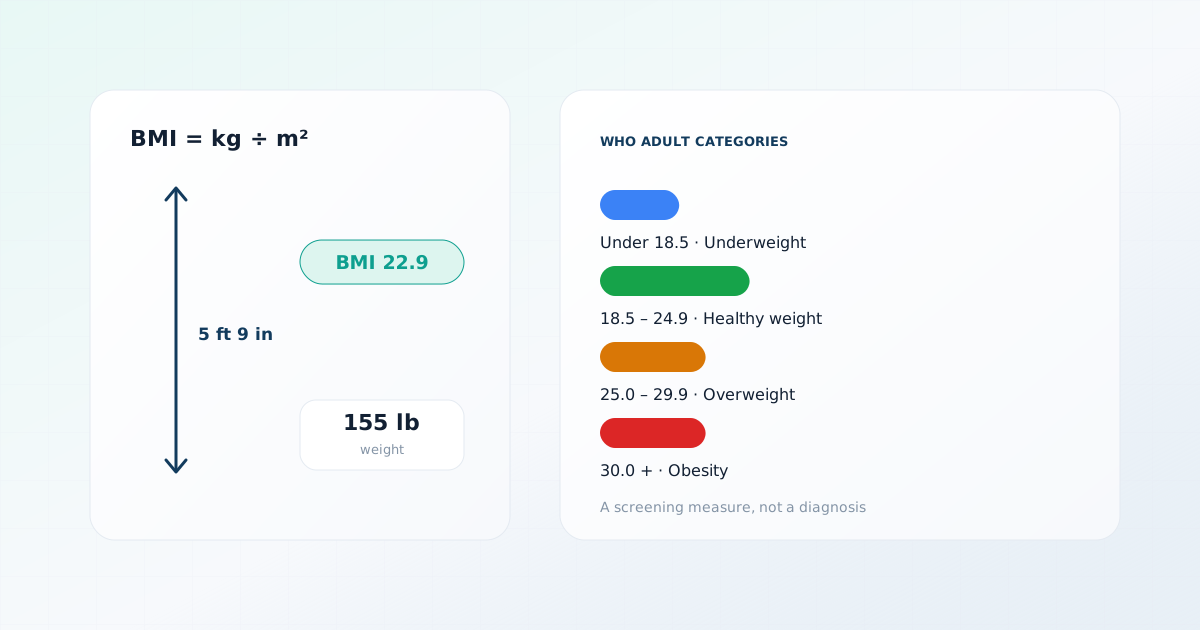
Body mass index compares weight with height and says nothing about where the weight sits. Two people with the same BMI can have very different amounts of fat around the abdomen, and that difference is clinically relevant: fat stored in and around the abdominal organs, often called central or visceral adiposity, is more strongly associated with cardiometabolic risk than fat stored in the hips and thighs.
That is the reasoning behind measuring the waist. A tape measure cannot distinguish visceral fat from subcutaneous fat, so every waist-based number is an indirect marker, but it is a cheap and reproducible one that adds information BMI lacks. It is also one of the few body measurements most people can take accurately at home.
A complement to BMI, not a replacement
How to measure correctly
Technique changes the number, and the published cut-points assume a particular protocol. The World Health Organization expert consultation on waist circumference and waist-hip ratio sets out a standard method, and a measurement taken differently is not comparable to its thresholds.
- Stand upright, feet together, arms relaxed at your sides, and breathe normally.
- Find the midpoint between the lowest rib and the top of the hip bone (the iliac crest) at the side of the body.
- Wrap a flexible, non-stretch tape measure around the body at that level, snug but not compressing the skin, and keep it parallel to the floor.
- Take the reading at the end of a normal, relaxed exhalation, not while holding your breath or pulling the stomach in.
- For the hip measurement, measure around the widest part of the buttocks, again with the tape level.
- Measure twice. If the two readings differ by more than about a centimeter, measure a third time.
Measuring over clothing, at a different level from the standard, or in the evening after a large meal will all shift the number. For tracking over time, the most important thing is to measure the same way each time, at roughly the same time of day.
Three measurements and what each says
Waist circumference, waist-to-hip ratio and waist-to-height ratio all target central fat but through different arithmetic, and each has its own strengths.
| Measurement | Men | Women | Source |
|---|---|---|---|
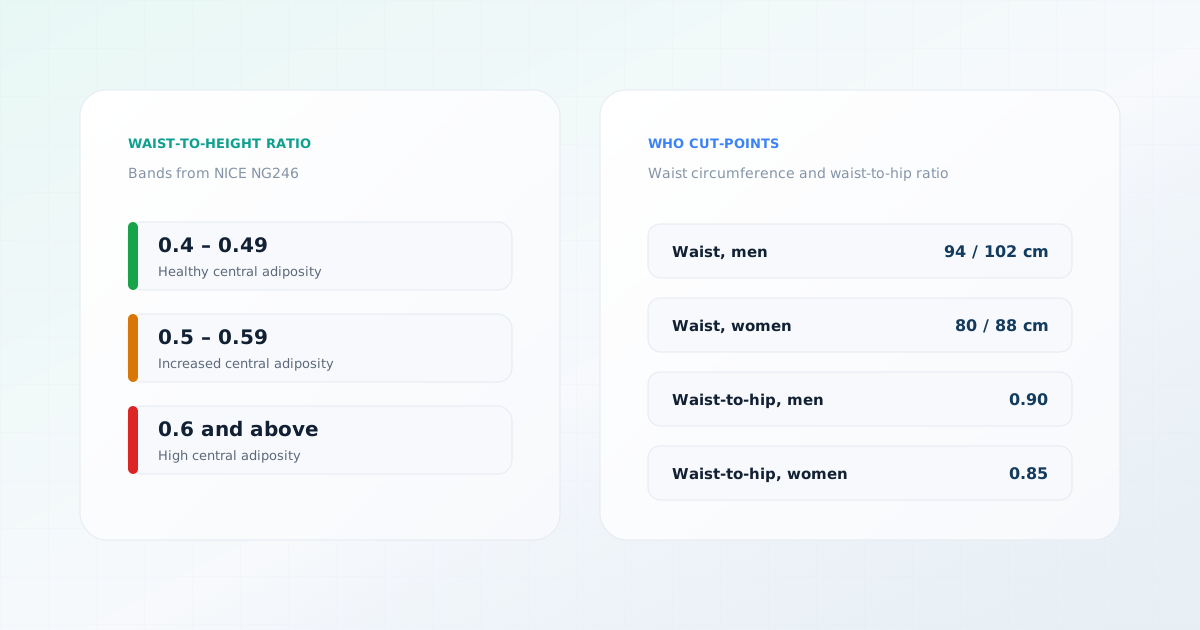
| Waist circumference, increased risk | 94 cm (about 37 in) | 80 cm (about 31.5 in) | WHO 2008 |
| Waist circumference, substantially increased risk | 102 cm (about 40 in) | 88 cm (about 34.5 in) | WHO 2008 |
| Waist-to-hip ratio, abdominal obesity | 0.90 or above | 0.85 or above | WHO 2008 |
| Waist-to-height ratio, healthy | 0.4 to 0.49 | 0.4 to 0.49 | NICE NG246 |
| Waist-to-height ratio, increased central adiposity | 0.5 to 0.59 | 0.5 to 0.59 | NICE NG246 |
| Waist-to-height ratio, high central adiposity | 0.6 or above | 0.6 or above | NICE NG246 |
Waist circumference is the simplest: one measurement, no arithmetic. Its drawback is that it ignores height, so the same waist means different things in a short person and a tall one, and it requires separate cut-points for men and women, and in practice for different ethnic groups.
Waist-to-hip ratio divides the waist by the hip measurement, and so captures body shape: a higher value means proportionally more fat at the waist than at the hips. The hip measurement adds a second source of error and the ratio can obscure a large waist in someone who also has large hips.
Waist-to-height ratio divides the waist by height. It adjusts for body size without a hip measurement, and because the NICE bands use the same values for men and women of different heights, it is the easiest to remember: a waist less than half of your height falls in the lower band.
A worked example
Consider an adult woman who is 165 centimeters tall with a waist of 84 centimeters and hips of 100 centimeters. Her waist-to-height ratio is 84 divided by 165, which is 0.51, within the NICE band described as increased central adiposity. Her waist-to-hip ratio is 84 divided by 100, which is 0.84, just under the WHO cut-point of 0.85. Her waist circumference of 84 centimeters is above the WHO lower threshold of 80 centimeters for women and below the upper threshold of 88.
Three measurements, three slightly different readings of the same body. That is not a contradiction: the measures use different thresholds, built from different populations and endpoints, and none of them is a diagnosis. What the example shows is why it is worth looking at more than one, and why none of the three should be treated as a verdict.
Try the calculatorCalculate your waist-to-height ratioTry the calculatorCalculate your waist-to-hip ratioLimits and who the cut-points fit less well
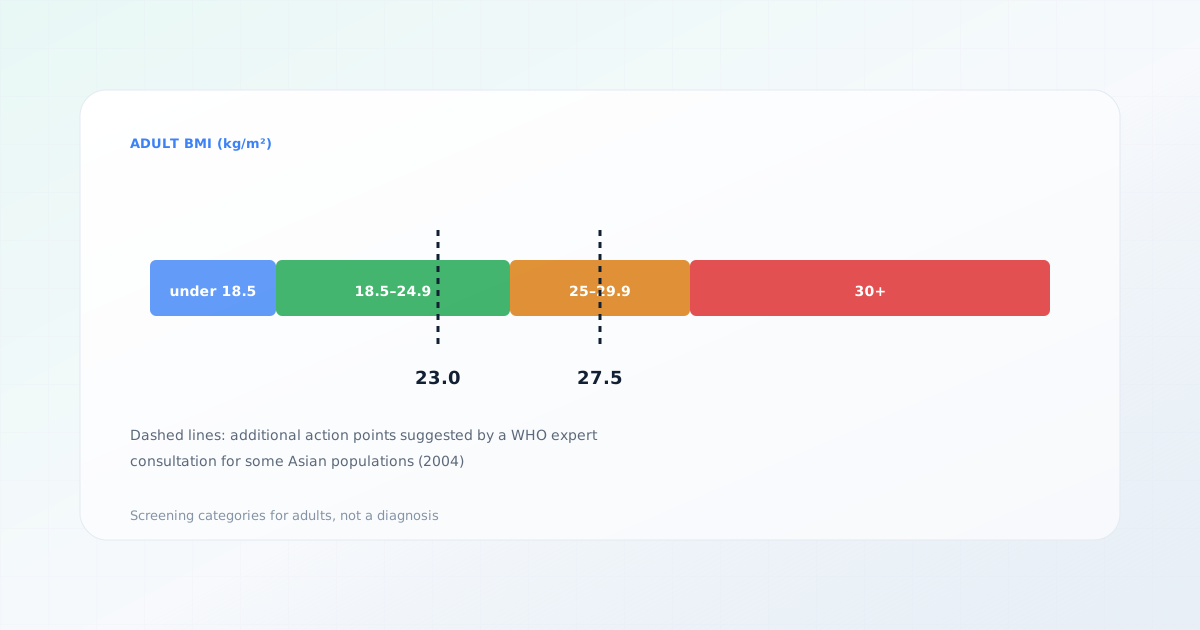
Cut-points are population averages. They were derived in specific groups, and the relationship between waist size and risk is not the same in every group. The World Health Organization has noted that lower thresholds may be appropriate for some populations, particularly people of South Asian and East Asian ancestry, at whom risk can be raised at smaller waist sizes.
- Pregnancy makes the waist measurement meaningless for assessing central fat.
- Very tall or very short adults, and children and adolescents, are not well served by adult cut-points.
- Large waist measurements caused by fluid, a hernia or a large abdominal mass do not reflect fat distribution, and a rapidly increasing waist without weight gain is worth raising with a clinician.
- Adults with a BMI of 35 or more are outside the NICE waist-to-height bands.
- A reading above a threshold identifies a higher likelihood of risk across a population, not a diagnosis in an individual.
What a measurement does not say
Tracking a waist measurement over time
A single waist measurement is a snapshot, and the useful information is usually in the change. Measuring once every month or two, at the same time of day, with the same tape and the same landmarks, is enough to show a trend without turning a tape measure into a source of anxiety. Daily measuring mostly records noise from meals, hydration and posture.
- Write down the date, the waist and the hip measurement, and your height once a year.
- Use the same tape. Cloth tapes stretch over time, and a retired tape can shift readings by a centimeter or more.
- Do not compare a reading taken over clothes with one taken against the skin.
- A waist that changes while body weight stays steady is more informative than the reverse, because it points to a change in where weight is carried.
Waist circumference often falls when body weight falls, and resistance training and better sleep are commonly associated with healthier body composition, but the relationship differs between people. A smaller number is not a goal in itself: someone who is unwell, under-eating or losing muscle can lose centimeters in ways that do not reflect better health.
Using the numbers sensibly
Used well, waist measurements are most informative as a trend. A tape measure taken the same way every few months shows whether the waist is moving in a direction that warrants attention, in a way that day-to-day scale fluctuations do not.
If a measurement falls in a higher band, the useful response is a conversation rather than alarm. A clinician can place it alongside blood pressure, a lipid panel and a glucose or HbA1c result, which together give a much clearer picture of cardiometabolic health than any one body measurement does.
Frequently asked questions
Sources
This page is based on the following sources. Each was reviewed on the access date shown.
- Waist circumference and waist-hip ratio: report of a WHO expert consultation, Geneva, 8-11 December 2008(opens in a new tab)
World Health Organization
Clinical guidelinePublished January 1, 2011Accessed September 27, 2026
- Overweight and obesity management: identifying and assessing overweight, obesity and central adiposity (NG246)(opens in a new tab)
National Institute for Health and Care Excellence (NICE)
Clinical guidelinePublished January 14, 2025Accessed September 27, 2026
- About Adult BMI(opens in a new tab)
Centers for Disease Control and Prevention
Government health agencyAccessed September 27, 2026
- Waist-to-height ratio is a better screening tool than waist circumference and BMI for adult cardiometabolic risk factors: systematic review and meta-analysis(opens in a new tab)
Obesity Reviews
Systematic reviewPublished March 1, 2012Accessed October 12, 2026DOI 10.1111/j.1467-789X.2011.00952.x